


Review
doi: 10.1172/JCI30953.
Gene therapy for severe combined immunodeficiency: are we there yet?
Affiliations
- PMID: 17549248
- PMCID: PMC1878528
- DOI: 10.1172/JCI30953
Item in Clipboard
Review
Gene therapy for severe combined immunodeficiency: are we there yet?
J Clin Invest.
2007 Jun.
Abstract
Inherited and acquired diseases of the hematopoietic system can be cured by allogeneic hematopoietic stem cell transplantation. This treatment strategy is highly successful when an HLA-matched sibling donor is available, but if not, few therapeutic options exist. Gene-modified, autologous bone marrow transplantation can circumvent the severe immunological complications that occur when a related HLA-mismatched donor is used and thus represents an attractive alternative. In this review, we summarize the advantages and limitations associated with the use of gene therapy to cure SCID. Insertional mutagenesis and technological improvements aimed at increasing the safety of this strategy are also discussed.
Figures
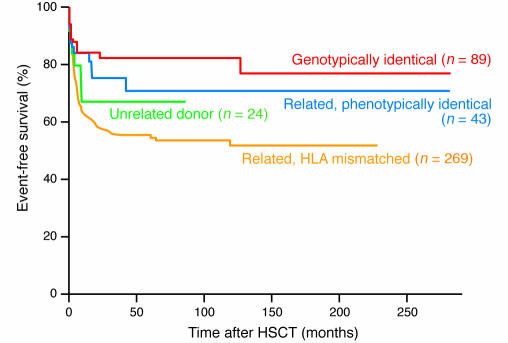
Figure reproduced with permission from The Lancet (6).

(A) The transcription of the therapeutic gene is driven by the enhancer-promoter activity of the U3 region of the retroviral LTR. (B) The transcription of the therapeutic gene is driven by the addition of an internal promoter. The U3 region of the retroviral LTR has been almost completely deleted. (C) The provirus contains the cHS4 element (i.e., insulator) in order to protect the transcriptional cassette against position effects. (D) This provirus contains 2 cassettes: (a) the therapeutic gene driven by a first internal promoter and (b) a suicide gene (e.g., thymidine kinase, TK) that could allow the elimination of gene-corrected cells if an adverse event such as a monoclonal proliferation occurs. EF-1a, elongation factor–1a; IRES, internal ribosome entry site; PGK, phosphoglycerate kinase; R, repeats; SA, site acceptor; SD, site donor.

The loci of retroviral insertion in the clones of the first 2 cases of monoclonal proliferation that occurred in P4 and P5 patient clones were characterized by LAM PCR sequencing of the 5′ insertion site fusion sequence. The enhancer activity of the proviral LTR allows the hyperexpression of LMO2 transcripts of the expected 3.3 kb size as well as the production of a high quantity of normal-size LMO2 protein. MFG-γc, retroviral vector.
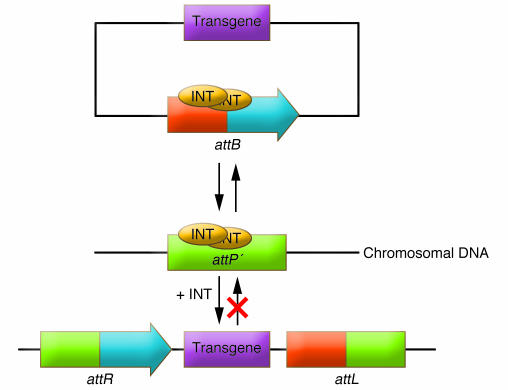
Two phiC31 molecules attach to the attB recognition site and the attP pseudo-sites in the mammalian genome (attP′). The recombination process is based on a 2-bp staggered cut of the DNAs and rotation of the DNA targets by 180°. The integration reaction results in integration of the transgene flanked by 2 hybrid att sites, attL and attR. Figure modified and reproduced with permission from Molecular Therapy (118).

Three zinc fingers (ribbon structures attached to nucleases [purple ovals]) can be used to latch onto either side of a mutated gene and to snip it. The cell then fixes the break with supplied DNA. Figure modified and reproduced with permission from Science (119).
References
-
- Kay M.A., Glorioso J.C., Naldini L. Viral vectors for gene therapy: the art of turning infectious agents into vehicles of therapeutics. Nat. Med. 2001;7:33–40. - PubMed
-
- Verma I.M., Weitzman M.D. Gene therapy: twenty-first century medicine. Annu. Rev. Biochem. 2005;74:711–738. - PubMed
-
- Jiang H., et al. Evidence of multiyear factor IX expression by AAV-mediated gene transfer to skeletal muscle in an individual with severe hemophilia B. Mol. Ther. 2006;14:452–455. - PubMed
-
- Lanuti M., et al. Evaluation of an E1E4-deleted adenovirus expressing the herpes simplex thymidine kinase suicide gene in cancer gene therapy. Hum. Gene Ther. 1999;10:463–475. - PubMed
-
- Manno C.S., et al. AAV-mediated factor IX gene transfer to skeletal muscle in patients with severe hemophilia B. Blood. 2003;101:2963–2972. - PubMed
Publication types
MeSH terms
Grants and funding
LinkOut - more resources
Full Text Sources
Other Literature Sources
Medical
Research Materials
