


A beneficial role for IL-1 beta in Alzheimer disease?
- PMID: 17549252
- PMCID: PMC1878536
- DOI: 10.1172/JCI32356
A beneficial role for IL-1 beta in Alzheimer disease?
Abstract
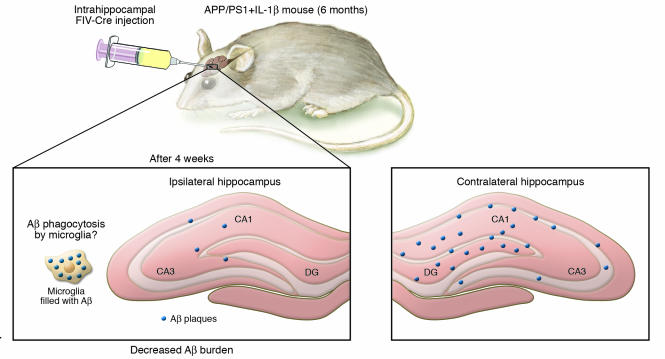
While the term neuroinflammation often conjures up images of cellular damage, mounting evidence suggests that certain proinflammatory molecules, such as the cytokine IL-1 beta, may have beneficial and protective effects. In a report in this issue of the JCI, Shaftel and coworkers have generated an elegant mouse model in which local hippocampal overexpression of IL-1 beta in an Alzheimer disease (AD) transgenic mouse model resulted not in the expected exacerbation of the amyloid beta plaque deposition common to AD, but instead in plaque amelioration (see the related article beginning on page 1595). Thus, manipulation of the immune system may be a potential therapeutic approach to protect against AD, although further studies are needed to understand all of the downstream effects of this manipulation.
Figures
Comment on
-
Sustained hippocampal IL-1 beta overexpression mediates chronic neuroinflammation and ameliorates Alzheimer plaque pathology.J Clin Invest. 2007 Jun;117(6):1595-604. doi: 10.1172/JCI31450. J Clin Invest. 2007. PMID: 17549256 Free PMC article.
References
-
- Morgan D., Gordon M.N., Tan J., Wilcock D., Rojiani A.M. Dynamic complexity of the microglial activation response in transgenic models of amyloid deposition: implications for Alzheimer’s therapeutics. J. Neuropathol. Exp. Neurol. 2005;64:743–753. - PubMed
-
- Eikelenboom P., et al. The significance of neuroinflammation in understanding Alzheimer’s disease. J. Neural Transm. 2006;113:1685–1695. - PubMed
-
- Wyss-Coray T. Inflammation in Alzheimer disease: driving force, bystander or beneficial response? Nat. Med. 2006;12:1005–1015. - PubMed
-
- Wolfe M. Shutting down Alzheimer’s. Sci. Am. 2006;294:72–79. - PubMed
