


Long-term follow-up of patients treated by adoptive transfer of melanoma tumor-infiltrating lymphocytes as adjuvant therapy for stage III melanoma
- PMID: 17549472
- PMCID: PMC11030710
- DOI: 10.1007/s00262-007-0340-1
Long-term follow-up of patients treated by adoptive transfer of melanoma tumor-infiltrating lymphocytes as adjuvant therapy for stage III melanoma
Abstract
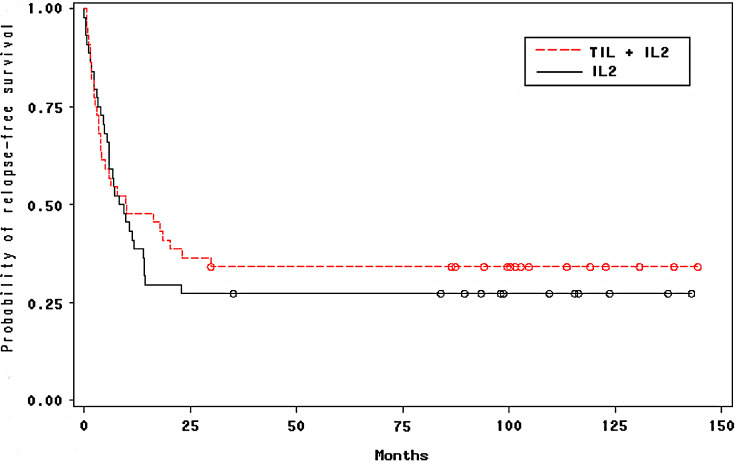
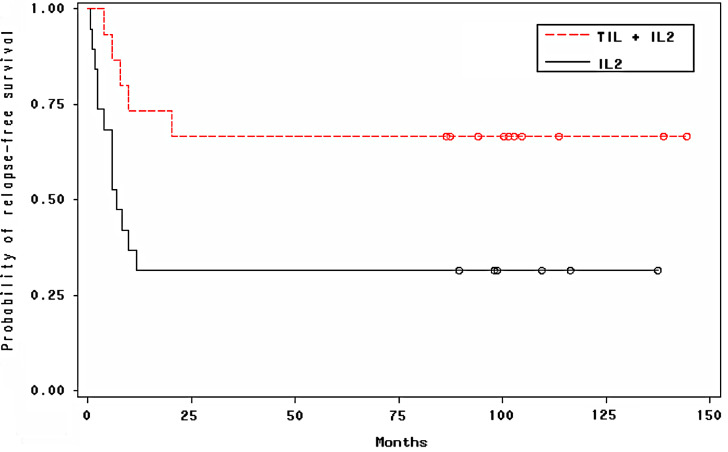
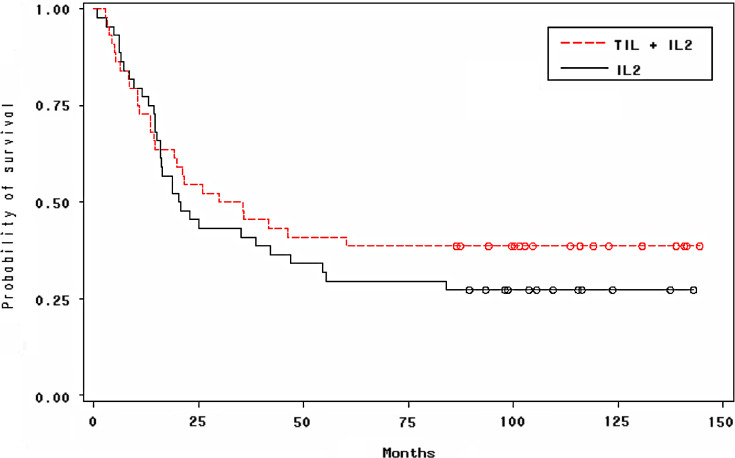
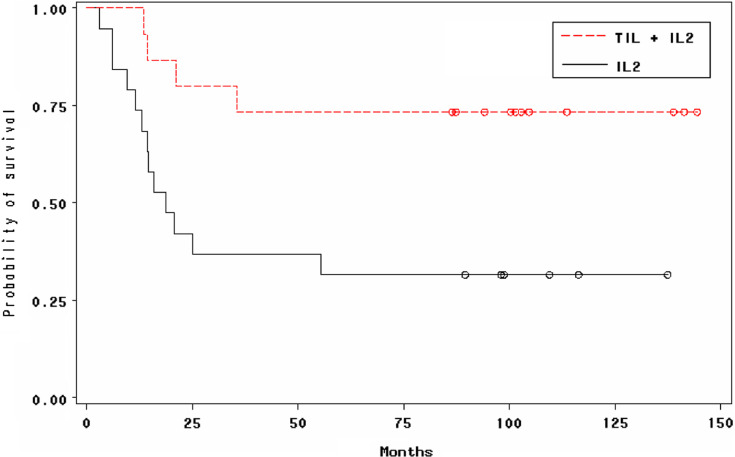
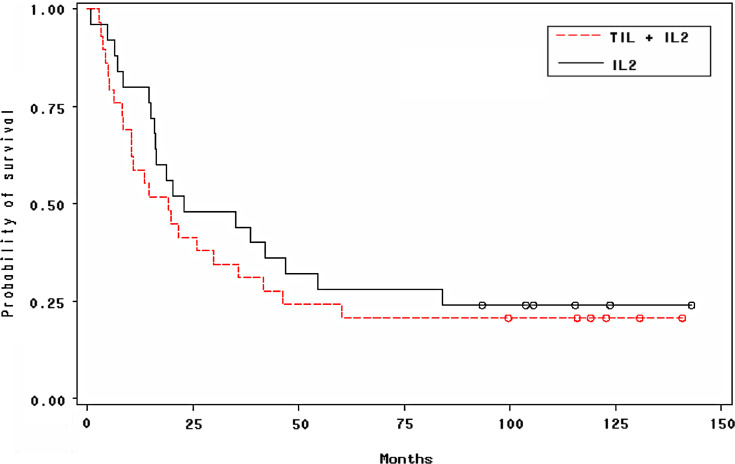
The first analysis of our clinical trial on interest of using tumor-infiltrating lymphocytes (TIL) as adjuvant therapy for stage III (regional lymph nodes) melanoma was published in 2002 [5]. The aim of this paper is to update clinical results of 7 years of follow-up after the last treated patient. In the trial conducted between December 1993 and January 1999, patients without any detectable metastases after lymph node excision were randomly assigned to receive either TIL plus interleukin-2 (IL-2) for 2 months, or IL-2 only. The duration of the relapse-free interval was the primary objective. Eighty-eight patients were enrolled in the study. Currently, the last analysis performed in June 2006, after a median follow-up of 114.8 months, did not show change of non-significant extension of the relapse-free interval or overall survival. However, this second analysis strengthens our first hypothesis about the relationship between number of invaded lymph nodes and TIL treatment effectiveness. In the group with only one invaded lymph node, the estimated relapse rate was significantly lower (P (adjusted) = 0.0219) and the overall survival was increased (P (adjusted) = 0.0125) in the TIL+IL-2 arm compared with the IL-2 only arm. No differences between the two arms, either with regard to the duration of disease-free survival (P (adjusted) = 0.38) or overall survival (P (adjusted) = 0.43), were noted in the group with more than one invaded lymph node, whatever the number of invaded lymph nodes. Treatment was compatible with normal daily activity. This study, with a very long follow up (median of almost 10 years), postulates for the first time relationship between TIL efficiency in stage III melanoma (AJCC) and number of invaded lymph nodes, indicating that tumor burden might be a crucial factor in the production of an effective in vitro expansion of T cells specific for autologous tumor antigen, a finding which could be of value in future vaccine development for the treatment of melanoma.
Figures

References
-
- Algarra I, Garcia-Lora A, Cabrera T, Ruiz-Cabello F, Garrido F. The selection of tumor variants with altered expression of classical and nonclassical MHC class I molecules: implications for tumor immune escape. Cancer Immunol Immunother. 2004;53:904. doi: 10.1007/s00262-004-0517-9. - DOI - PMC - PubMed
-
- Benlalam H, Vignard V, Khammari A, Bonnin A, Godet Y, Pandolfino MC, Jotereau F, Dreno B, Labarriere N. Infusion of Melan-A/Mart-1 specific tumor-infiltrating lymphocytes enhanced relapse-free survival of melanoma patients. Cancer Immunol Immunother. 2007;56(4):515–526. doi: 10.1007/s00262-006-0204-0. - DOI - PMC - PubMed
-
- Dreno B, Nguyen JM, Khammari A, Pandolfibno MC, Tessier MH, Bercegey S, Cassidanius A, Lemarre Ph, Billaudel S, Labarriere N, Jotereau F. Randomized trial of adoptive transfert of melanoma Tumor Infiltrating Lymphocytes (TIL) as adjuvant therapy in melanoma stage III. Cancer Immunol Immunother. 2002;10:539. - PMC - PubMed
Publication types
MeSH terms
Substances
LinkOut - more resources
Full Text Sources
Other Literature Sources
Medical
