


Management of type 2 diabetes with multiple oral hypoglycaemic agents or insulin in primary care: retrospective cohort study
- PMID: 17550670
- PMCID: PMC2078170
Management of type 2 diabetes with multiple oral hypoglycaemic agents or insulin in primary care: retrospective cohort study
Abstract
Background: Intensive glycaemic control can reduce the risk of microvascular complications in people with type 2 diabetes.
Aim: To examine the extent of monitoring and glycaemic control of patients with type 2 diabetes prescribed oral agents and/or insulin, and to investigate transition to insulin.
Design of study: Retrospective cohort study.
Setting: A total of 154 general practices in the UK contributing to the DIN-LINK database between 1995 and 2005.
Method: People with type 2 diabetes were identified using Read codes and prescribing data. Outcome measures were: glycaemic monitoring and control on multiple oral agents and/or insulin, and transition to insulin.
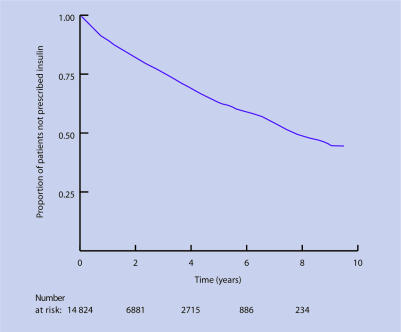
Results: A total of 14 824 people with type 2 diabetes were prescribed multiple oral agents concurrently, of whom 5064 (34.16%) had haemoglobin A(1c) (HbA(1c)) assessments 6 months before and following initiation of their last oral therapy. Mean HbA(1c) before therapy was 9.07%, which dropped to 8.16% following therapy (mean difference 0.91%, 95% confidence interval [CI] = 0.86 to 0.95, P <0.0001). Of the patients with HbA(1c) assessments, 3153 (62.26%) had evidence of poor glycaemic control following therapy. Median time to insulin for patients prescribed multiple oral agents was 7.7 years (95% CI = 7.4 to 8.5 years); 1513 people began insulin during the study and had HbA(1c) assessments 6 months before and following insulin. Mean HbA(1c) before insulin was 9.85% (standard deviation [SD] 1.96%) which decreased by 1.34%, (95% CI = 1.24% to 1.44%) following therapy, but 1110 people (73.36%) still had HbA(1c) > or =7.5%.
Conclusion: Many people with type 2 diabetes received inadequate monitoring and had poor glycaemic control. Intensive management is required to reduce the risk of microvascular complications.
Figures
References
-
- Dormandy JA, Charbonnel B, Eckland DJ, et al. Secondary prevention of macrovascular events in patients with type 2 diabetes in the PROactive Study (PROspective pioglitAzone Clinical Trial In macro Vascular Events): a randomised controlled trial. Lancet. 2005;366:1279–1289. - PubMed
-
- UK Prospective Diabetes Study (UKPDS) Intensive blood-glucose control with sulphonylureas or insulin compared with conventional treatment and risk of complications in patients with type 2 diabetes (UKPDS 33) Lancet. 1998;352:837–853. - PubMed
-
- National Institute for Clinical Excellence. Management of type 2 diabetes. Management of blood glucose. London: National Institute for Clinical Excellence; 2002. Guideline G1-27.
-
- Department of Health. GMS contract. www.dh.gov.uk/PolicyAndGuidance/OrganisationPolicy/PrimaryCare/PrimaryCa... (accessed 28 Mar 2007)
Publication types
MeSH terms
Substances
LinkOut - more resources
Full Text Sources
Other Literature Sources
Medical
Research Materials
Miscellaneous
