


Fitness increases with partner and neighbour allopreening
- PMID: 17550875
- PMCID: PMC2390679
- DOI: 10.1098/rsbl.2007.0258
Fitness increases with partner and neighbour allopreening
Abstract
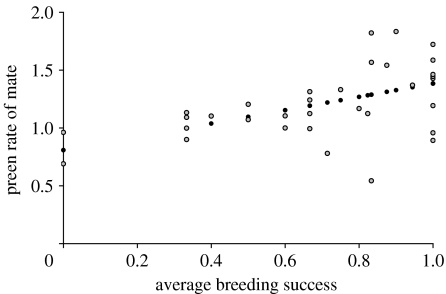
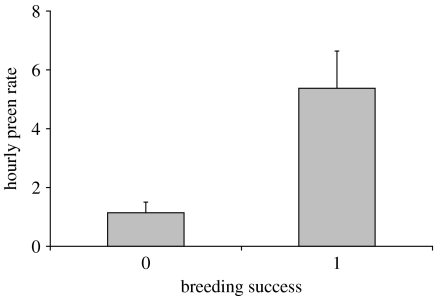
Altruism and selfishness are fundamental characteristics of human and animal societies. Among colonial biparental species, breeding outcome depends on interactions between mates and neighbours. However, the relationships between cooperation within and among partnerships and fitness have not been fully investigated. We show that in the highly colonial common guillemot (Uria aalge), altruistic behaviour (allopreening) towards a mate was positively related to long-term fitness, whereas allopreening a neighbour was related to current fitness. Turnover is much lower within than between pairs, so our results suggest that allopreening within pairs generates fitness returns at longer timescales than between pairs. Allopreening not only removes ectoparasites and maintains plumage condition, but may also have important social functions. We found a negative relationship between fight rate and allopreen rate between breeding neighbours, with nests exhibiting low breeding success having a higher frequency of fights with neighbours. We also found evidence for reciprocity in allopreening. Thus, allopreening may function as a reciprocal stress reducer, to decrease the likelihood of fights and associated breeding failure. We suggest that altruistic behaviour has long-term benefits for the survival of the offspring when living in a crowded neighbourhood.
Figures
References
-
- Axelrod R, Hamilton W.D. The evolution of cooperation. Science. 1981;211:1390–1396. doi:10.1126/science.7466396 - DOI - PubMed
-
- Barton T.R, Harris M.P, Wanless S, Elston D.A. The activity periods and life-cycle of the tick Ixodes uriae (Acari: Ixodidae) in relation to host breeding strategies. Parasitology. 1996;112:571–580. - PubMed
-
- Birkhead T.N. Behavioural adaptations to high density nesting in the common guillemot Uria aalge. Anim. Behav. 1978;26:321–331. doi:10.1016/0003-3472(78)90050-7 - DOI
-
- Black J.M. Oxford University Press; Oxford, UK: 1996. Partnerships in birds: the study of monogamy.
-
- Buntin J.D. Role of prolactin in avian incubation behavior and care of young: is there a causal relationship. Ann. N Y Acad. Sci. 1986;474:252–267. doi:10.1111/j.1749-6632.1986.tb28016.x - DOI - PubMed
Publication types
MeSH terms
LinkOut - more resources
Full Text Sources
