


Low host-pathogen specificity in the leaf-cutting ant-microbe symbiosis
- PMID: 17550881
- PMCID: PMC2275177
- DOI: 10.1098/rspb.2007.0431
Low host-pathogen specificity in the leaf-cutting ant-microbe symbiosis
Abstract
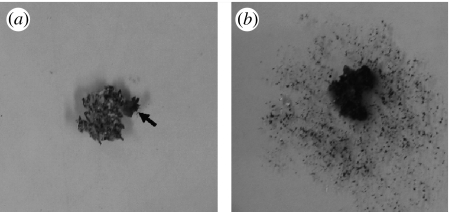
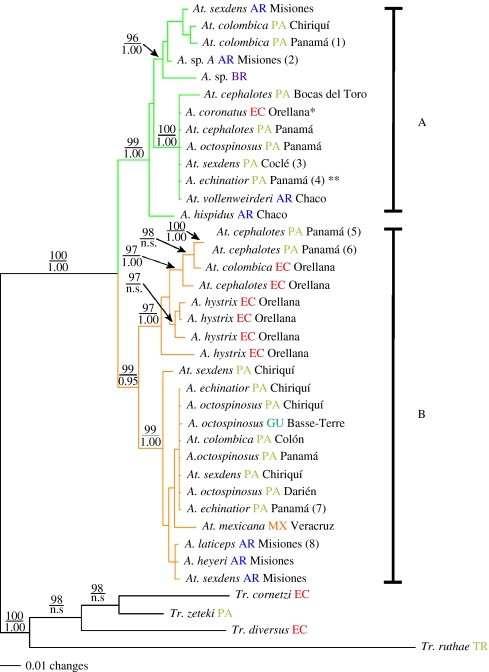
Host-parasite associations are shaped by coevolutionary dynamics. One example is the complex fungus-growing ant-microbe symbiosis, which includes ancient host-parasite coevolution. Fungus-growing ants and the fungi they cultivate for food have an antagonistic symbiosis with Escovopsis, a specialized microfungus that infects the ants' fungus gardens. The evolutionary histories of the ant, cultivar and Escovopsis are highly congruent at the deepest phylogenetic levels, with specific parasite lineages exclusively associating with corresponding groups of ants and cultivar. Here, we examine host-parasite specificity at finer phylogenetic levels, within the most derived clade of fungus-growing ants, the leaf-cutters (Atta spp. and Acromyrmex spp.). Our molecular phylogeny of Escovopsis isolates from the leaf-cutter ant-microbe symbiosis confirms specificity at the broad phylogenetic level, but reveals frequent host-switching events between species and genera of leaf-cutter ants. Escovopsis strains isolated from Acromyrmex and Atta gardens occur together in the same clades, and very closely related strains can even infect the gardens of both ant genera. Experimental evidence supports low host-parasite specificity, with phylogenetically diverse strains of Escovopsis being capable of overgrowing all leaf-cutter cultivars examined. Thus, our findings indicate that this host-pathogen association is shaped by the farming ants having to protect their cultivated fungus from phylogenetically diverse Escovopsis garden pathogens.
Figures
References
-
- Agrawal A.F, Lively C.M. Infection genetics: gene-for-gene versus matching-alleles models and all points in between. Evol. Ecol. Res. 2002;4:79–90.
-
- Bender W, Spierer P, Hogness D.S. Chromosomal walking and jumping to isolate DNA from the Ace and Rosy loci and the bithorax complex in Drosophila melanogaster. J. Mol. Biol. 1983;168:17–33. doi:10.1016/S0022-2836(83)80320-9 - DOI - PubMed
-
- Bot A.N.M, Rehner S.A, Boomsma J.J. Partial incompatibility between ants and symbiotic fungi in two sympatric species of Acromyrmex leaf-cutter ants. Evolution. 2001;55:1980–1991. - PubMed
-
- Carius H.J, Little T.J, Ebert D. Genetic variation in a host–parasite association: potential for coevolution and frequency-dependent selection. Evolution. 2001;55:1136–1145. - PubMed
-
- Chapela I.H, Rehner S.A, Schultz T.R, Mueller U.G. Evolutionary history of the symbiosis between fungus-growing ants and their fungi. Science. 1994;266:1691–1694. doi:10.1126/science.266.5191.1691 - DOI - PubMed
Publication types
MeSH terms
LinkOut - more resources
Full Text Sources
Miscellaneous
