


Spatial and temporal variability across life's hierarchies in the terrestrial Antarctic
- PMID: 17553768
- PMCID: PMC2443176
- DOI: 10.1098/rstb.2006.1949
Spatial and temporal variability across life's hierarchies in the terrestrial Antarctic
Abstract
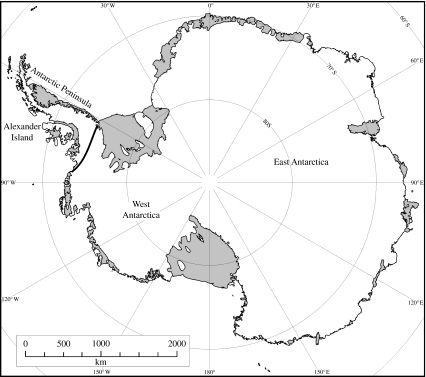
Antarctica and its surrounding islands lie at one extreme of global variation in diversity. Typically, these regions are characterized as being species poor and having simple food webs. Here, we show that terrestrial systems in the region are nonetheless characterized by substantial spatial and temporal variations at virtually all of the levels of the genealogical and ecological hierarchies which have been thoroughly investigated. Spatial variation at the individual and population levels has been documented in a variety of genetic studies, and in mosses it appears that UV-B radiation might be responsible for within-clump mutagenesis. At the species level, modern molecular methods have revealed considerable endemism of the Antarctic biota, questioning ideas that small organisms are likely to be ubiquitous and the taxa to which they belong species poor. At the biogeographic level, much of the relatively small ice-free area of Antarctica remains unsurveyed making analyses difficult. Nonetheless, it is clear that a major biogeographic discontinuity separates the Antarctic Peninsula and continental Antarctica, here named the 'Gressitt Line'. Across the Southern Ocean islands, patterns are clearer, and energy availability is an important correlate of indigenous and exotic species richness, while human visitor numbers explain much of the variation in the latter too. Temporal variation at the individual level has much to do with phenotypic plasticity, and considerable life-history and physiological plasticity seems to be a characteristic of Antarctic terrestrial species. Environmental unpredictability is an important driver of this trait and has significantly influenced life histories across the region and probably throughout much of the temperate Southern Hemisphere. Rapid climate change-related alterations in the range and abundance of several Antarctic and sub-Antarctic populations have taken place over the past several decades. In many sub-Antarctic locations, these have been exacerbated by direct and indirect effects of invasive alien species. Interactions between climate change and invasion seem set to become one of the most significant conservation problems in the Antarctic. We conclude that despite the substantial body of work on the terrestrial biodiversity of the Antarctic, investigations of interactions between hierarchical levels remain scarce. Moreover, little of the available information is being integrated into terrestrial conservation planning, which lags far behind in this region by comparison with most others.
Figures
References
-
- Allegrucci G, Carchini G, Todisco V, Convey P, Sbordoni V. A molecular phylogeny of Antarctic Chironomidae and its implications for biogeographical history. Polar Biol. 2006;29:320–326. doi:10.1007/s00300-005-0056-7 - DOI
-
- Andrássy I. Nematodes in the sixth continent. J. Nemat. Morphol. Syst. 1998;1:107–186.
-
- Angilletta M.J, Niewiarowski P.H, Navas C.A. The evolution of thermal physiology in ectotherms. J. Therm. Biol. 2002;27:249–268. doi:10.1016/S0306-4565(01)00094-8 - DOI
-
- Anonymous. Department of Environmental Affairs and Tourism; Pretoria, South Africa: 1996. Prince Edward Islands management plan.
-
- Ashworth A.C, Kuschel G. Fossil weevils (Coleoptera: Curculionidae) from latitude 85° S Antarctica. Palaeogeogr. Palaeoclimatol. Palaeoecol. 2003;191:191–202. doi:10.1016/S0031-0182(02)00712-5 - DOI
Publication types
MeSH terms
Substances
LinkOut - more resources
Full Text Sources
Miscellaneous
