


A protein kinase A-dependent mechanism by which rotavirus affects the distribution and mRNA level of the functional tight junction-associated protein, occludin, in human differentiated intestinal Caco-2 cells
- PMID: 17553883
- PMCID: PMC1951370
- DOI: 10.1128/JVI.00263-07
A protein kinase A-dependent mechanism by which rotavirus affects the distribution and mRNA level of the functional tight junction-associated protein, occludin, in human differentiated intestinal Caco-2 cells
Abstract
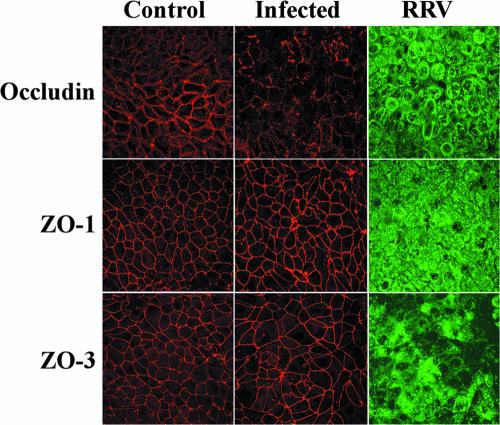
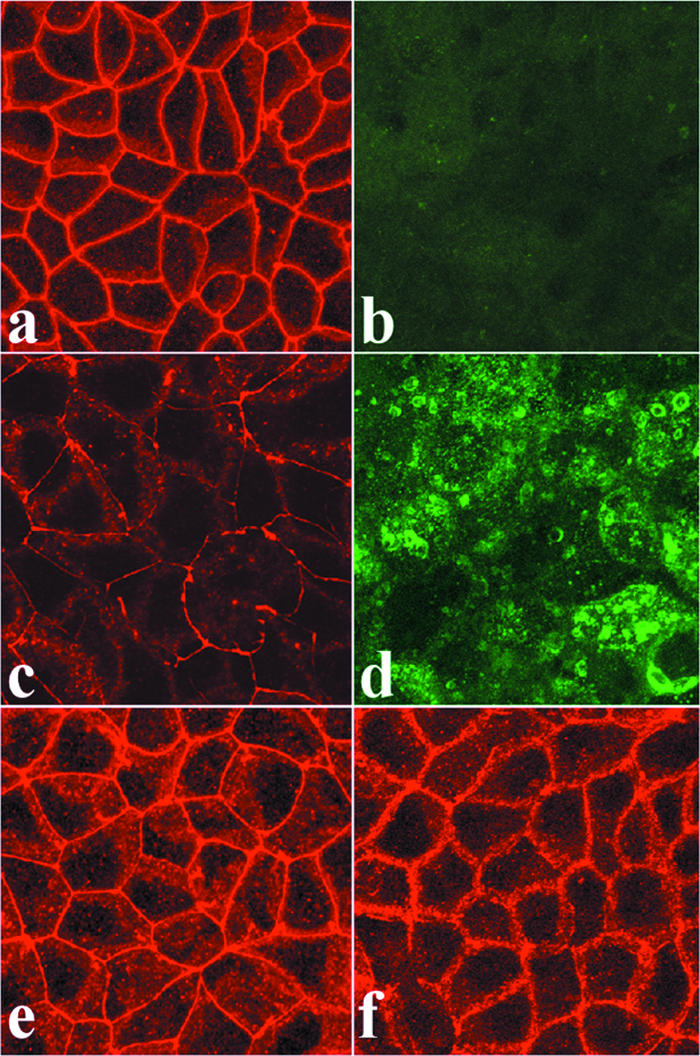
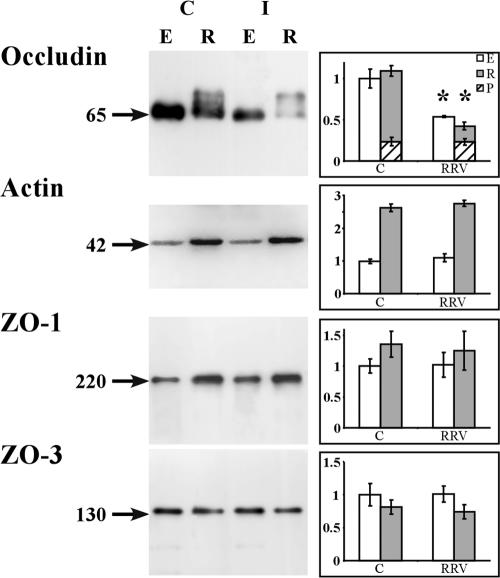
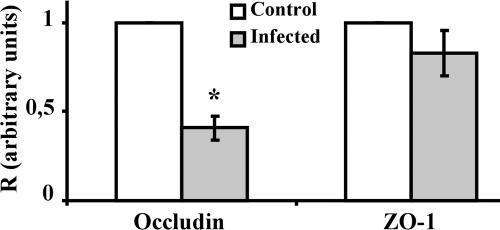
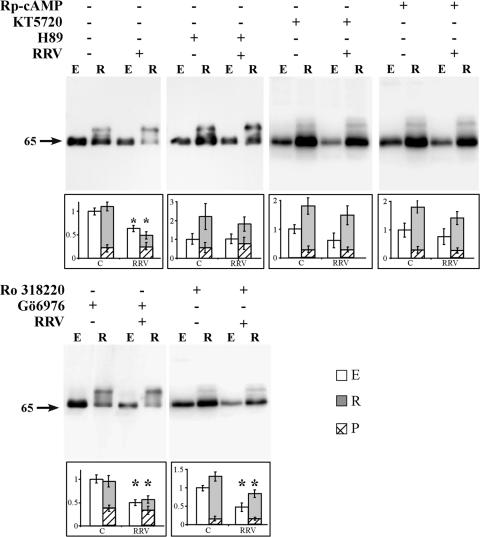
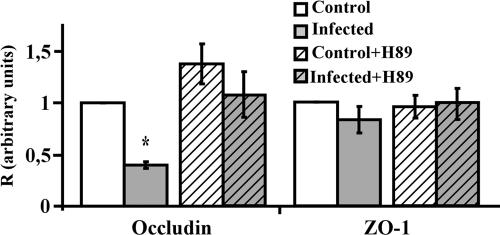
We found that at the tight junctions (TJs) of Caco-2 cell monolayers, rhesus monkey rotavirus (RRV) infection induced the disappearance of occludin. Confocal laser scanning microscopy showed the disappearance of occludin from the cell-cell boundaries without modifying the expression of the other TJ-associated proteins, ZO-1 and ZO-3. Western immunoblot analysis of RRV-infected cells showed a significant fall in the levels of the nonphosphorylated form of occludin in both Triton X-100-insoluble and Triton X-100-soluble fractions, without any change in the levels of the phosphorylated form of occludin. Quantitative reverse transcription-PCRs revealed that the level of transcription of the gene that encodes occludin was significantly reduced in RRV-infected cells. Treatment of RRV-infected cells with Rp-cyclic AMP and protein kinase A inhibitors H89 and KT5720 during the time course of the infection restored the distribution of occludin and a normal level of transcription of the gene that encodes occludin.
Figures
References
-
- Andras, I. E., H. Pu, J. Tian, M. A. Deli, A. Nath, B. Hennig, and M. Toborek. 2005. Signaling mechanisms of HIV-1 Tat-induced alterations of claudin-5 expression in brain endothelial cells. J. Cereb. Blood Flow Metab. 25:1159-1170. - PubMed
-
- Andreeva, A. Y., E. Krause, E. C. Muller, I. E. Blasig, and D. I. Utepbergenov. 2001. Protein kinase C regulates the phosphorylation and cellular localization of occludin. J. Biol. Chem. 276:38480-38486. - PubMed
-
- Balda, M. S., C. Flores-Maldonado, M. Cereijido, and K. Matter. 2000. Multiple domains of occludin are involved in the regulation of paracellular permeability. J. Cell. Biochem. 78:85-96. - PubMed
Publication types
MeSH terms
Substances
LinkOut - more resources
Full Text Sources
Miscellaneous
