Listeria monocytogenes surface proteins: from genome predictions to function
- PMID: 17554049
- PMCID: PMC1899877
- DOI: 10.1128/MMBR.00039-06
Listeria monocytogenes surface proteins: from genome predictions to function
Abstract
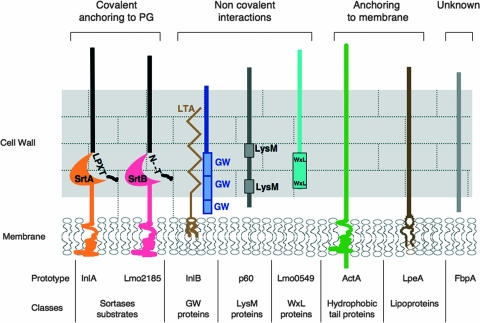
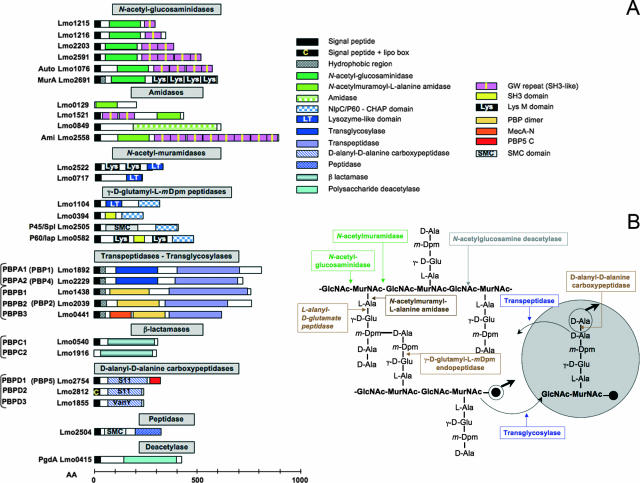
The genome of the human food-borne pathogen Listeria monocytogenes is predicted to encode a high number of surface proteins. This abundance likely reflects the ability of this bacterium to survive in diverse environments, including soil, food, and the human host. This review focuses on the various mechanisms by which listerial proteins are attached at the bacterial surface and their many functions, including peptidoglycan metabolism, protein processing, adhesion to host cells, and invasion of host tissues. Extensive in silico analysis of the domains or motifs present in these mosaic proteins reveals that diverse structural features allow the surface proteome to interact with diverse bacterial or host components. This diversity offers new clues about the molecular bases of Listeria pathogenesis.
Figures

References
-
- Abachin, E., C. Poyart, E. Pellegrini, E. Milohanic, F. Fiedler, P. Berche, and P. Trieu-Cuot. 2002. Formation of d-alanyl-lipoteichoic acid is required for adhesion and virulence of Listeria monocytogenes. Mol. Microbiol. 43:1-14. - PubMed
-
- Alvarez-Dominguez, C., J. A. Vazquez-Boland, E. Carrasco-Marin, P. Lopez-Mato, and F. Leyva-Cobian. 1997. Host cell heparan sulfate proteoglycans mediate attachment and entry of Listeria monocytogenes, and the listerial surface protein ActA is involved in heparan sulfate receptor recognition. Infect. Immun. 65:78-88. - PMC - PubMed
Publication types
MeSH terms
Substances
LinkOut - more resources
Full Text Sources
Molecular Biology Databases