


Social control of brain morphology in a eusocial mammal
- PMID: 17556547
- PMCID: PMC1965550
- DOI: 10.1073/pnas.0610344104
Social control of brain morphology in a eusocial mammal
Abstract
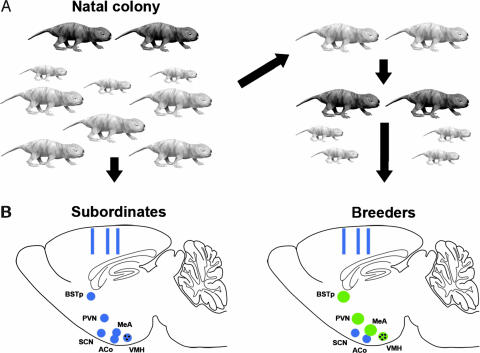
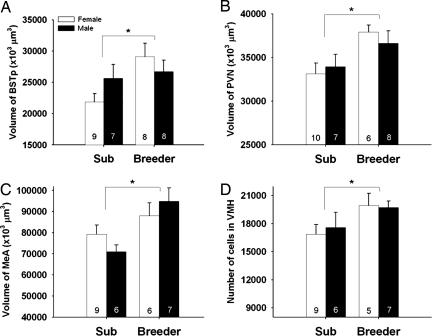
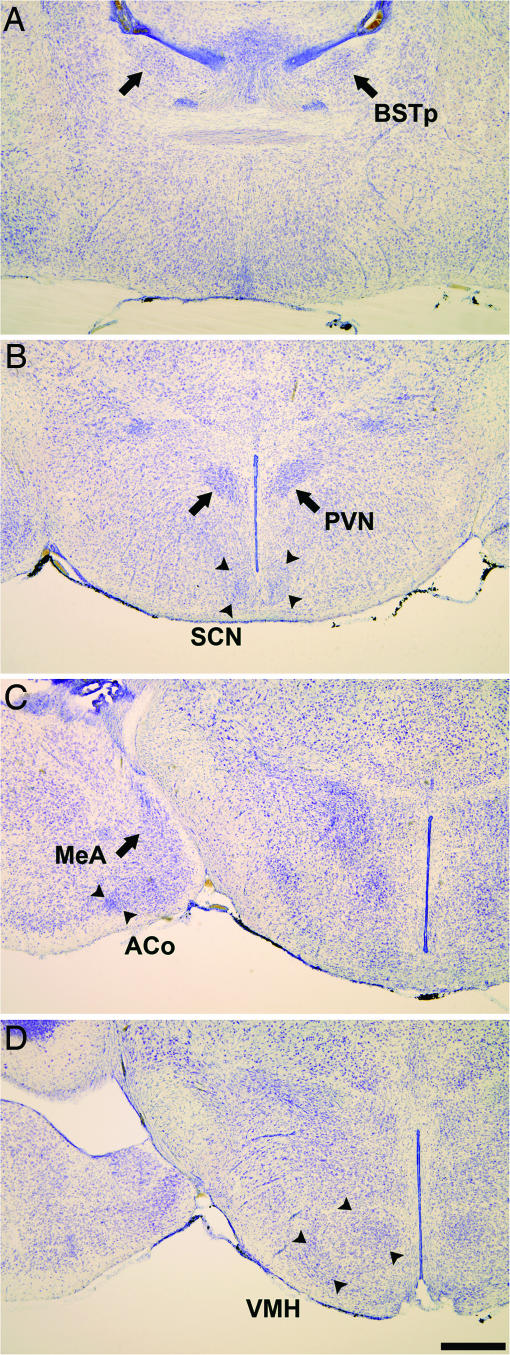
Social status impacts reproductive behavior in diverse vertebrate species, but little is known about how it affects brain morphology. We explore this in the naked mole-rat, a species with the most rigidly organized reproductive hierarchy among mammals. Naked mole-rats live in large, subterranean colonies where breeding is restricted to a single female and small number of males. All other members of the colony, known as subordinates, are reproductively suppressed. Subordinates can become breeders if removed from the colony and placed with an opposite sex partner, but in nature most individuals never attain reproductive status. We examined the brains of breeding and subordinate naked mole-rats of both sexes, including several regions linked to reproduction and shown to be sexually dimorphic in other mammals. Stereological analyses revealed that neural morphology depends on status, such that breeders, regardless of sex, had more cells than subordinates in the ventromedial nucleus of the hypothalamus and a larger volume of the bed nucleus of the stria terminalis, paraventricular nucleus, and medial amygdala. Several other brain regions examined were unaffected. Surprisingly, males and females did not differ on any measure. These findings provide evidence that a change in social status triggers considerable neural remodeling and indicate that status, rather than sex, has a predominant role in determining neural structure in this remarkably social mammal.
Conflict of interest statement
The authors declare no conflict of interest.
Figures
References
-
- Cooke B, Hegstrom CD, Villeneuve LS, Breedlove SM. Front Neuroendo. 1998;19:323–362. - PubMed
-
- Darwin C. The Descent of Man, and Selection in Relation to Sex. London: Murray; 1871.
-
- Abbot DH. J Zool. 1987;213:455–470.
-
- Jarvis JUM. Science. 1981;212:571–573. - PubMed
-
- Brett RA. In: The Biology of the Naked Mole-Rat. Sherman PW, Jarvis JUM, Alexander RD, editors. Princeton: Princeton Univ Press; 1991. pp. 97–136.
Publication types
MeSH terms
Grants and funding
LinkOut - more resources
Full Text Sources
