. 2007 Jun;19(6):2006-22.
doi: 10.1105/tpc.106.048629. Epub 2007 Jun 8.

A heteromeric plastidic pyruvate kinase complex involved in seed oil biosynthesis in Arabidopsis

Affiliations

A heteromeric plastidic pyruvate kinase complex involved in seed oil biosynthesis in Arabidopsis

Carl Andre et al. Plant Cell. 2007 Jun.

Abstract

Glycolysis is a ubiquitous pathway thought to be essential for the production of oil in developing seeds of Arabidopsis thaliana and oil crops. Compartmentation of primary metabolism in developing embryos poses a significant challenge for testing this hypothesis and for the engineering of seed biomass production. It also raises the question whether there is a preferred route of carbon from imported photosynthate to seed oil in the embryo. Plastidic pyruvate kinase catalyzes a highly regulated, ATP-producing reaction of glycolysis. The Arabidopsis genome encodes 14 putative isoforms of pyruvate kinases. Three genes encode subunits alpha, beta(1), and beta(2) of plastidic pyruvate kinase. The plastid enzyme prevalent in developing seeds likely has a subunit composition of 4alpha4beta(1), is most active at pH 8.0, and is inhibited by Glu. Disruption of the gene encoding the beta(1) subunit causes a reduction in plastidic pyruvate kinase activity and 60% reduction in seed oil content. The seed oil phenotype is fully restored by expression of the beta(1) subunit-encoding cDNA and partially by the beta(2) subunit-encoding cDNA. Therefore, the identified pyruvate kinase catalyzes a crucial step in the conversion of photosynthate into oil, suggesting a preferred plastid route from its substrate phosphoenolpyruvate to fatty acids.


Figures
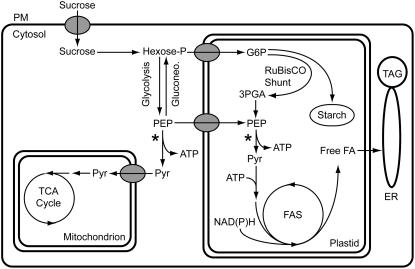
Figure 1.
Figure 1.
Simplified Scheme of Carbon Metabolism with Emphasis on Oil Production in Cells of Green Developing Seeds. Asterisks demark the pyruvate kinase reaction. Single arrows can indicate multiple reactions. 3PGA, 3-phosphoglycerate; ER, endoplasmic reticulum; FA, fatty acid; FAS, fatty acid synthase; G6P, glucose 6-phosphate; Gluconeo., gluconeogenesis; PM, plasma membrane; Pyr, pyruvate; TAG, triacylglycerol; TCA, tricarboxylic acid.
Figure 2.
Figure 2.
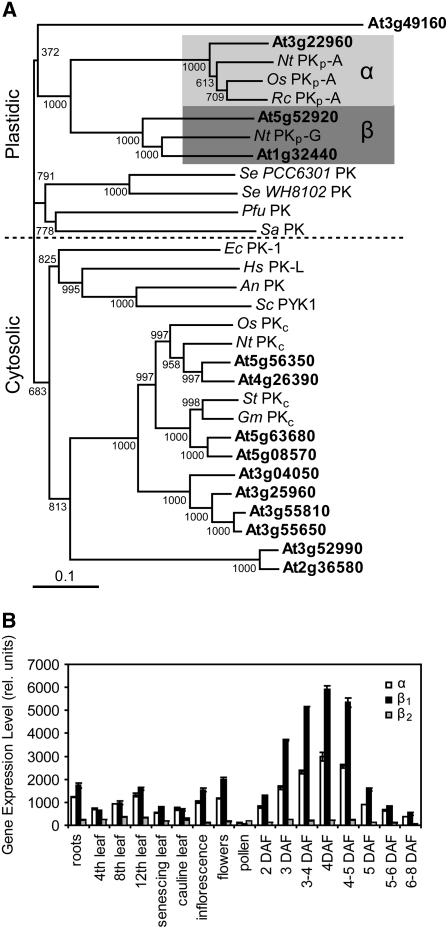
Pyruvate Kinase Similarity and Selected Gene Expression in Arabidopsis. (A) Pyruvate kinase phylogeny. Amino acid sequences of Arabidopsis (gene loci in bold) and other bona fide pyruvate kinases were used. Bootstrap values are indicted at branches; α and β represent plastidic PK subunit families. The scale represents 10% difference. An, Aspergillus niger; Ec, Eschericia coli; Gm, Glycine max; Hs, Homo sapiens; Nt, Nicotiana tabacum; Os, Oryza sativa; Pfu, Pyrococcus furiosus; Rc, Ricinus communus; Sa, Sulfolobus acidocaldarius; Se, Synechocystis sp; Sc, Saccharomyces cerevisiae; St, Solanum tuberosum. (B) Relative gene expression of putative Arabidopsis PKp-α (At3g22960), PKp1 (At5g52920), and PKp2 (At1g32440) encoding genes (derived from published microarray data; Schmid et al., 2005). Values are the mean ± sd (n = 3). DAF, days after flowering.
Figure 3.
Figure 3.
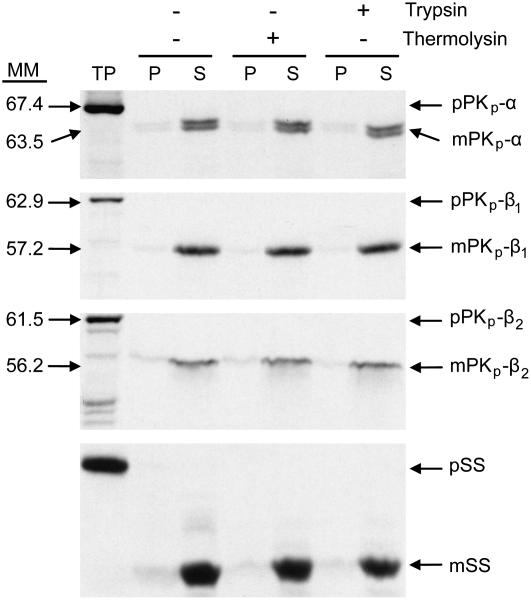
Subcellular Localizations of Pyruvate Kinase Subunits. In vitro import of PKp subunits into isolated pea chloroplasts. After import, chloroplasts were subjected to either no treatment (−) or to post-treatment (+) with either thermolysin or trypsin. Intact chloroplasts were subsequently recovered by centrifugation through 40% Percoll cushion and fractionated into a total membrane (P) and a supernatant (S) fraction. All fractions were analyzed by SDS-PAGE and fluorography. MM, molecular masses of precursor and mature proteins based on Rf analysis; TP, 10% of translation reaction added; p, precursor form; m, mature form; pSS, precursor of the small subunit of Rubisco included as control.
Figure 4.
Figure 4.
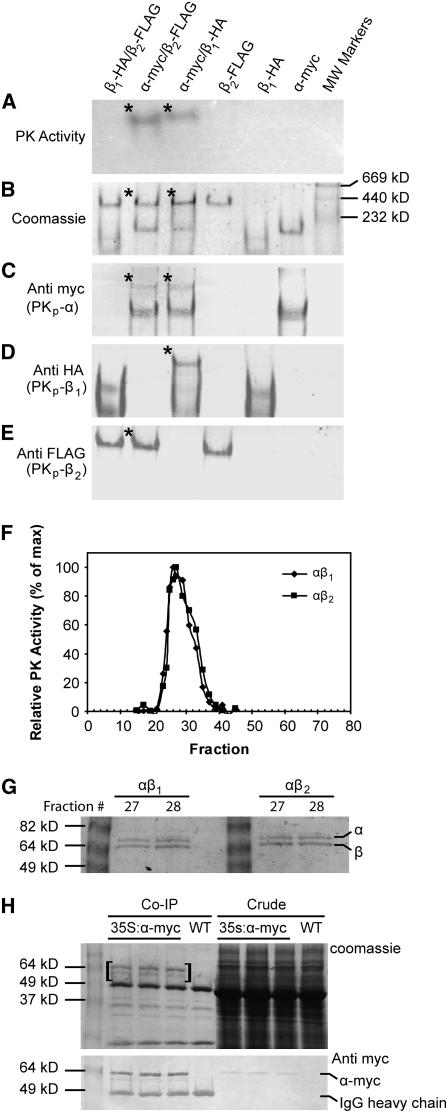
In Vitro and in Vivo Interaction of PKp Subunits. (A) to (E) Identically loaded native-PAGE gels showing in vitro interaction of PKp subunits. A total of 10 pmol (∼0.6 μg) of each subunit was used per lane. The asterisk denotes bands corresponding to the active PK complexes. (A) PK activity stained gel. (B) CBB-stained gel. (C) Immunological detection of α-myc with anti c-myc. (D) Immunological detection of β1-HA with anti HA. (E) Immunological detection of β2-FLAG with anti FLAG. (F) PK activity elution profile after fast protein liquid chromatography over Superdex-200. (G) SDS-PAGE gel of most active fractions from (F). Total protein (75 ng) was loaded per lane. (H) CBB-stained gel and anti-myc immunoblot of co-IP proteins. Total proteins were extracted from wild-type and 35S:α-myc silique tissue and were subjected to co-IP. Approximately 37.5 μg of crude protein and half of the total eluate were loaded per lane. Bands unique to the 35S:α-myc co-IP lanes (in brackets) were excised and identified. IgG heavy chain is indicated on the immunoblot for reference.
Figure 5.
Figure 5.
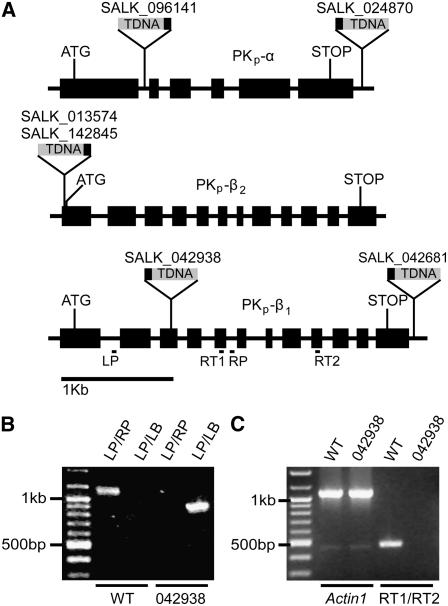
Identification of a SALK T-DNA Mutant in PKp1. (A) Gene structure of the three PK subunits and locations of T-DNA insertions. Black box on T-DNA is the left border. LP and RP depict locations of primers used for genotyping in (B). RT1 and RT2 depict locations of primers used for RT-PCR in (C). ATG, start codon; STOP, stop codon. (B) PCR-based genotyping of SALK_042938. LP and RP refer to At5g52920-specific primers shown in (A) and in Table 4. LB refers to the T-DNA left border primer in Table 5. (C) RT-PCR to measure PKp1 encoding gene expression in SALK_042938. Actin1 (At2g37620) is the control. RT1 and RT2 refer to At5g52920-specific primers shown in (A) and in Table 5.
Figure 6.
Figure 6.
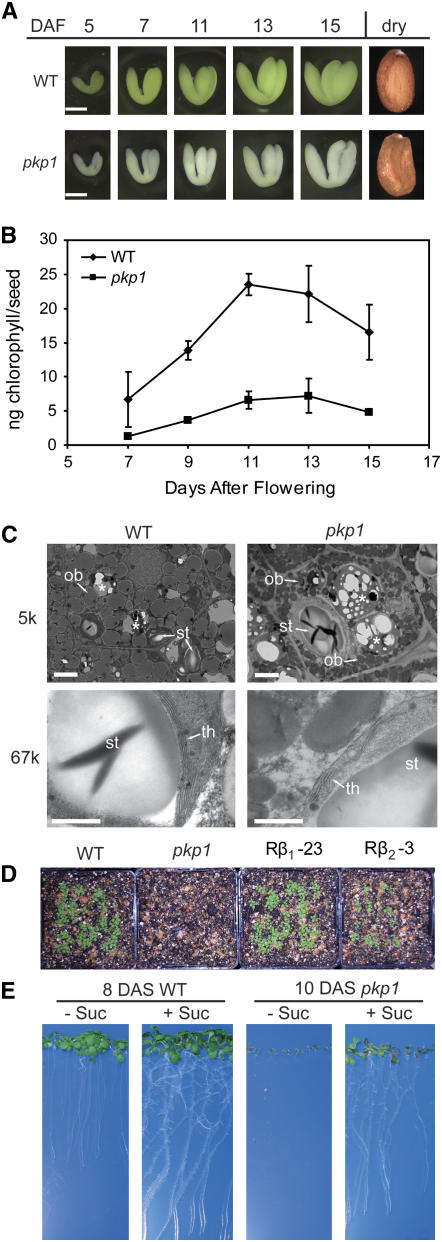
pkp1 Seed Phenotypes. (A) Seed phenotypes of pkp1 and the wild type. Embryos were dissected out of developing seeds at the time indicated. Fully dessicated mature seeds are shown as well. Bars = 0.2 mm. (B) Total chlorophyll content of pkp1 and wild-type developing seeds. Forty seeds were measured per sample. Values are the mean ± sd (n = 3). (C) Electron micrographs of cells from 13 DAF wild-type and pkp1 cotyledons. Starch granules (st) and oil bodies (ob) are marked with arrows in the top panels. Higher magnification in the bottom panels reveals thylakoid membranes (th) inside plastids. The 5k and 67k denote magnification used. Asterisks mark protein bodies. Bars = 2 μm in top panels and 0.5 μm in bottom panels. Left panels, wild type; right panels, pkp1 mutant. (D) Seedling establishment on soil. 100 seeds per line were sown directly on soil after sterilization. Picture was taken are 12 d after sowing. Rβ1-23, pkp1 rescued with CaMV 35S–driven PKp1; Rβ2-3, pkp1 rescued with CaMV 35S–driven PKp2. (E) Sucrose-dependent seedling establishment of pkp1. Seeds were germinated on Murashige and Skoog medium without (−) or with (+) 2% sucrose. The wild type and the pkp1 mutant were compared at similar developmental stages.
Figure 7.
Figure 7.
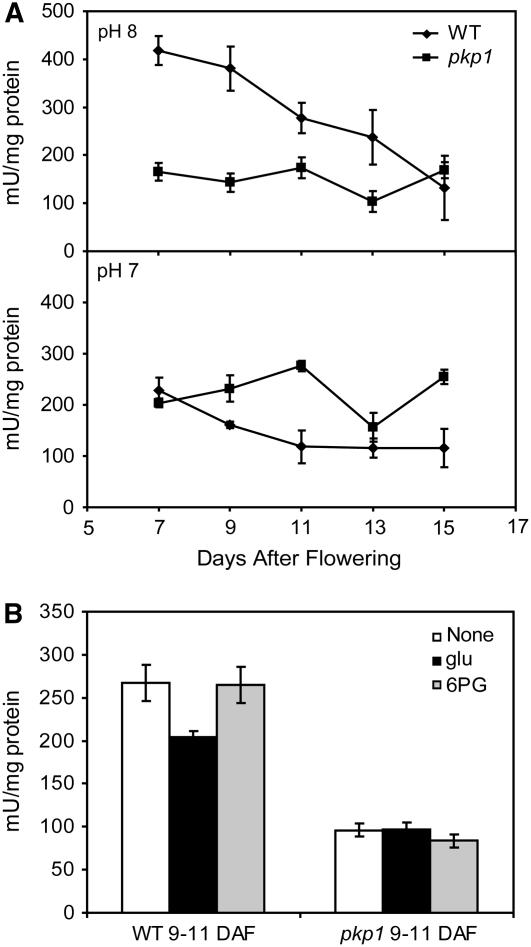
PK Activity in pkp1 and Wild-Type Seeds. (A) Total PK activity measured at pH 8.0 and 7.0 in saturating substrate conditions. One mU is defined as 1 nmol pyruvate formed per minute. Values are the mean ± sd (n = 4). (B) Native seed PK activity at 9 to 11 DAF in response to metabolite effectors. Activity was measured at pH 8.0 with subsaturating substrate concentrations. None, no effectors; glu, 5 mM Glu; 6-PG, 0.2 mM 6-phosphogluconate. One mU is defined as 1 nmol pyruvate formed per minute. Values are the mean ± sd (n = 4).
Figure 8.
Figure 8.
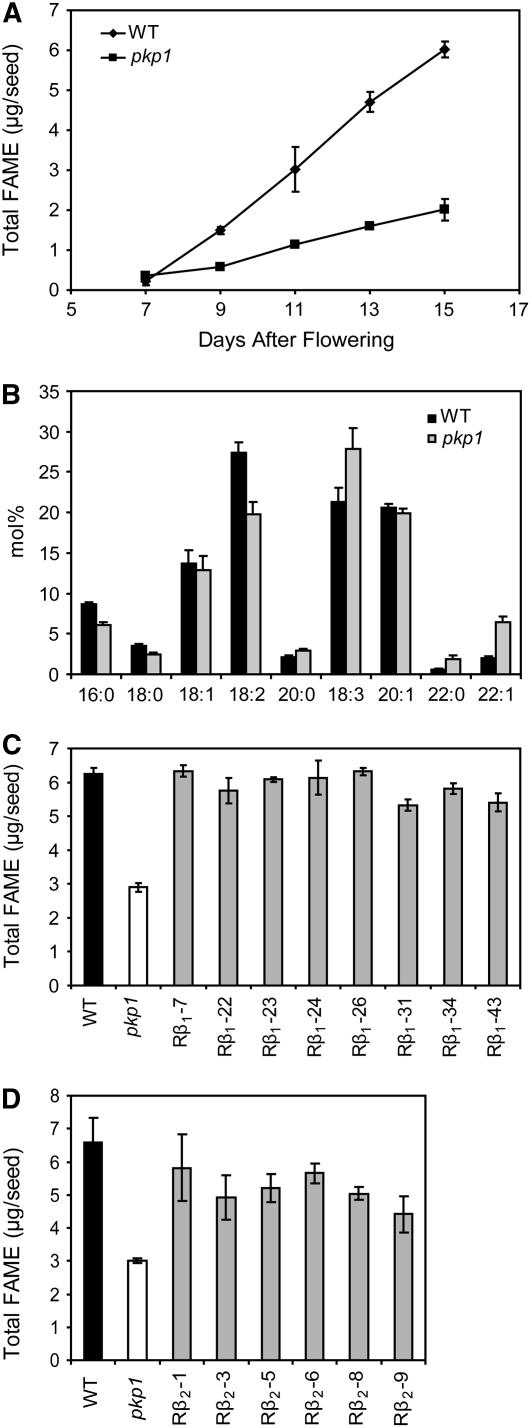
Lipid Phenotype of pkp1 Seeds. (A) Fatty acid accumulation in developing seeds. Values are the mean ± sd (n = 6). (B) Fatty acid profile of desiccated mature seeds. Values obtained from FAME analysis of dry seeds. Values are the mean ± sd (n = 6). (C) Rescue of low oil phenotype in mature seeds of pkp1 by overexpression of PKp1 encoding cDNA. The eight individual rescued lines are denoted with Rβ1 and a number. Values are the mean ± sd (n = 3). (D) Rescue of low oil phenotype in mature seeds of pkp1 by overexpression of PKp2 encoding cDNA. The six individual rescued lines are denoted with Rβ2 and a number. Values are the mean ± sd (n = 3).
Figure 9.
Figure 9.
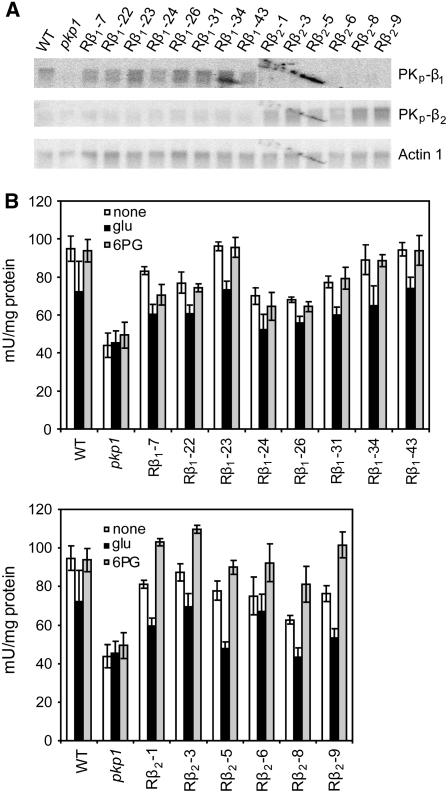
PKp Gene Expression and Enzyme Activity in pkp1 Lines Rescued with Ectopic Overexpression of PKp1 or PKp2. (A) Expression of PKp encoding genes in siliques of wild-type, pkp1, and rescued lines. Rβ1 represents overexpression of PKp1, and Rβ2 denotes overexpression of PKp2. An Actin1 probe was used for loading control. (B) Native PK activity of 9 to 11 DAF siliques in response to metabolite effectors. Top panel includes wild-type, pkp1, and pkp1 lines rescued with overexpression of PKp1 (Rβ1). Bottom panel includes wild-type, pkp1, and pkp1 lines rescued with overexpression of PKp2 (Rβ2). Activity was measured at pH 8.0 with subsaturating substrate concentrations. None, no effectors; glu, 5 mM Glu; 6-PG, 0.2 mM 6-phosphogluconate. One mU is defined as 1 nmol pyruvate formed per minute. Values are the mean ± sd (n = 4).
Figure 10.
Figure 10.
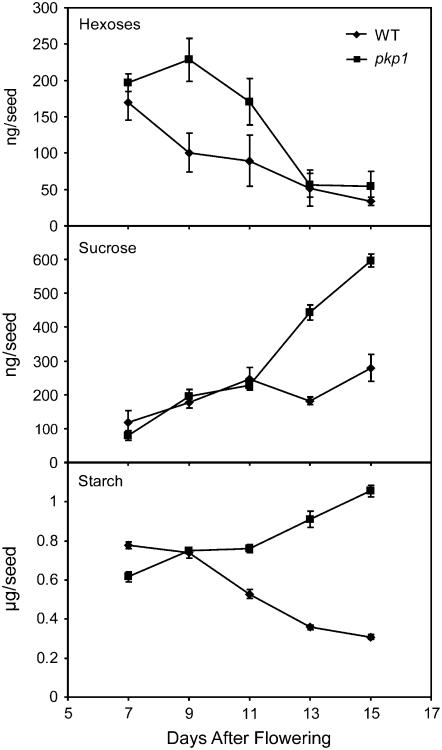
Carbohydrate Accumulation in pkp1 and Wild-Type Seeds. Hexoses (glucose plus fructose), sucrose, and starch levels in developing seeds. Values are the mean ± sd (n = 4).

References

    1. Alonso, J.M., et al. (2003). Genome-wide insertional mutagenesis of Arabidopsis thaliana. Science 301 653–657. - PubMed
    1. Arabidopsis Genome Initiative (2000). Analysis of the genome sequence of the flowering plant Arabidopsis thaliana. Nature 408 796–815. - PubMed
    1. Ballicora, M.A., Dubay, J.R., Devillers, C.H., and Preiss, J. (2005). Resurrecting the ancestral enzymatic role of a modulatory subunit. J. Biol. Chem. 280 10189–10195. - PubMed
    1. Baud, S., Boutin, J., Miquel, M., Lepiniec, L., and Rochat, C. (2002). An integrated overview of seed development in Arabidopsis thaliana ecotype WS. Plant Physiol. Biochem. 40 151–160.
    1. Blakeley, S., Gottlob-McHugh, S., Wan, J., Crews, L., Miki, B., Ko, K., and Dennis, D.T. (1995). Molecular characterization of plastid pyruvate kinase from castor and tobacco. Plant Mol. Biol. 27 79–89. - PubMed

Publication types

MeSH terms