


Role of insulin in the hyperandrogenemia of lean women with polycystic ovary syndrome and normal insulin sensitivity
- PMID: 17559844
- PMCID: PMC3846535
- DOI: 10.1016/j.fertnstert.2006.12.055
Role of insulin in the hyperandrogenemia of lean women with polycystic ovary syndrome and normal insulin sensitivity
Abstract
Objective: To determine the effect of reducing insulin secretion on hyperandrogenemia in lean normoinsulinemic women with polycystic ovary syndrome (PCOS) and normal metabolic insulin sensitivity.
Design: Transversal assessment at baseline and prospective follow-up of lean PCOS group after 8 days of diazoxide, which reduces insulin secretion, and 1 month of leuprolide, which suppresses LH.
Setting: Clinical research center of an academic hospital.
Patient(s): Nine lean women (body mass index <or=25 kg/m(2)) with PCOS and normal insulin levels, as well as 17 lean healthy women.
Intervention(s): Lean PCOS women were reassessed after 8 days of diazoxide and after 1 month of leuprolide, which suppresses LH.
Main outcome measure(s): Androgen levels and insulin-stimulated glucose disposal (metabolic insulin sensitivity), determined by euglycemic-hyperinsulinemic clamp (M-value).
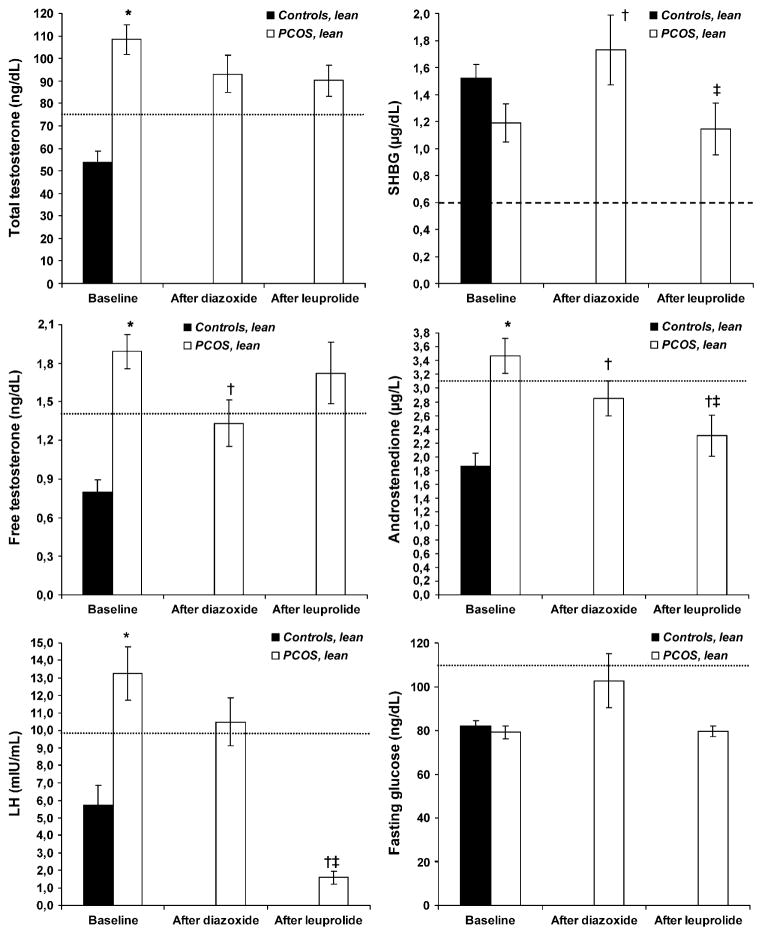
Result(s): Mean M-value of lean PCOS women (48.5 micromol/kg.min) was similar to lean control subjects (52.9 micromol/kg.min). They also had comparable anthropometric measures, lipids, fibrinogen, and plasminogen activator inhibitor 1. The LH did not change significantly after diazoxide, but was almost suppressed after leuprolide in the PCOS group. Androstenedione decreased significantly after diazoxide and even more after leuprolide. However, free T significantly decreased only after diazoxide in lean PCOS women. Diazoxide also increased SHBG significantly in this group.
Conclusion(s): In women with typical PCOS and normal insulin levels and metabolic insulin sensitivity, reducing insulin secretion significantly decreased androgen and increased SHBG levels. These results suggest that insulin contributes to hyperandrogenemia even in PCOS women with normal metabolic insulin sensitivity, which might be due to increased sensitivity of their androgenic insulin pathway.
Figures
Comment in
-
Correlates between hyperinsulinism and hyperandrogenemia?Fertil Steril. 2008 Apr;89(4):1033-4; author reply 1034. doi: 10.1016/j.fertnstert.2008.02.138. Epub 2008 Mar 12. Fertil Steril. 2008. PMID: 18339386 No abstract available.
References
-
- Baillargeon JP, Iuorno MJ, Nestler JE. Insulin sensitizers for polycystic ovary syndrome. Clin Obstet Gynecol. 2003;46:325–40. - PubMed
-
- Rotterdam ESHRE/ASRM-Sponsored PCOS Consensus Workshop Group. Revised 2003 consensus on diagnostic criteria and long-term health risks related to polycystic ovary syndrome (PCOS) Hum Reprod. 2004;19:41–7. - PubMed
-
- Nestler JE, Jakubowicz DJ, de Vargas AF, Brik C, Quintero N, Medina F. Insulin stimulates testosterone biosynthesis by human thecal cells from women with polycystic ovary syndrome by activating its own receptor and using inositolglycan mediators as the signal transduction system. J Clin Endocrinol Metab. 1998;83:2001–5. - PubMed
-
- Willis D, Mason H, Gilling-Smith C, Franks S. Modulation by insulin of follicle-stimulating hormone and luteinizing hormone actions in human granulosa cells of normal and polycystic ovaries. J Clin Endocrinol Metab. 1996;81:302–9. - PubMed
-
- Gilling-Smith C, Story H, Rogers V, Franks S. Evidence for a primary abnormality of thecal cell steroidogenesis in the polycystic ovary syndrome. Clin Endocrinol (Oxf) 1997;47:93–9. - PubMed
Publication types
MeSH terms
Substances
Grants and funding
LinkOut - more resources
Full Text Sources
Medical
Miscellaneous
