. 2007 Aug;27(2):207-19.
doi: 10.1016/j.nbd.2007.04.009. Epub 2007 May 5.

Abnormal motor phenotype in the SMNDelta7 mouse model of spinal muscular atrophy

Affiliations

Abnormal motor phenotype in the SMNDelta7 mouse model of spinal muscular atrophy

Matthew E R Butchbach et al. Neurobiol Dis. 2007 Aug.

Abstract

Spinal muscular atrophy (SMA) is a recessive motor neuron disease that affects motor neurons in the anterior horn of the spinal cord. SMA results from the reduction of SMN (survival motor neuron) protein. Even though SMN is ubiquitously expressed, motor neurons are more sensitive to the reduction in SMN than other cell types. We have previously generated mouse models of SMA with varying degrees of clinical severity. So as to more clearly understand the pathogenesis of motor neuron degeneration in SMA, we have characterized the phenotype of the SMNDelta7 SMA mouse which normally lives for 13.6+/-0.7 days. These mice are smaller than their non-SMA littermates and begin to lose body mass at 10.4+/-0.4 days. SMNDelta7 SMA mice exhibit impaired responses to surface righting, negative geotaxis and cliff aversion but not to tactile stimulation. Spontaneous motor activity and grip strength are also significantly impaired in SMNDelta7 SMA mice. In summary, we have demonstrated an impairment of neonatal motor responses in SMNDelta7 SMA mice. This phenotype characterization could be used to assess the effectiveness of potential therapies for SMA.


Figures
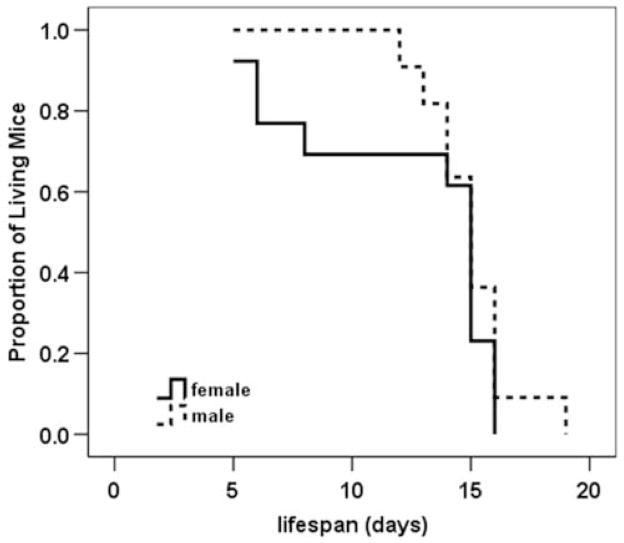
Figure 1
Figure 1. Survival curves of male and female SMNΔ7 SMA mice
Kaplan Meier analysis reveals that male SMNΔ7 SMA mice (dashed line) have an average lifespan that is about 2.5 days longer than female SMNΔ7 SMA mice (solid line; 15.0 ± 0.6 d vs. 12.5 ± 1.2 d) but the difference between sexes is not statistically significant (χ2 = 0.834, p = 0.36).
Figure 2
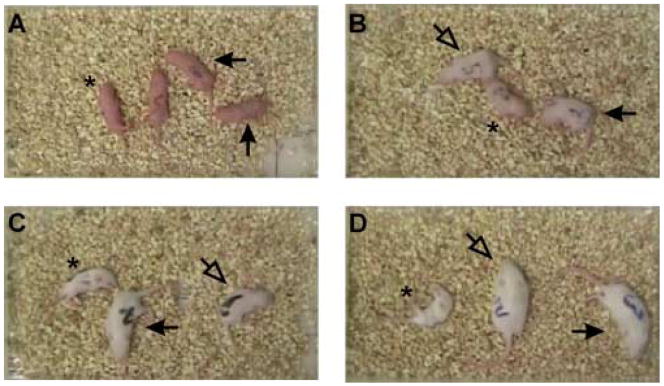
Figure 2. General appearance of SMNΔ7 SMA mice
Apart from their smaller sizes and inability to right themselves, SMNΔ7 SMA mice (SMN2+/+;SMNΔ7+/+;mSmn−/−; asterisk) at PND04 (A) and PND07 (B) are similar in appearance to their carrier (SMN2+/+;SMNΔ7+/+;mSmn+/−; closed arrow) and normal (SMN2+/+;SMNΔ7+/+;mSmn+/+; open arrowhead) littermates. On PND11 (C) and PND14 (D), SMNΔ7 SMA mice appear small and emaciated presumably the result of neurogenic muscle atrophy.
Figure 3
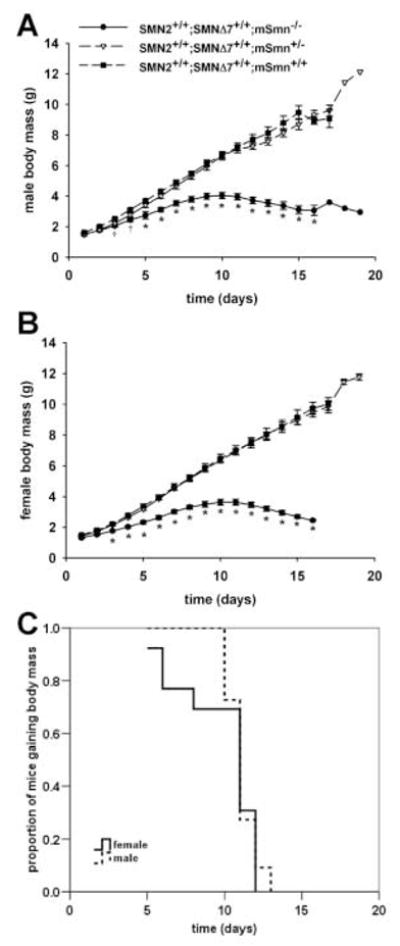
Figure 3. Body mass growth curves of SMNΔ7 SMA mice
Male (A) and female (B) carrier and normal pups have a continuous growth curve. As shown in (A) and (B), For male pups (A), the mean body masses between SMA and normal mice are significant different beginning at PND03; however, the differences in mean body mass between SMA and carrier mice are significant starting at PND05. Male (A) and female (B) SMA continue to gain body mass until PND09-PND11 where after they start losing body mass. Legend for (A) and (B); †p < 0.05 for SMA vs. normal mice, *p < 0.05 for SMA vs. normal mice and vs. carrier mice.
Figure 4
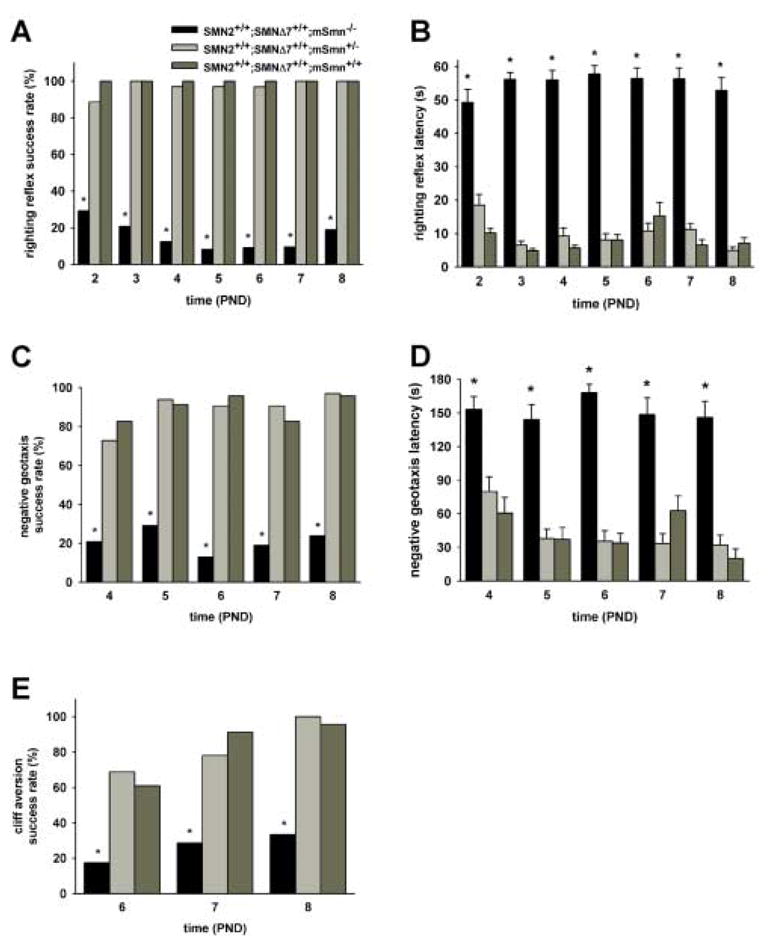
Figure 4. Acquisition of reflex responses in SMNΔ7 SMA mice
SMNΔ7 SMA mice (black bars) as well as their carrier (light grey bars) and normal (dark grey bars) littermates were assessed for the acquisition of various reflex responses and their latencies. Most of the SMNΔ7 SMA mice tested were unable to exhibit a surface righting response (A), response to negative geotaxis (C) or aversion to falling from a cliff (E) at all ages tested. As a result, the amount of time needed (latency) to exhibit the surface righting (B) and the negative geotaxis (D) response is significantly greater in SMNΔ7 SMA mice than in non-SMA (i.e., carrier or normal) mice. The success rates of carrier mice in acquiring the reflex responses tested as well as their latencies are the same as those of normal mice. Legend; *p < 0.05 for SMA vs. normal mice and vs. carrier mice.
Figure 5
Figure 5. Development of motor responses in SMNΔ7 SMA mice
SMNΔ7 SMA mice (black bars) as well as their carrier (light grey bars) and normal (dark grey bars) littermates were assessed for the development of various motor responses. For mice at PND04 and PND07, vectorial movement refers to crawling and it refers to walking for PND11 as well as PND14 mice. Significantly fewer SMNΔ7 SMA mice were able to successfully demonstrate vectorial movement (A) at all ages tested. Likewise, the latency to demonstrate vectorial movement (B) is significantly longer and the duration (C) is significantly shorter for SMNΔ7 SMA mice than for non-SMA (carrier and normal) mice at PND07-PND14. SMNΔ7 SMA mice crossed fewer grids per minute (D) and had fewer pivots per minute (E) than non-SMA littermates at all ages tested. Legend; *p < 0.05 for SMA vs. normal mice and vs. carrier mice.
Figure 6
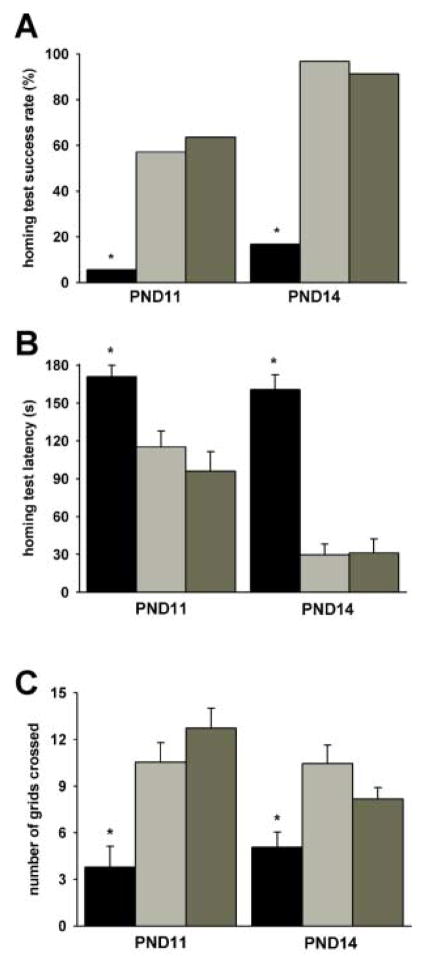
Figure 6. Homing test on SMNΔ7 SMA mice
The homing test was performed on SMNΔ7 SMA mice (black bars) as well as their carrier (light grey bars) and normal (dark grey bars) littermates at PND11 and PND14. As shown in (A), significant fewer SMNΔ7 SMA mice were able to successfully enter the home field within the allotted time (3 min) while most non-SMA littermates successfully completed the test. The amount of time needed to enter the home field (homing test latency; B) was greater for SMNΔ7 SMA mice than for non-SMA littermates. The number of grids crossed during the homing test (C) was significantly lower for SMNΔ7 SMA mice than for non-SMA littermates. Legend; *p < 0.05 for SMA vs. normal mice and vs. carrier mice.
Figure 7
Figure 7. Grip strength of SMNΔ7 SMA mice
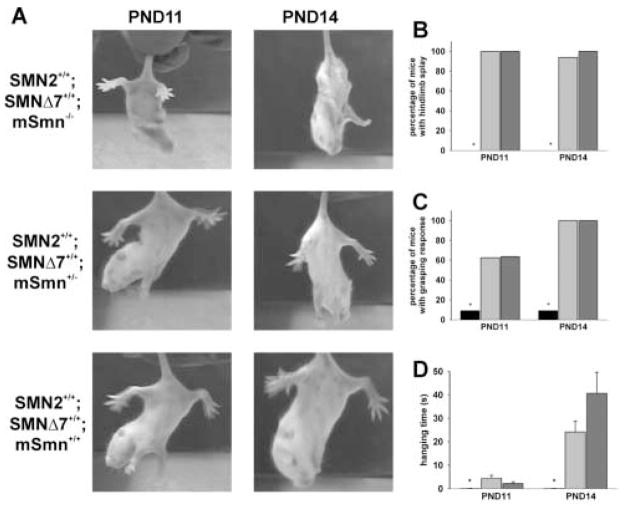
SMNΔ7 SMA mice (SMN2+/+;SMNΔ7+/+;mSmn−/−) retract their hindlimbs into their bodies (A) at PND11 and PND14 while carrier (SMN2+/+;SMNΔ7+/+;mSmn+/−) and normal (SMN2+/+;SMNΔ7+/+;mSmn+/+) littermates splay their hindlimbs from their bodies when suspended by their tails. As shown in (B), very few SMNΔ7 SMA mice (black bars) exhibit hindlimb splay while most carrier (light grey bars) and normal (dark grey bars) littermates show hindlimb splay at PND11 and PND14. Most SMNΔ7 SMA mice were not able to grasp onto a wire mesh (C); those that could grasp the wire mesh were able to do so for a very short period of time (D). Legend; *p < 0.05 for SMA vs. normal mice and vs. carrier mice.

References

    1. Altafaj X, Dierssen M, Baamonde C, Martí E, Visa J, Guimerà J, Oset M, González JR, Flórez J, Fillat C, Estivill X. Neurodevelopmental delay, motor abnormalities and cognitive deficits in transgenic mice overexpressing Dyrk1A minibrain), a murine model of Down’s syndrome. Hum Mol Genet. 2001;10:1915–1923. - PubMed
    1. Amendola J, Verrier B, Roubertoux P, Durand J. Altered sensorimotor development in a transgenic mouse model of amyotrophic lateral sclerosis. Eur J Neurosci. 2004;20:2822–2826. - PubMed
    1. Azzouz M, Leclerc N, Gurney M, Warter JM, Poindron P, Borg J. Progressive motor neuron impairment in an animal model of familial amyotrophic lateral sclerosis. Muscle Nerve. 1997;20:45–51. - PubMed
    1. Bruijn LI, Becher MW, Lee MK, Anderson KL, Jenkins NA, Copeland NG, Sisodia SS, Rothstein JD, Borchelt DR, Price DL, Cleveland DW. ALS-linked SOD1 mutant G85R mediates damage to astrocytes and promotes rapidly progressive disease with SOD1-containing inclusions. Neuron. 1997;18:327–338. - PubMed
    1. Butchbach MER, Burghes AHM. Perspectives on models of spinal muscular atrophy for drug discovery. Drug Discov Today Dis Model. 2004;1:151–156.

Publication types

Substances