


Core body temperature during competition in the heat: National Boys' 14s Junior Championships
- PMID: 17562747
- PMCID: PMC2465265
- DOI: 10.1136/bjsm.2007.036905
Core body temperature during competition in the heat: National Boys' 14s Junior Championships
Abstract
Objective: To examine on-court core body temperature (T(C)) and sweat loss, as well as pre- and post-play hydration status, in elite adolescent tennis players during a national championships event in a hot climate.
Methods: Eight healthy, fit, young male tennis players (mean (SD) age 13.9 (0.9) years; mass 56.0 (10.7) kg; height 169.2 (14.7) cm) were evaluated during first-round singles competition at the National Boys' 14s Junior Championships in the heat (wet-bulb globe temperature (WBGT) 29.6 (0.4) degrees C). Five of those same players were also evaluated during a same-day doubles match (WBGT 31.3 (0.5) degrees C).
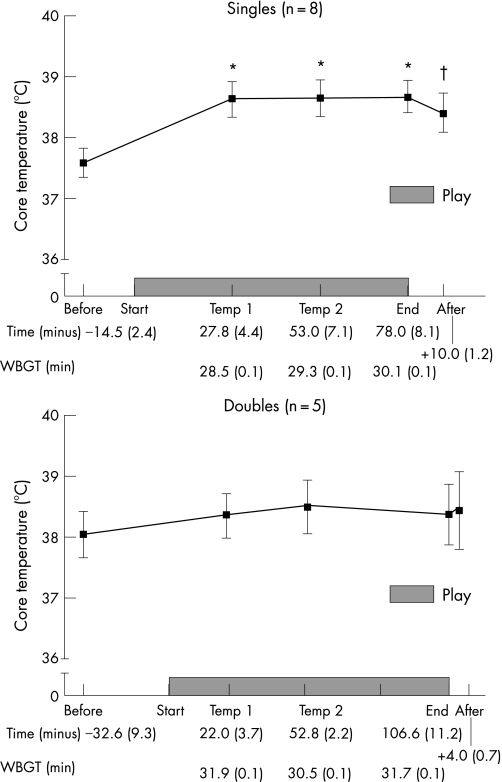
Results: During doubles (4.37 (0.35) h after singles), pre-play urine specific gravity (USG) (1.025 (0.002); p = 0.06) and total sweat loss (1.9 (0.2) litres; p = 0.10) tended to be higher before and during doubles, respectively, compared to singles. However, percentage change in body mass (-0.5 (0.3) %) tended to be comparatively less (p = 0.08), even though the doubles matches were generally longer (106.6 (11.2) vs 78.8 (10.9) min; p = 0.09) and the degree minutes total was greater (p = 0.04). T(C) increased (p<0.001) during singles and remained elevated, even after 10 min following the end of play. Notably, pre-play (singles) USG was strongly associated (p = 0.005) with the players' final T(C) (38.7 (0.3) degrees C) recorded at the end of singles play.
Conclusion: Junior tennis players who begin a match not well hydrated could have progressively increasing thermal strain and a greater risk for exertional heat illness as the match advances.
Conflict of interest statement
Competing interests: None declared.
References
-
- American Academy of Pediatrics, Committee on Sports Medicine and Fitness Climatic heat stress and the exercising child and adolescent. Pediatrics 2000106158–159. - PubMed
-
- Bergeron M F. Heat cramps during tennis: a case report. Int J Sport Nutr 1996662–68. - PubMed
-
- Bergeron M F. Heat cramps: fluid and electrolyte challenges during tennis in the heat. J Sci Med Sport 2003619–27. - PubMed
-
- Falk B. Effects of thermal stress during rest and exercise in the paediatric population. Sports Med 199825221–240. - PubMed
-
- Falk B, Bar‐Or O, MacDougall J D. Thermoregulatory responses of pre‐, mid‐, and late‐pubertal boys to exercise in dry heat. Med Sci Sports Exerc 199224688–694. - PubMed
Publication types
MeSH terms
LinkOut - more resources
Full Text Sources
Medical
