


Chemical cues induce consumer-specific defenses in a bloom-forming marine phytoplankton
- PMID: 17563379
- PMCID: PMC1965544
- DOI: 10.1073/pnas.0611600104
Chemical cues induce consumer-specific defenses in a bloom-forming marine phytoplankton
Abstract
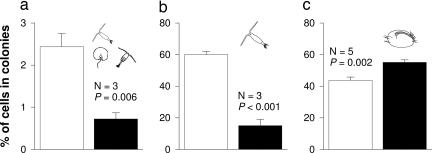
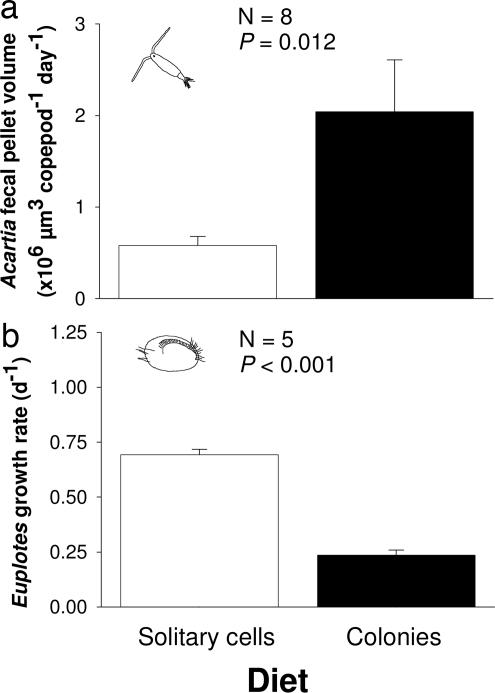
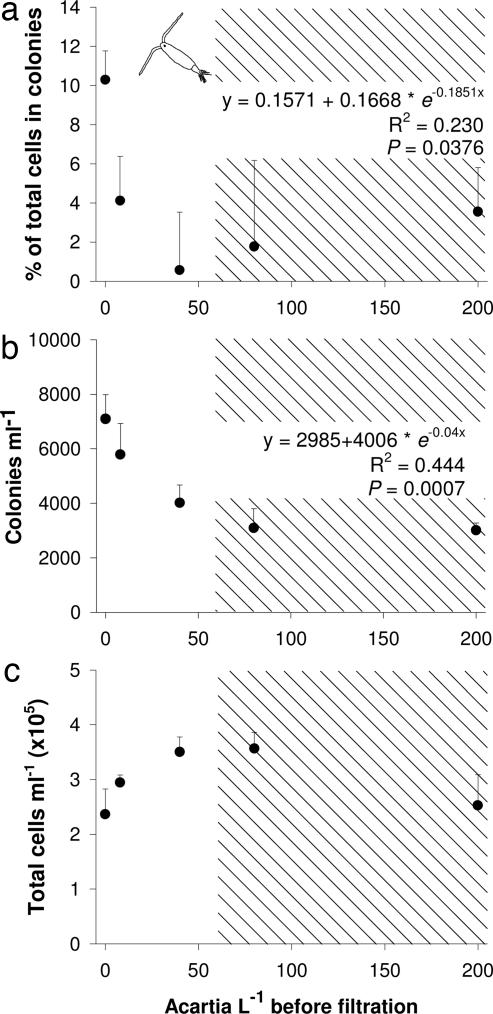
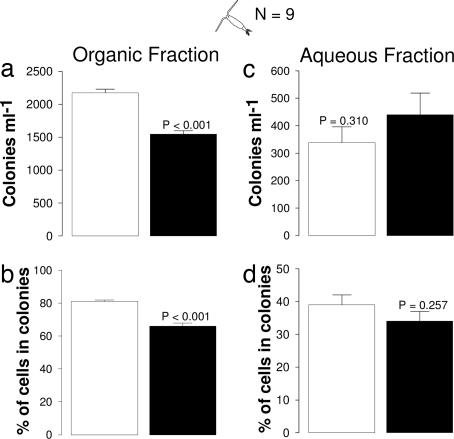
Blooms of the phytoplankton Phaeocystis can comprise 85% of total production and generate major biogeochemical signals across broad oceanic regions. The success of Phaeocystis may result from its ability to change size by many orders of magnitude when it shifts from small cells of 4-6 microm to large colonies of up to 30,000 microm in diameter. Single cells are consumed by ciliates but not copepods, whereas colonies are consumed by copepods but not ciliates. We demonstrate that chemical cues associated with each of these grazers induce consumer-specific, but opposing, morphological transformations in the bloom-forming species Phaeocystis globosa. Chemical cues from grazing copepods suppress colony formation by a significant 60-90%, a response that should be adaptive because copepods feed four times more on colonies versus solitary cells. In contrast, chemical cues from grazing ciliates enhance colony formation by >25%, a response that should be adaptive because ciliates grow three times faster when fed solitary cells versus colonies. Because size-selective predation fundamentally alters community structure and ecosystem function, this chemically cued shift may redirect energy and nutrients from food webs supporting fisheries to those fueling detrital pathways, thus potentially altering ecosystem-level processes such as productivity, carbon storage, and nutrient release.
Conflict of interest statement
The authors declare no conflict of interest.
Figures
References
-
- Irigoien X, Huisman J, Harris RP. Nature. 2004;429:863–867. - PubMed
-
- Verity PG, Villareal TA, Smayda TJ. J Plankton Res. 1988;10:749–766.
-
- Arrigo KR, Robinson DH, Worthen DL, Dunbar RB, DiTullio GR, VanWoert M, Lizotte MP. Science. 1999;283:365–367. - PubMed
-
- Smith WO, Codispoti LA, Nelson DM, Manley T, Buskey EJ, Niebauer HJ, Cota GF. Nature. 1991;352:514–516.
-
- Weisse T, Tande K, Verity P, Hansen F, Gieskes W. J Marine Syst. 1994;5:67–79.
Publication types
MeSH terms
LinkOut - more resources
Full Text Sources
Other Literature Sources
Molecular Biology Databases
