Longitudinal assessment of an ELISPOT test for Mycobacterium tuberculosis infection
- PMID: 17564487
- PMCID: PMC1891317
- DOI: 10.1371/journal.pmed.0040192
Longitudinal assessment of an ELISPOT test for Mycobacterium tuberculosis infection
Abstract
Background: Very little longitudinal information is available regarding the performance of T cell-based tests for Mycobacterium tuberculosis infection. To address this deficiency, we conducted a longitudinal assessment of the enzyme-linked immunosorbent spot test (ELISPOT) test in comparison to the standard tuberculin skin test (TST).
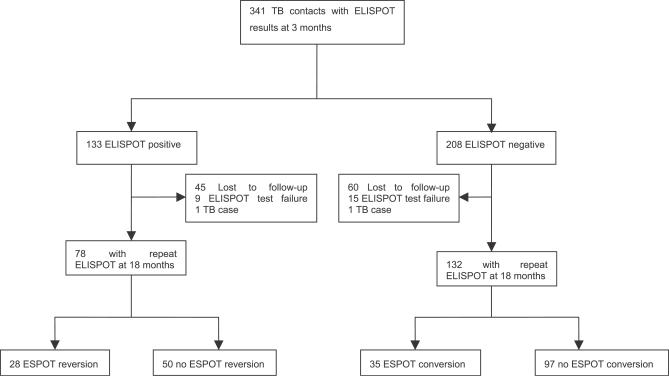
Methods and findings: In tuberculosis (TB) contacts we repeated ELISPOT tests 3 mo (n = 341) and 18 mo (n = 210) after recruitment and TSTs at 18 mo (n = 130). We evaluated factors for association with conversion and reversion and investigated suspected cases of TB. Of 207 ELISPOT-negative contacts, 51 (24.6%) had 3-mo ELISPOT conversion, which was associated with a positive recruitment TST (odds ratio [OR] 2.2, 95% confidence interval [CI] 1.0-5.0, p = 0.048) and negatively associated with bacillus Calmette-Guérin (BCG) vaccination (OR 0.5, 95% CI 0.2-1.0, p = 0.06). Of 134 contacts, 54 (40.2%) underwent 3-mo ELISPOT reversion, which was less likely in those with a positive recruitment TST (OR 0.3, 95% CI 0.1-0.8, p = 0.014). Between 3 and 18 mo, 35/132 (26.5%) contacts underwent ELISPOT conversion and 28/78 (35.9%) underwent ELISPOT reversion. Of the 210 contacts with complete results, 73 (34.8%) were ELISPOT negative at all three time points; 36 (17.1%) were positive at all three time points. Between recruitment and 18 mo, 20 (27%) contacts had ELISPOT conversion; 37 (50%) had TST conversion, which was associated with a positive recruitment ELISPOT (OR 7.2, 95% CI 1.4-37.1, p = 0.019); 18 (32.7%) underwent ELISPOT reversion; and five (8.9%) underwent TST reversion. Results in 13 contacts diagnosed as having TB were mixed, but suggested higher TST sensitivity.
Conclusions: Both ELISPOT conversion and reversion occur after M. tuberculosis exposure. Rapid ELISPOT reversion may reflect M. tuberculosis clearance or transition into dormancy and may contribute to the relatively low reported ELISPOT conversion rate. Therefore, a negative ELISPOT test for M. tuberculosis infection should be interpreted with caution.
Conflict of interest statement
Figures


Comment in
-
Serial testing for tuberculosis: can we make sense of T cell assay conversions and reversions?PLoS Med. 2007 Jun;4(6):e208. doi: 10.1371/journal.pmed.0040208. PLoS Med. 2007. PMID: 17564491 Free PMC article.
References
-
- Ewer K, Deeks J, Alvarez L, Bryant G, Waller S, et al. Comparison of T-cell-based assay with tuberculin skin test for diagnosis of Mycobacterium tuberculosis infection in a school tuberculosis outbreak. Lancet. 2003;361:1168–1173. - PubMed
-
- Hill PC, Brookes RH, Fox A, Fielding K, Jeffries DJ, et al. Large-scale evaluation of enzyme-linked immunospot assay and skin test for diagnosis of Mycobacterium tuberculosis infection against a gradient of exposure in The Gambia. Clin Infect Dis. 2004;38:966973. - PubMed
-
- Ferrara G, Losi M, D'Amico R, Roversi P, Piro R, et al. Use in routine clinical practice of two commercial blood tests for diagnosis of infection with Mycobacterium tuberculosis: A prospective study. Lancet. 2006;367:1328–1334. - PubMed
-
- Ewer K, Millington KA, Deeks JJ, Alvarez L, Bryant G, et al. Dynamic antigen-specific T-cell responses after point-source exposure to Mycobacterium tuberculosis . Am J Respir Crit Care Med. 2006;174:831–839. - PubMed
-
- Wilkinson KA, Kon OM, Newton SM, Meintjes G, Davidson RN, et al. Effect of treatment of latent tuberculosis infection on the T cell response to Mycobacterium tuberculosis antigens. J Infect Dis. 2006;193:354–359. - PubMed
Publication types
MeSH terms
Substances
Grants and funding
LinkOut - more resources
Full Text Sources
Other Literature Sources
Medical