. 2007 Jun 13;2(6):e514.
doi: 10.1371/journal.pone.0000514.

Blueprint for a high-performance biomaterial: full-length spider dragline silk genes

Affiliations

Blueprint for a high-performance biomaterial: full-length spider dragline silk genes

Nadia A Ayoub et al. PLoS One. .

Abstract

Spider dragline (major ampullate) silk outperforms virtually all other natural and manmade materials in terms of tensile strength and toughness. For this reason, the mass-production of artificial spider silks through transgenic technologies has been a major goal of biomimetics research. Although all known arthropod silk proteins are extremely large (>200 kiloDaltons), recombinant spider silks have been designed from short and incomplete cDNAs, the only available sequences. Here we describe the first full-length spider silk gene sequences and their flanking regions. These genes encode the MaSp1 and MaSp2 proteins that compose the black widow's high-performance dragline silk. Each gene includes a single enormous exon (>9000 base pairs) that translates into a highly repetitive polypeptide. Patterns of variation among sequence repeats at the amino acid and nucleotide levels indicate that the interaction of selection, intergenic recombination, and intragenic recombination governs the evolution of these highly unusual, modular proteins. Phylogenetic footprinting revealed putative regulatory elements in non-coding flanking sequences. Conservation of both upstream and downstream flanking sequences was especially striking between the two paralogous black widow major ampullate silk genes. Because these genes are co-expressed within the same silk gland, there may have been selection for similarity in regulatory regions. Our new data provide complete templates for synthesis of recombinant silk proteins that significantly improve the degree to which artificial silks mimic natural spider dragline fibers.


Conflict of interest statement

Competing Interests: The authors have declared that no competing interests exist.

Figures

Figure 1
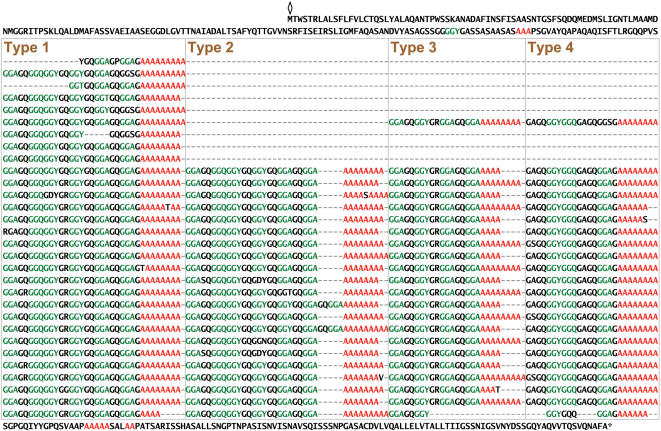
Figure 1. Complete amino acid sequence for L. hesperus major ampullate spidroin 1 (MaSp1).
The sequence is read from left to right and then top to bottom. The diamond marks the start position and the asterisk denotes the stop position. The protein is dominated by poly-A (red) and GGX (green) motifs. The majority of the sequence can be categorized into four types of ensemble repeat units. Repeats of each type are aligned within a box. Gaps (-) have been inserted in order to align repeat units within a type.
Figure 2
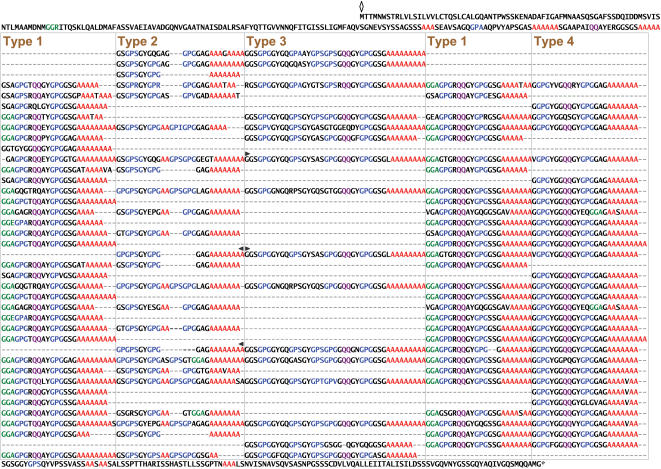
Figure 2. Complete amino acid sequence for L. hesperus major ampullate spidroin 2 (MaSp2).
The sequence is read from left to right and then top to bottom. Start position, stop position, and alignment gaps are indicated as for MaSp1 (Figure 1). MaSp2 is characterized by poly-A (red), GGX (green), GPX (blue), and QQ (purple) motifs. There are four types of ensemble repeats. Repeats of each type are aligned within a box, except for Type 1, which is separated into two boxes because it is approximately twice as prevalent as any other repeat type. Right and left pointing arrows mark beginnings and ends of two near-perfect repeats of 778 aa.
Figure 3
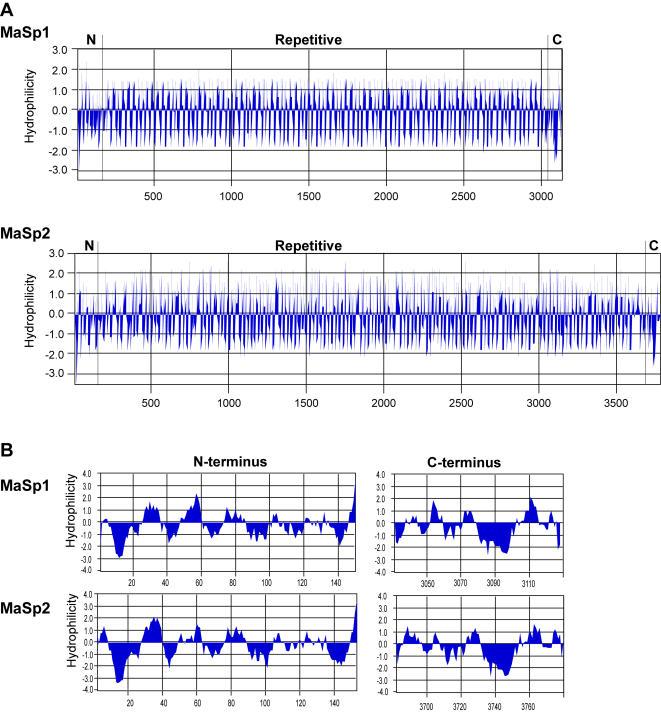
Figure 3. Kyte and Doolittle hydrophilicity plots for L. hesperus MaSp1 and MaSp2.
Scan window size = 7. Negative values indicate hydrophobicity. (A) Complete proteins. (B) Non-repetitive terminal regions.
Figure 4
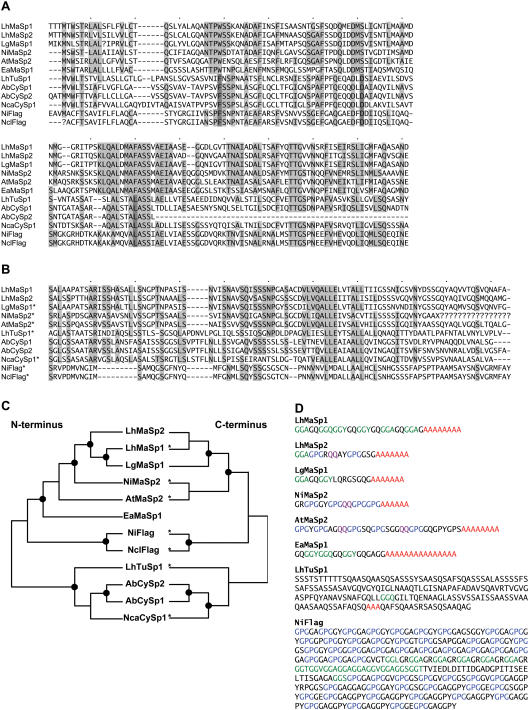
Figure 4. Comparison of N-termini, C-termini and repeat units of spider silk proteins.
(A) Alignment of published N-terminal amino acid sequences. Amino acids shared by ≥50% of proteins are highlighted in grey. Gaps are represented by dashes and missing characters by question marks. (B) Alignment of corresponding C-terminal amino acid sequences. Taxa with an asterisk result from partial sequencing and are presumed to belong to the same locus as the N-terminal sequences. (C) MP trees of N and C-terminal encoding sequences treating gaps as a fifth state and employing midpoint rooting. Left tree length = 1449 (N-terminus); Right tree length = 838 (C-terminus). Dots represent nodes with >75% bootstrap support in all MP and ML analyses and >95% Bayesian posterior probability. (D) Exemplar repeat units for each of the major ampullate fibroins and representative TuSp1 and Flag repeats. Amino acid motifs are colored as in Figure 2. Abbreviations: LhMaSp2, Latrodectus hesperus MaSp2 (EF595245); LhMaSp1, L. hesperus MaSp1 (EF595246); LgMaSp1, L. geometricus MaSp1 (5′ sequence: DQ059133S1, 3′ sequence: DQ059133S2); NiMaSp2, Nephila inaurata madagascariensis MaSp2 (5′ sequence: DQ059135, 3′ sequence: AF350278); AtMaSp2, Argiope trifasciata MaSp2 (5′ sequence: DQ059136, 3′ sequence: AF350266); EaMaSp1; Euprosthenops australis MaSp1 (AM259067); LhTuSp1, L. hesperus TuSp1 (5′ sequence: DQ379383, 3′ sequence: AY953070); AbCySp1, A. bruennichi CySp1 AB242144; AbCySp2, A. bruennichi CySp2 (AB242145); NcaCySp1, N. clavata CySp1 (5′ sequence: AB218974, 3′ sequence: AB218973); NiFlag, N. i. madagascariensis Flag (5′ sequence: AF218623S1, 3′ sequence: AF218623S2); NclFlag, N. clavipes Flag (5′ sequence: AF027972, 3′ sequence: AF027973).
Figure 5
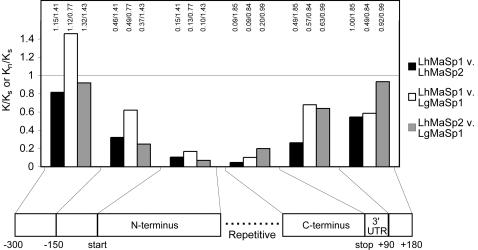
Figure 5. K/Ks or Kn/Ks for flanking and terminal regions of Latrodectus major ampullate silk genes. Ks(N-terminus) is the denominator for upstream ratios; Ks(C-terminus) is the denominator for downstream ratios.
Actual K values shown above bars. Gene abbreviations are the same as for Figure 4.
Figure 6
Figure 6. Global AVID alignment of L. hesperus genomic clones containing MaSp1 and MaSp2 visualized with VISTA.
The MaSp1-containing clone was used as the reference sequence. Peak height corresponds to level of identity between the two clones. Regions exceeding 70% conservation over a window length of 100 bp are colored (blue for exons, red for non-coding sequence). The red peak corresponds to a putative transposable element found in both clones. Arrows mark open reading frames (ORFs) on the clone containing MaSp1.

References

    1. Vollrath F, Knight DP. Liquid crystalline spinning of spider silk. Nature. 2001;410:541–548. DOI: 10.1038/35069000. - PubMed
    1. Gosline J, Lillie M, Carrington E, Guerrette P, Ortlepp C, et al. Elastic proteins: biological roles and mechanical properties. Phil Trans R Soc Lond B Biol Sci. 2002;357:121–132. DOI: 10.1098/rstb.2001.1022. - PMC - PubMed
    1. Foo CWP, Kaplan DL. Genetic engineering of fibrous proteins: spider dragline silk and collagen. Adv Drug Deliv Rev. 2002;54:1131–1143. DOI: 10.1016/S0169-409X(02)00061-3. - PubMed
    1. Gosline JM, DeMont ME, Denny MW. The structure and properties of spider silk. Endeavour. 1986;10:37–43. DOI: 10.1016/0160-9327(86)90049-9.
    1. Hinman M, Dong Z, Xu M, Lewis RV. Spider silk: a mystery starting to unravel. In: Case ST, editor. Biopolymers. Berlin: Springer; 1992. pp. 227–254. - PubMed

Publication types

Substances