


Synapsis-defective mutants reveal a correlation between chromosome conformation and the mode of double-strand break repair during Caenorhabditis elegans meiosis
- PMID: 17565963
- PMCID: PMC1950611
- DOI: 10.1534/genetics.107.076968
Synapsis-defective mutants reveal a correlation between chromosome conformation and the mode of double-strand break repair during Caenorhabditis elegans meiosis
Abstract
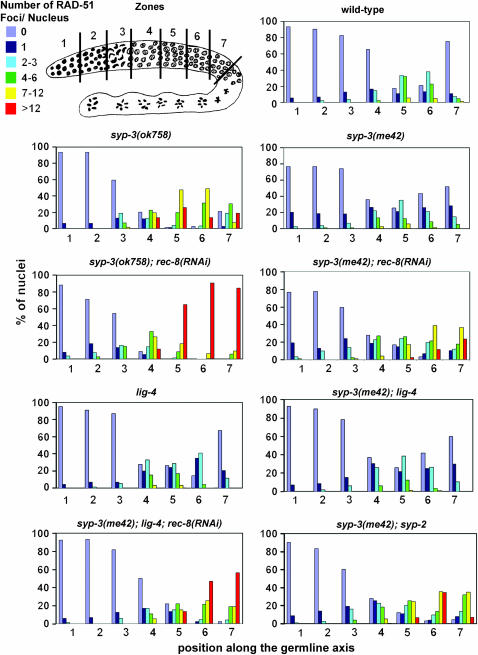
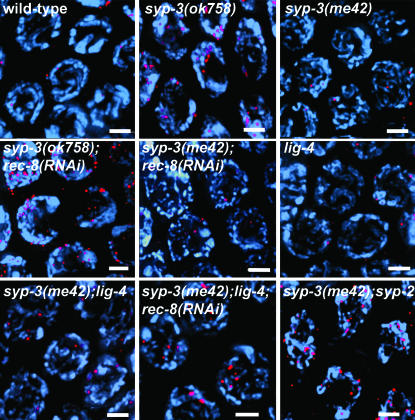
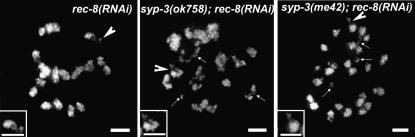
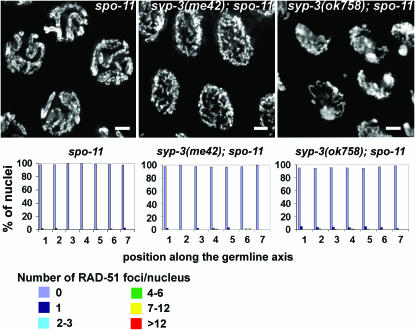
SYP-3 is a new structural component of the synaptonemal complex (SC) required for the regulation of chromosome synapsis. Both chromosome morphogenesis and nuclear organization are altered throughout the germlines of syp-3 mutants. Here, our analysis of syp-3 mutants provides insights into the relationship between chromosome conformation and the repair of meiotic double-strand breaks (DSBs). Although crossover recombination is severely reduced in syp-3 mutants, the production of viable offspring accompanied by the disappearance of RAD-51 foci suggests that DSBs are being repaired in these synapsis-defective mutants. Our studies indicate that once interhomolog recombination is impaired, both intersister recombination and nonhomologous end-joining pathways may contribute to repair during germline meiosis. Moreover, our studies suggest that the conformation of chromosomes may influence the mode of DSB repair employed during meiosis.
Figures
References
-
- Bergerat, A., B. de Massy, D. Gadelle, P. C. Varoutas, A. Nicolas et al., 1997. An atypical topoisomerase II from Archaea with implications for meiotic recombination. Nature 386: 414–417. - PubMed
-
- Colaiácovo, M. P., A. J. MacQueen, E. Martinez-Perez, K. McDonald, A. Adamo et al., 2003. Synaptonemal complex assembly in C. elegans is dispensable for loading strand-exchange proteins but critical for proper completion of recombination. Dev. Cell 5: 463–474. - PubMed
Publication types
MeSH terms
Grants and funding
LinkOut - more resources
Full Text Sources
Research Materials
