. 2007 Jun 26;104(26):10830-4.
doi: 10.1073/pnas.0703969104. Epub 2007 Jun 12.

The yeast mitochondrial ADP/ATP carrier functions as a monomer in mitochondrial membranes

Affiliations

The yeast mitochondrial ADP/ATP carrier functions as a monomer in mitochondrial membranes

Lisa Bamber et al. Proc Natl Acad Sci U S A. .

Abstract

Mitochondrial carriers are believed widely to be dimers both in structure and function. However, the structural fold is a barrel of six transmembrane alpha-helices without an obvious dimerisation interface. Here, we show by negative dominance studies that the yeast mitochondrial ADP/ATP carrier 2 from Saccharomyces cerevisiae (AAC2) is functional as a monomer in the mitochondrial membrane. Adenine nucleotide transport by wild-type AAC2 is inhibited by the sulfhydryl reagent 2-sulfonatoethyl-methanethiosulfonate (MTSES), whereas the activity of a mutant AAC2, devoid of cysteines, is unaffected. Wild-type and cysteine-less AAC2 were coexpressed in different molar ratios in yeast mitochondrial membranes. After addition of MTSES the residual transport activity correlated linearly with the fraction of cysteine-less carrier present in the membranes, and so the two versions functioned independently of each other. Also, the cysteine-less and wild-type carriers were purified separately, mixed in defined ratios and reconstituted into liposomes. Again, the residual transport activity in the presence of MTSES depended linearly on the amount of cysteine-less carrier. Thus, the entire transport cycle for ADP/ATP exchange is carried out by the monomer.


Conflict of interest statement

The authors declare no conflict of interest.

Figures
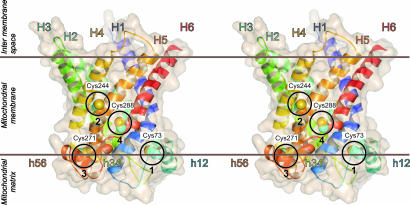
Fig. 1.
Fig. 1.
Stereoview of the comparative structural model of the yeast ADP/ATP carrier AAC2. The model (courtesy of A. Robinson, Medical Research Council, Cambridge, U.K.) is based on coordinates of the bovine ADP/ATP carrier (13) and the alignment in SI Fig. 4. The structure is shown in cartoon and surface representation as generated by PyMOL (DeLano Scientific, Palo Alto, CA). The TM α-helices are numbered according to their appearance in the sequence. The matrix helices are preceded by h and named by the two TM α-helices they connect (13). The four encircled cysteines are numbered by their order in the sequence and they are shown as van der Waals spheres.
Fig. 2.
Fig. 2.
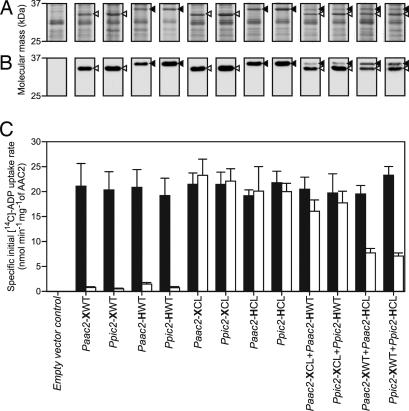
The transport activities in the presence and absence of MTSES of untagged and/or His-tagged AAC2 versions expressed individually or in combinations. (A) Coomassie blue-stained sodium-dodecylsulfate polyacrylamide gel of isolated mitochondrial membranes with ≈7.5 μg of protein loaded per lane. (B) Western blot of the same samples with α-AAC2 antibody with ≈0.75 μg of protein loaded per lane. Closed and open arrow heads indicate the positions of the His-tagged and untagged AAC2, respectively. (C) The effect of MTSES on the specific initial uptake rate of wild-type and cysteine-less AAC2, expressed individually or in combinations. The black and the white bars indicate the specific initial uptake rate in the absence and the presence of MTSES, respectively. Paac2 and Ppic2 are the promoters. X and H indicate untagged and His-tagged AAC2, respectively, and CL and WT indicate the cysteine-less and wild-type AAC2, respectively.
Fig. 3.
Fig. 3.
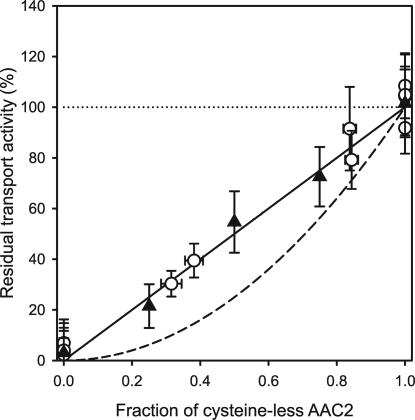
Correlation between the fraction of cysteine-less AAC2 and the residual initial transport rate after addition of MTSES. The residual initial transport rate in the presence of MTSES is expressed as a percentage of the rate in the absence of MTSES. Open circles represent the residual rate of coexpressed wild-type and/or cysteine-less AAC2 in mitochondrial membranes. The average rate in the absence of MTSES (100%, dotted line) was 20.6 ± 2.7 nmol·min−1·mg−1 of AAC2 (raw data from Fig. 2). The closed triangles indicate the residual transport rate of wild-type and/or cysteine-less AAC2, purified separately and mixed in defined molar ratios and then reconstituted into liposomes. In this case, the average rate was 16.4 ± 4.6 nmol·min−1·mg−1 of AAC2 in the absence of MTSES (100%, dotted line). The initial uptake rates of [14C]-ADP were determined in quintuplicate in the first 15 s of linear uptake. The amount of AAC2 in the fused mitochondrial membranes or proteoliposomes was quantified in triplicate by using Western blot analyses and known amounts of purified AAC2 as standard. The continuous and dashed lines represent the theoretical correlation for the independent and dependent functional interactions of the cysteine-less AAC2 and wild-type AAC2, respectively.

References

    1. Lin CS, Hackenberg H, Klingenberg EM. FEBS Lett. 1980;113:304–306. - PubMed
    1. Klingenberg M. Nature. 1981;290:449–454. - PubMed
    1. Klingenberg M, Appel M. Eur J Biochem. 1989;180:123–131. - PubMed
    1. Bisaccia F, Zara V, Capobianco L, Iacobazzi V, Mazzeo M, Palmieri F. Biochim Biophys Acta. 1996;1292:281–288. - PubMed
    1. Riccio P, Aquila H, Klingenberg M. FEBS Lett. 1975;56:133–138. - PubMed

Publication types

MeSH terms

Substances

LinkOut - more resources