


Physical activity in adolescence and smoking in young adulthood: a prospective twin cohort study
- PMID: 17567404
- PMCID: PMC1905863
- DOI: 10.1111/j.1360-0443.2007.01858.x
Physical activity in adolescence and smoking in young adulthood: a prospective twin cohort study
Abstract
Aims: To control for familial confounds, we studied the association between adolescent physical activity and later smoking in twin siblings discordant for their baseline physical activity.
Design and measurements: In this prospective population-based twin study, we asked whether persistent physical activity/inactivity in adolescence (assessed at 16, 17 and 18.5 years) predicted questionnaire-reported daily smoking at ages 22-27. Twins who, on the three baseline questionnaires, consistently reported frequent leisure physical activity (more than three times weekly) were classified as persistent exercisers, those who exercised less than three times monthly were called persistently inactive, others were occasional exercisers.
Setting: Finland.
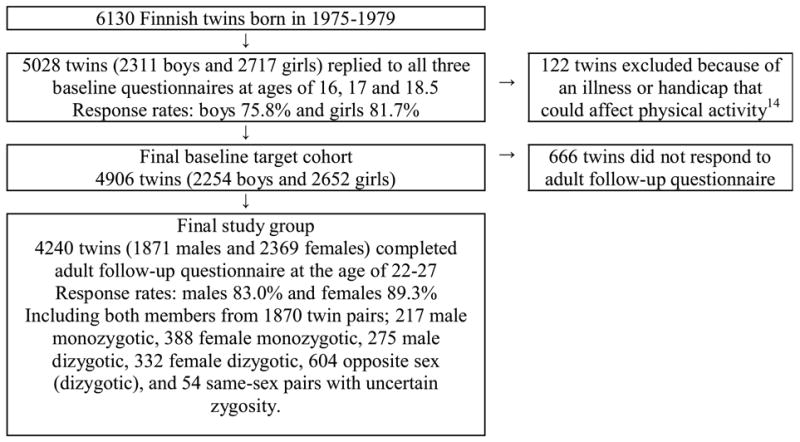
Participants: A total of 4240 individuals, including 1870 twin pairs. Findings In analyses of individual twins, compared to persistent activity, persistent physical inactivity predicted increased risk of daily smoking (age- and sex-adjusted odds ratio 5.53, 95% confidence interval 3.88-7.88, P < 0.001). The risk remained elevated even after excluding all those who had smoked 50 cigarettes or more life-time at baseline and adjusted for educational level in adolescence. In within-pair analyses compared to the active members of discordant twin pairs, the physically inactive co-twins had increased risk of future daily smoking (sex-adjusted odds ratio 3.39, 95% confidence interval 1.56-7.39, P = 0.002).
Conclusions: Persistent physical inactivity in adolescence relates to adult smoking, even after familial factors are taken into account.
Conflict of interest statement
Figures
Comment in
-
Does exercise in adolescence prevent smoking uptake?Addiction. 2007 Jul;102(7):1025-6. doi: 10.1111/j.1360-0443.2007.01919.x. Addiction. 2007. PMID: 17567383 No abstract available.
References
-
- Kujala UM, Kaprio J, Koskenvuo M. Modifiable risk factors as predictors of all-cause mortality: the roles of genetics and childhood environment. Am J Epidemiol. 2002;156:985–93. - PubMed
-
- US Department of Health and Human Services. Health Consequences of Smoking. Rockwille, MD: Public Health Service, Office on Smoking and Health; 2004.
-
- Escobedo L, Marcus S, Holtzman D, Giovino GA. Sports participation, age at smoking initiation, and the risk of smoking among US high school students. JAMA. 1993;269:1391–5. - PubMed
