


doi: 10.1128/JVI.00569-07.
Epub 2007 Jun 13.
Porcine arterivirus attachment to the macrophage-specific receptor sialoadhesin is dependent on the sialic acid-binding activity of the N-terminal immunoglobulin domain of sialoadhesin
Affiliations
- PMID: 17567703
- PMCID: PMC1951444
- DOI: 10.1128/JVI.00569-07
Item in Clipboard
Porcine arterivirus attachment to the macrophage-specific receptor sialoadhesin is dependent on the sialic acid-binding activity of the N-terminal immunoglobulin domain of sialoadhesin
J Virol.
2007 Sep.
Abstract
The sialic acid-binding lectin sialoadhesin (Sn) is a macrophage-restricted receptor for porcine reproductive and respiratory syndrome virus (PRRSV). To investigate the importance of pSn sialic acid-binding activity for PRRSV infection, an R(116)-to-E mutation was introduced in the predicted sialic acid-binding domain of pSn, resulting in a mutant, pSn(RE), that could not bind sialic acids. PSn, but not pSn(RE), allowed PRRSV binding and internalization. These data show that the sialic acid-binding activity of pSn is essential for PRRSV attachment to pSn and thus identifies the variable, N-terminal domain of Sn as a PRRSV binding domain.
Figures
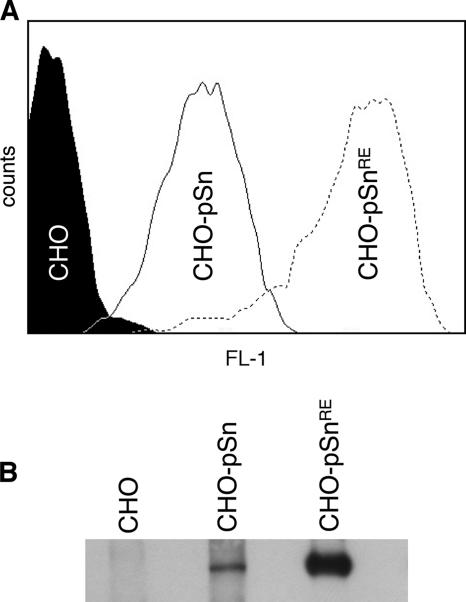
Analysis of porcine Sn expression in CHO cells expressing pSn (CHO-pSn) and CHO cells expressing a pSn with a mutation in the sialic acid-binding domain (CHO-pSnRE) by flow cytometric analysis (surface expression) (A) and Western blotting (total expression levels) (B). Histograms and Western blots are representative of three independent experiments.
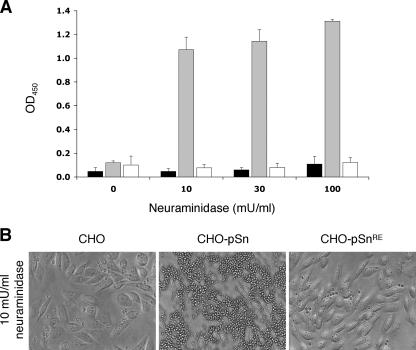
Analysis of the sialic acid-binding capacity of different CHO cell lines by a sheep red blood cell binding assay. (A) Parental CHO cells (black bars), CHO cells expressing pSn (CHO-pSn) (gray bars), or CHO cells expressing a pSn with a mutation in the sialic acid-binding domain (CHO-pSnRE) (white bars) were treated with different concentrations of neuraminidase and incubated with sheep red blood cells. Data are means ± standard deviations from three experiments. (B) Microscopic images of the cells described above.
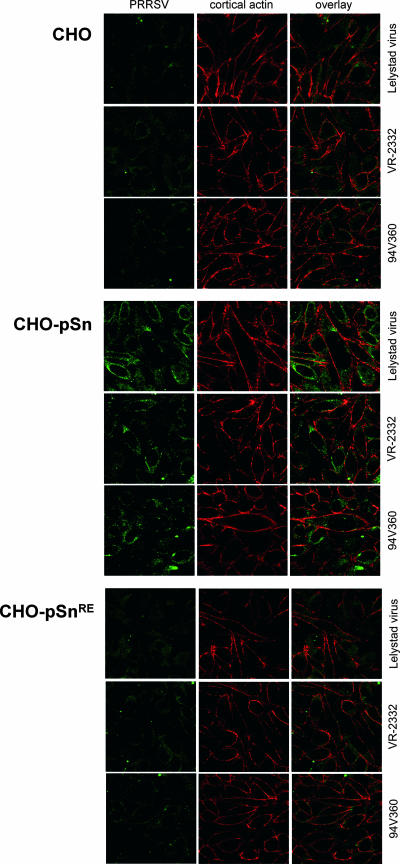
Confocal microscopic analysis of PRRSV attachment and internalization in CHO cells. PRRSV is stained green, cortical actin is stained red, and the overlay shows a superposition of the two images. Staining of the cortical actin, which lies just beneath the plasma membrane, allows discrimination of bound and internalized virus particles. The number of internalized PRRSV particles was analyzed with parental CHO cells, with CHO-pSn cells, which express recombinant porcine Sn, and with CHO-pSnRE cells, which express a mutant porcine Sn that lacks sialic acid-binding activity. Each image represents one confocal z-section through the middle of the cell.
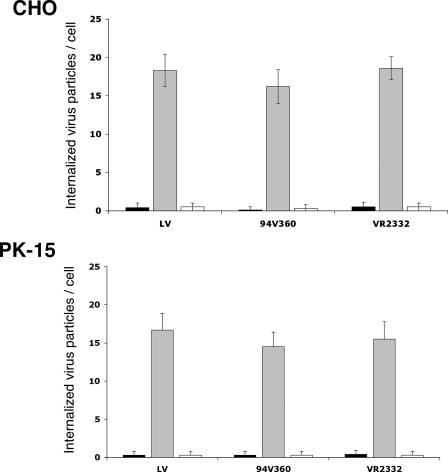
Quantification of PRRSV internalization in CHO and PK-15 cells. The number of internalized PRRSV particles was analyzed by confocal microscopy of parental cell lines (black bars), cells expressing pSn (gray bars), and cells expressing pSnRE (white bars). Data are means ± standard deviations from three experiments.
References
-
- Benfield, D. A., E. Nelson, J. E. Collins, L. Harris, S. M. Goyal, D. Robison, W. T. Christianson, R. B. Morrison, D. Gorcyca, and D. Chladek. 1992. Characterization of swine infertility and respiratory syndrome (SIRS) virus (isolate ATCC VR-2332). J. Vet. Diagn. Investig. 4:127-133. - PubMed
-
- Cafruny, W. A., R. G. Duman, G. H. Wong, S. Said, P. Ward-Demo, R. R. Rowland, and E. A. Nelson. 2006. Porcine reproductive and respiratory syndrome virus (PRRSV) infection spreads by cell-to-cell transfer in cultured MARC-145 cells, is dependent on an intact cytoskeleton, and is suppressed by drug-targeting of cell permissiveness to virus infection. Virol. J. 3:90. - PMC - PubMed
-
- Delputte, P. L., S. Costers, and H. J. Nauwynck. 2005. Analysis of porcine reproductive and respiratory syndrome virus attachment and internalization: distinctive roles for heparan sulphate and sialoadhesin. J. Gen. Virol. 86:1441-1445. - PubMed
Publication types
MeSH terms
Substances
LinkOut - more resources
Full Text Sources
Other Literature Sources
Molecular Biology Databases
