Promoting bicycle helmet wearing by children using non-legislative interventions: systematic review and meta-analysis
- PMID: 17567970
- PMCID: PMC2598365
- DOI: 10.1136/ip.2006.013441
Promoting bicycle helmet wearing by children using non-legislative interventions: systematic review and meta-analysis
Abstract
Objectives: To assess the effectiveness of non-legislative interventions in increasing bicycle helmet use among children and young people, and to identify possible reasons for differential effectiveness of interventions.
Design: Systematic review and meta-analysis.
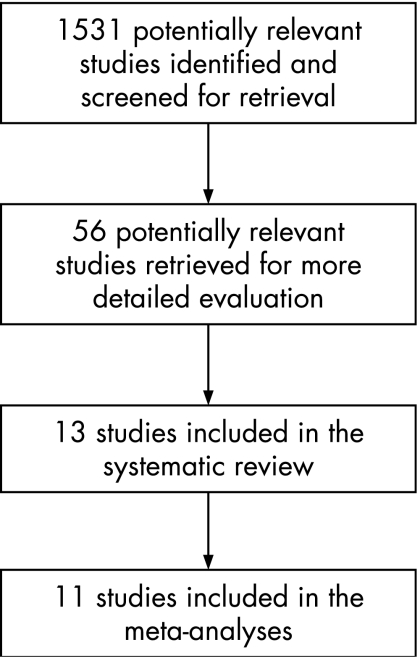
Data sources: 10 electronic databases were searched up to October 2006. Several other sources of potentially relevant information were identified and examined.
Review methods: We included randomized controlled trials, non-randomized controlled trials and controlled before-and-after studies of interventions to promote bicycle helmet use, which did not require the enactment of legislation. Participants were aged between 0 and 18 years.
Main outcome measure: Observed helmet wearing.
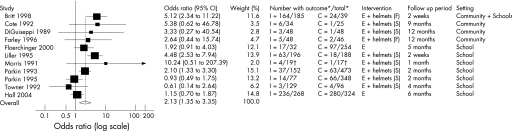
Results: 13 studies were included in the review and 11 in the meta-analysis. The odds of observed helmet wearing were significantly greater among children and young people in the intervention groups (OR 2.13, 95% CI 1.35 to 3.35). Subgroup analysis indicated that the effect might be greater for community-based studies (4.57, 2.37 to 8.81) and those providing free helmets (4.60, 2.25 to 9.43) than for those providing subsidized helmets (2.11, 1.09 to 4.06) and those set in schools (1.73, 1.04 to 2.89). Evidence for the effectiveness of the interventions was stronger in studies with follow-up periods of <or=6 months (2.23, 1.27 to 3.90) than in those with longer-term follow-up (1.63, 0.91 to 2.91).
Conclusions: Non-legislative interventions are effective in increasing bicycle helmet use among children and young people. Community-based helmet promotion programmes that include the provision of free helmets may increase observed helmet wearing to a greater extent than those set in schools or those providing subsidized helmets.
Conflict of interest statement
Competing interests: None.
References
-
- World Health Organization World report on roads traffic injury prevention. Geneva: World Health Organization, 2004
-
- Barnes G.The benefits of bicycling in Minnesota. Minnesota: Minnesota Department of Transportation Research Services Section, 2004
-
- Gill T.Cycling and children and young people: a review. London: National Children's Bureau, 2005
-
- Cody B E, Quraishi A Y, Mickalide A D.Headed for injury: an observational survey of helmet use among children ages 5 to 14 participating in wheeled sports. Washington, DC: National SAFE KIDS Campaign, 2004
Publication types
MeSH terms
LinkOut - more resources
Full Text Sources