


Suicide among male veterans: a prospective population-based study
- PMID: 17568055
- PMCID: PMC2465754
- DOI: 10.1136/jech.2006.054346
Suicide among male veterans: a prospective population-based study
Erratum in
- J Epidemiol Community Health. 2007 Aug;61(8):751
Abstract
Objectives: To assess the risk of mortality from suicide among male veteran participants in a large population-based health survey.
Design and setting: A prospective follow-up study in the US. Data were obtained from the US National Health Interview Surveys 1986-94 and linked to the Multiple Cause of Death file (1986-97) through the National Death Index.
Participants: The sample comprised 320 890 men, aged >/=18 years at baseline. The participants were followed up with respect to mortality for 12 years.
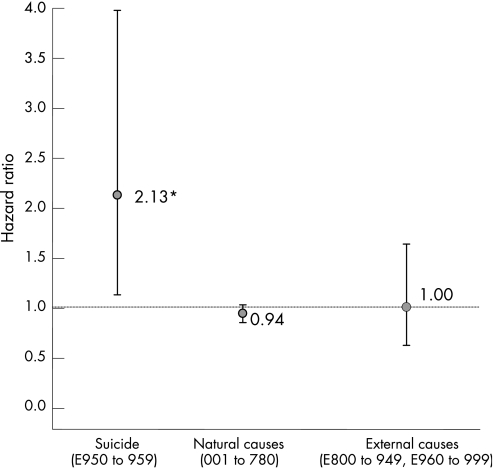
Results: Cox proportional hazards analysis showed that veterans who were white, those with >/=12 years of education and those with activity limitations (after adjusting for medical and psychiatric morbidity) were at a greater risk for completing suicide. Veterans were twice as likely (adjusted hazard ratio 2.13, 95% CI 1.14 to 3.99) [corrected] to die of suicide compared with non-veterans in the general population. The risk of death from "natural" causes (diseases) and the risk of death from "external" causes did not differ between the veterans and the non-veterans. Interestingly, male veterans who were overweight had a significantly lower risk of completing suicide than those who were of normal weight.
Conclusions: Veterans in the general US population, whether or not they are affiliated with the Department of Veterans Affairs (VA), are at an increased risk of suicide. With a projected rise in the incidence of functional impairment and psychiatric morbidity among veterans of the conflicts in Afghanistan and Iraq, clinical and community interventions that are directed towards patients in both VA and non-VA healthcare facilities are needed.
Conflict of interest statement
Competing interests: None.
References
-
- Goldsmith S K, Pellmar T C, Kleinman A M.et alReducing suicide: a national imperative. Washington, DC: National Academy Press, 2002, http://www.nap.edu/catalog/10398.html (accessed 26 Mar 2006) - PubMed
-
- Centers for Disease Control and Prevention, National Centers for Injury Prevention and Control Web‐based Injury Statistics Query and Reporting System (WISQARS) 2005. www.cdc.gov/ncipc/wisqars (accessed 26 Jan 2006)
-
- Desai R, Dausey D, Rosenheck R A. Mental health service delivery and suicide risk: the role of individual patient and facility factors. Am J Psychiatry 2005162311–318. - PubMed
-
- Lambert M T, Fowler D R. Suicide risk factors among veterans: risk management in the changing culture of the Department of Veterans Affairs. J Ment Health Adm 199724350–358. - PubMed
-
- Rosenheck R. Mental and substance use health services for veterans: experience with performance evaluation in the Department of Veterans Affairs. In: Institute of Medicine, ed. Improving the quality of health care for mental and substance‐use conditions: Quality Chasm Series. Washington, DC: National Academy Press, 2006;382–448, http://darwin.nap.edu/books/0309100445/html (accessed 26 Mar 2006)
Publication types
MeSH terms
Grants and funding
LinkOut - more resources
Full Text Sources
Medical
