


Enhanced sensitivity to stress and drug/alcohol craving in abstinent cocaine-dependent individuals compared to social drinkers
- PMID: 17568398
- PMCID: PMC2746372
- DOI: 10.1038/sj.npp.1301470
Enhanced sensitivity to stress and drug/alcohol craving in abstinent cocaine-dependent individuals compared to social drinkers
Abstract
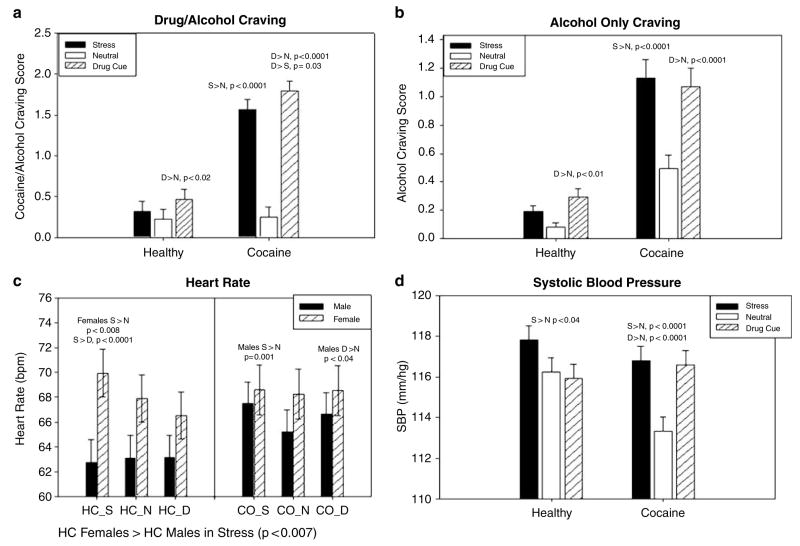
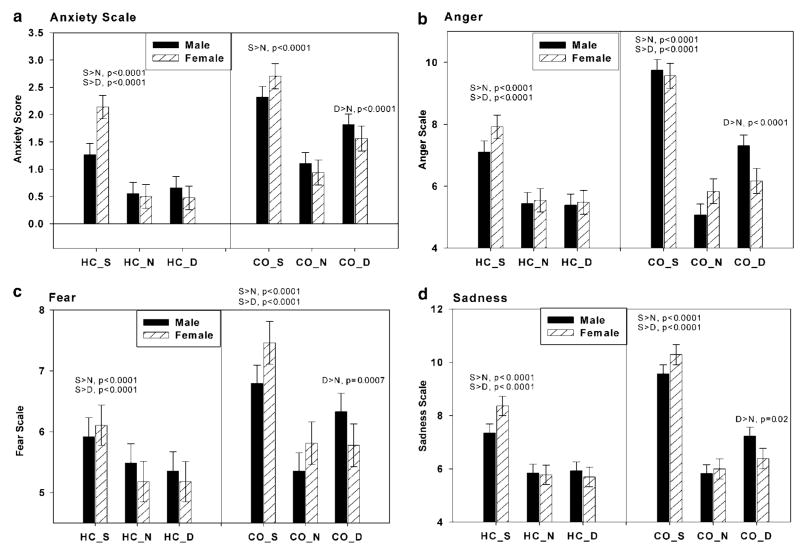
Chronic exposure to cocaine is associated with neuroadaptions in stress and reward circuits that may increase susceptibility to relapse. We examined whether there are alterations in stress response and craving in abstinent cocaine-dependent individuals compared with a demographically matched group of non-addicted socially drinking community controls. Forty treatment-engaged abstinent cocaine patients (17F/23M) and 40 controls (19F/21M) were exposed to a brief 5 min guided imagery of individually calibrated stressful situations, personal drug/alcohol-related situation and a neutral-relaxing situation, one imagery per session, presented in random order. Craving, anxiety, emotion rating scales, and physiological measures were assessed. Cocaine patients reported significantly higher and more persistent stress- and cue-induced drug/alcohol craving, negative emotions, and physiological responses compared with social drinkers. In cocaine patients, stress- and cue-induced drug craving was accompanied by increased anger, fear, sadness, heart rate, and SBP. Controls reported minimal stress-induced craving and only increases in anxiety and SBP during stress exposure. Cue-induced alcohol craving was accompanied only by an increase in relaxed state. Females reported increased stress-induced anxiety and sadness compared with males, while males were emotionally and physiologically more reactive in the cue condition. These findings are the first to document functional alterations in stress- and reward-related affect and physiology in recently abstinent cocaine patients that is marked by an enhanced sensitivity to stress- and drug-related cue exposure. These data suggest that recovery from chronic cocaine abuse could be hampered by a hyper-responsive stress- and drug-craving state that increases cocaine relapse susceptibility.
Conflict of interest statement
The authors declare that they have no competing financial interests.
Figures
References
-
- Ahmed SH, Koob GF. Transition to drug addiction: a negative reinforcement model based on an allostatic decrease in reward function. Psychopharmacology (Berl) 2005;180:473–490. - PubMed
-
- Avants SK, Margolin A, Kosten TR, Cooney NL. Differences between responders and nonresponders to cocaine cues in the laboratory. Addict Behav. 1995;20:215–224. - PubMed
-
- Back SE, Brady KT, Jackson JL, Salstrom S, Zinzow H. Gender differences in stress reactivity among cocaine-dependent individuals. Psychopharmacology (Berl) 2005;180:169–176. - PubMed
-
- Bernstein DP, Fink L. Childhood Trauma Questionnaire: A Retrospective Self-Report Manual. The Psychological Corporation; San Antonio, TX: 1998.
Publication types
MeSH terms
Grants and funding
LinkOut - more resources
Full Text Sources
Medical
