


Assessment of hepatic fibrosis in pediatric cases with hepatitis C virus in Egypt
- PMID: 17569121
- PMCID: PMC4395637
- DOI: 10.3748/wjg.v13.i20.2846
Assessment of hepatic fibrosis in pediatric cases with hepatitis C virus in Egypt
Abstract
Aim: To assess hepatic fibrosis and factors associated with its progression in children with HCV infection.
Methods: At the Hepatology Unit, Cairo University Children's Hospital, a single liver biopsy was performed to 43 children with HCV infection after an informed consent between 1998-2004. Their mean age at liver biopsy was 8.67 +/- 4.3 years.
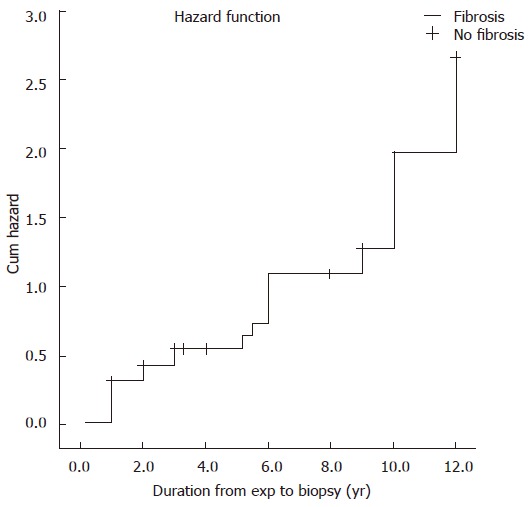
Results: Among the 43 patients' biopsies, 12 (27.9%) were having no fibrosis, 20 (46.5%) mild fibrosis and 11 (25.6%) moderate to severe fibrosis. The median time for development of fibrosis was estimated to be 5.5 years. Developing fibrosis was significantly associated with shorter duration from first detected ALT elevation to biopsy (12 mo vs 1.2 mo, P=0.015) and having higher levels of direct serum bilirubin (0.3 mg/dL vs 0.5 mg/dL, P=0.048). No association was found between fibrosis stage and the presence of co-morbid conditions (P=0.33).
Conclusion: Hepatic fibrosis was present in 72.1% of children with HCV infection. The development of fibrosis was associated with higher levels of direct serum bilirubin. There was no significant association between fibrosis and age, duration of infection, risk factors, co-morbid conditions and most biochemical parameters.
Figures
References
-
- Abdel-Wahab MF, Zakaria S, Kamel M, Abdel-Khaliq MK, Mabrouk MA, Salama H, Esmat G, Thomas DL, Strickland GT. High seroprevalence of hepatitis C infection among risk groups in Egypt. Am J Trop Med Hyg. 1994;51:563–567. - PubMed
-
- Chamberlain RW, Adams N, Saeed AA, Simmonds P, Elliott RM. Complete nucleotide sequence of a type 4 hepatitis C virus variant, the predominant genotype in the Middle East. J Gen Virol. 1997;78(Pt6):1341–1347. - PubMed
-
- WHO. Hepatitis C: global prevalence. Wkly Epidemiol Rec. 1997;72:341–344. - PubMed
-
- Poynard T, Bedossa P, Opolon P. Natural history of liver fibrosis progression in patients with chronic hepatitis C. The OBSVIRC, METAVIR, CLINIVIR, and DOSVIRC groups. Lancet. 1997;349:825–832. - PubMed
-
- Seeff LB. Natural history of hepatitis C. Hepatology. 1997;26:21S–28S. - PubMed
MeSH terms
Substances
LinkOut - more resources
Full Text Sources
Medical
