The impact of expansive arterial remodeling on clinical presentation in carotid artery disease: a multidetector CT angiography study
- PMID: 17569959
- PMCID: PMC2955285
- DOI: 10.3174/ajnr.A0508
The impact of expansive arterial remodeling on clinical presentation in carotid artery disease: a multidetector CT angiography study
Abstract
Background and purpose: Atherosclerotic arterial remodeling has been described in the coronary circulation but has not been studied extensively for carotid atherosclerosis. The purpose of our study was to examine the association between carotid artery remodeling and clinical presentation in patients with significant stenosis by using multidetector row CT (MDCT).
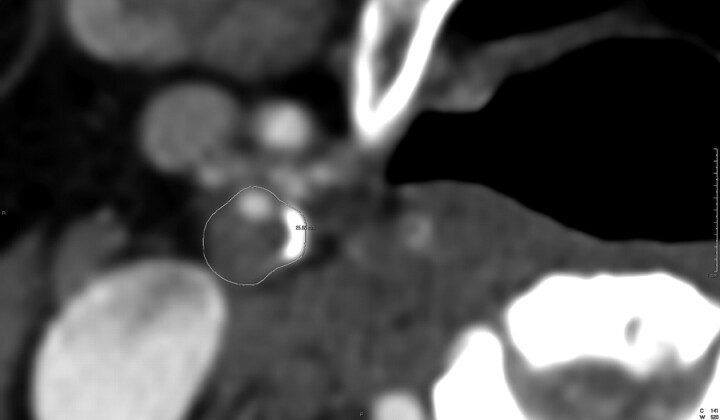
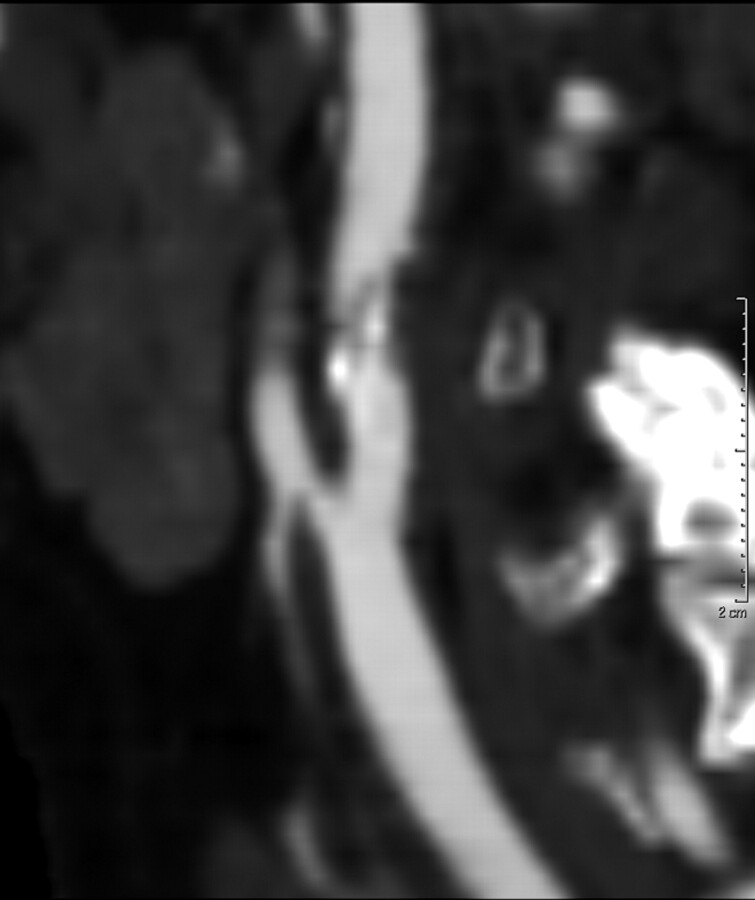
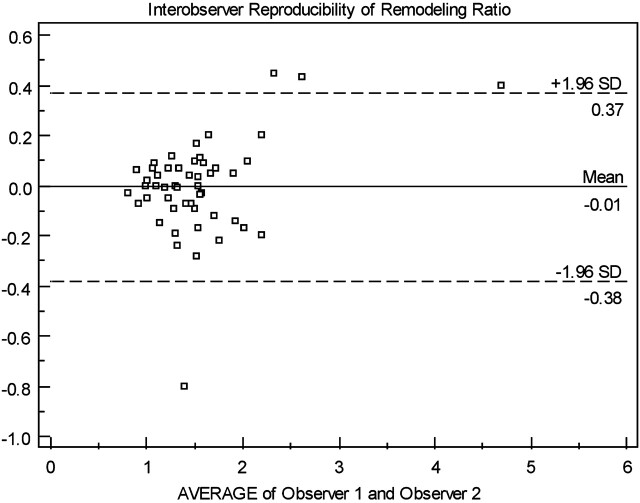
Materials and methods: One hundred eight patients with >or=50% stenosis (North American Symptomatic Carotid Endarterectomy Trial criteria) by MDCT angiography between January 2004 and June 2006 were identified. The study group included 37 symptomatic (65.9 +/- 13.0 years; 12 women; stenosis, 81.5 +/- 12.2%; 17 with stroke; 15 with transient ischemic attack; 5 with amaurosis fugax) and 71 asymptomatic patients (70.5 +/- 10.5 years; 28 women; stenosis, 78.8 +/- 11.1%). Remodeling ratio (RR) was calculated by dividing the outer vessel circumference at the site of greatest stenosis by a normal reference-segment vessel circumference. Maximum vessel thickness (MxVT) and eccentricity index (EI) of the plaque, defined as maximal thickness/minimal thickness at the site of greatest luminal narrowing, were also determined. Data were analyzed by using an independent t test.
Results: The RR was significantly higher in symptomatic patients (1.64 +/- 0.44) than in asymptomatic patients (1.41 +/- 0.5) (P=.02). There was no significant difference in MxVT in symptomatic (5.9 +/- 2.1 mm) and asymptomatic patients (5.6 +/- 2.4 mm) (P=.45) and no significant difference in EI (symptomatic, 4.7 +/- 2.7; asymptomatic, 4.3 +/- 2.2; P=.38).
Conclusion: In this series of subjects with significant internal carotid artery stenosis, expansive carotid remodeling was significantly greater in patients with cerebral ischemic symptoms than in asymptomatic patients. The extent of expansive remodeling may indicate underlying atherosclerotic plaque vulnerability. MDCT has a role in the evaluation of carotid artery disease beyond examining luminal stenosis.
Figures
References
-
- Beneficial effect of carotid endarterectomy in symptomatic patients with high-grade carotid stenosis: North American Symptomatic Carotid Endarterectomy Trial Collaborators. N Engl J Med 1991;325:445–53 - PubMed
-
- Endarterectomy for asymptomatic carotid artery stenosis: Executive Committee for the Asymptomatic Carotid Atherosclerosis Study. JAMA 1995;273:1421–28 - PubMed
-
- Falk E, Shah PK, Fuster V. Coronary plaque disruption. Circulation 1995;92:657–71 - PubMed
-
- Fuster V. Elucidation of the role of plaque instability and rupture in acute coronary events. Am J Cardiol 1995;76:24C–33C - PubMed
MeSH terms
Grants and funding
LinkOut - more resources
Full Text Sources
Other Literature Sources
Medical