Plagiorchis muris infection in Apodemus agrarius from northern Gyeonggi-do (Province) near the demilitarized zone
- PMID: 17570981
- PMCID: PMC2526306
- DOI: 10.3347/kjp.2007.45.2.153
Plagiorchis muris infection in Apodemus agrarius from northern Gyeonggi-do (Province) near the demilitarized zone
Abstract
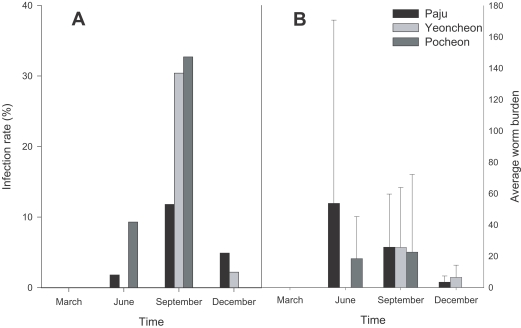
The small intestines of 6 species of rodents and 1 species of insectivore were examined seasonally for Plagiorchis muris infection in 3 different localities in northern Gyeonggi-do (Province), near the demilitarized zone (DMZ). A total of 1,496 animals, including 1,366 Apodemus agrarius, 54 Crocidura lasiura (insectivore), 32 Mus musculus, 28 Micronytus fortis, 9 Eothenomys regulus, 6 Micronys minutus, and 3 Cricetulus triton, were live-trapped at Yeoncheon-gun (n = 351), Paju-shi (804) and Pocheon-gun (343) at 3-mo intervals from December 2004 to September 2005. A total of 1,647 P. muris were collected from 72 (5.3%) A. agrarius. The infection rate was the highest in Pocheon-gun (8.2%), followed by Yeoncheon-gun (5.0%) and Paju-shi (4.2%). A higher infection rate was observed in A. agrarius captured during September (19.4%) than those captured during December (3.0%), June (2.6%), or April (0%). However, the worm burden was the highest in June (av. 32.1/animal), followed by September (24.7), December (4.0), and April (0). None of the other animal species were found infected with P. muris. The results reveal that A. agrarius is a natural definitive host for P. muris, and infection rates and worm burdens vary seasonally and geographically.
Figures
References
-
- Asada JI, Otagaki H, Morita M, Takeuchi T, Sakai Y, Konoshi T, Okahashi K. A case report on the human infection with Plagiorchis muris Tanabe, 1922 in Japan. Jap J Parasitol. 1962;11:512–516.
-
- Hong SJ, Ahn JH, Woo HC. Plagiorchis muris: recovery, growth and development in albino rats. J Helminthol. 1998;72:215–256. - PubMed
-
- Hong SJ, Woo HC, Chai JY. A human case of Plagiorchis muris (Tanabe, 1922: Digenea) infection in the Republic of Korea: freshwater fish as a possible source of infection. J Parasitol. 1996;82:647–649. - PubMed
Publication types
MeSH terms
LinkOut - more resources
Full Text Sources
Miscellaneous