. 2007 Jul;39(7):914-21.
doi: 10.1038/ng2045. Epub 2007 Jun 17.

Tissue-specific and reversible RNA interference in transgenic mice

Affiliations

Tissue-specific and reversible RNA interference in transgenic mice

Ross A Dickins et al. Nat Genet. 2007 Jul.

Abstract

Genetically engineered mice provide powerful tools for understanding mammalian gene function. These models traditionally rely on gene overexpression from transgenes or targeted, irreversible gene mutation. By adapting the tetracycline (tet)-responsive system previously used for gene overexpression, we have developed a simple transgenic system to reversibly control endogenous gene expression using RNA interference (RNAi) in mice. Transgenic mice harboring a tet-responsive RNA polymerase II promoter driving a microRNA-based short hairpin RNA targeting the tumor suppressor Trp53 reversibly express short hairpin RNA when crossed with existing mouse strains expressing general or tissue-specific 'tet-on' or 'tet-off' transactivators. Reversible Trp53 knockdown can be achieved in several tissues, and restoring Trp53 expression in lymphomas whose development is promoted by Trp53 knockdown leads to tumor regression. By leaving the target gene unaltered, this approach permits tissue-specific, reversible regulation of endogenous gene expression in vivo, with potential broad application in basic biology and drug target validation.


Figures
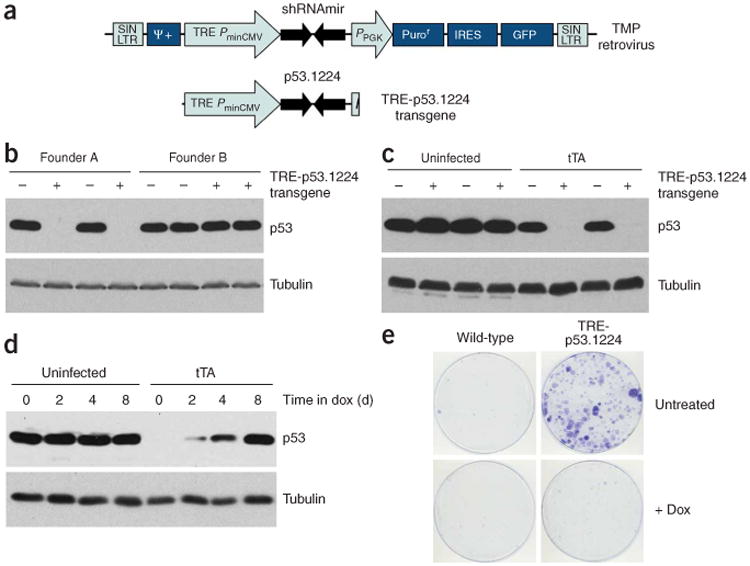
Figure 1
Figure 1
Germline transmission of a functional TRE-p53.1224 cassette. (a) Diagram of the TRE-p53.1224 transgene, derived from the TMP-p53.1224 retroviral vector. (b) Trp53 protein blot of MEFs of indicated TRE-p53.1224 genotype (+ indicates transgenic) isolated from two different TRE-p53.1224 founder lines (A and B), infected with tTA. Note that Trp53 knockdown is only observed in line A. (c) Trp53 protein blot of MEFs of indicated TRE-p53.1224 genotype, either infected with tTA (right) or uninfected (left). (d) Trp53 protein blot of TRE-p53.1224 transgenic MEFs infected with tTA and cultured in doxycycline (Dox) for various periods. Uninfected controls are shown. (e) Colony formation assay for TRE-p53.1224 transgenic and nontransgenic littermate MEFs infected with tTA, plated at low density and cultured with or without doxycycline.
Figure 2
Figure 2
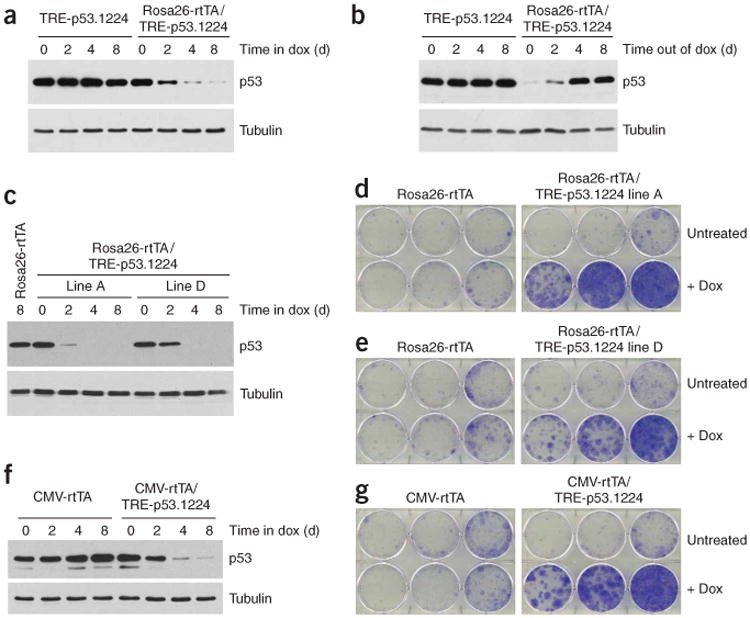
Transgenic tet-transactivators can drive Trp53 knockdown in MEFs. (a) Time course of Trp53 knockdown in Rosa26-rtTA/TRE-p53.1224 double-transgenic MEFs in response to doxycycline (Dox) treatment. (b) Time course of Trp53 re-expression in Rosa26-rtTA/TRE-p53.1224 double-transgenic MEFs that were cultured in doxycycline for 8 d and then shifted to normal medium at day 0. (c) Time course of Trp53 knockdown in Rosa26-rtTA/TRE-p53.1224 (from TRE-p53.1224 founder lines A and D) double-transgenic MEFs in response to doxycycline treatment. Littermate control doxycycline-treated Rosa26-rtTA MEFs are also shown. (d) Colony formation assay for Rosa26-rtTA/TRE-p53.1224 (founder line A) MEFs plated at low density and cultured with or without doxycycline. Littermate control Rosa26-rtTA MEFs are also shown. (e) As in d, but for TRE-p53.1224 founder line D. (f) Tme course of Trp53 knockdown in CMV-rtTA/TRE-p53.1224 double-transgenic MEFs in response to doxycycline treatment. Littermate control doxycycline-treated CMV-rtTA MEFs are also shown. (g) Colony formation assay for CMV-rtTA/TRE-p53.1224 MEFs plated at low density and cultured with or without doxycycline. Littermate control CMV-rtTA MEFs are also shown.
Figure 3
Figure 3
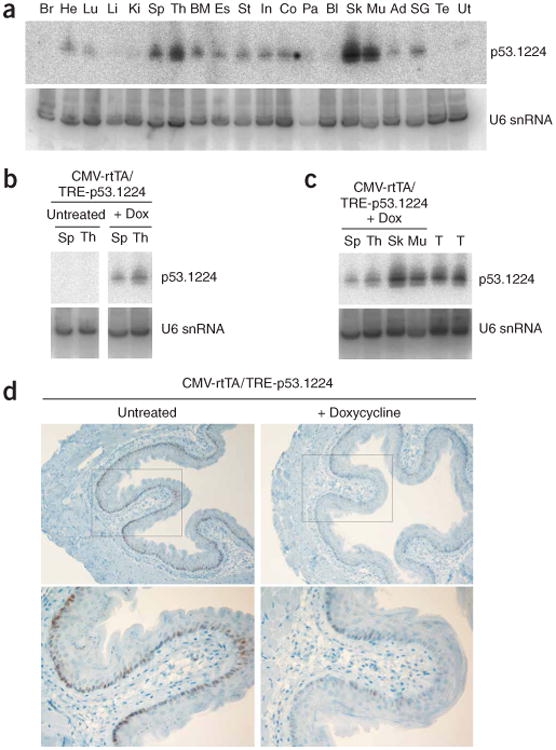
CMV-rtTA drives widespread and functional p53.1224 shRNA expression. (a) Small RNA blot showing expression of p53.1224 siRNA in tissues of doxycycline (Dox)-treated CMV-rtTA/TRE-p53.1224 double-transgenic mice. Br, brain; He, heart; Lu, lung; Li, liver; Ki, kidney; Sp, spleen; Th, thymus; BM, bone marrow; Es, esophagus; St, stomach; In, small intestine; Co, colon; Pa, pancreas; Bl, bladder; Sk, skin; Mu, muscle; Ad, adipose tissue; SG, salivary gland; Te, testis; Ut, uterus. U6 small nuclear (sn) RNA is shown as a loading control. (b) Small RNA blot showing induction of p53.1224 siRNA by doxycycline in spleen and thymus of CMV-rtTA/TRE-p53.1224 double-transgenic mice. Left and right panels are derived from the same blot. (c) Small RNA blot comparing p53.1224 siRNA expression in tissues of doxycycline-treated CMV-rtTA/TRE-p53.1224 double-transgenic mice with control tumor samples (T) in which Trp53 knockdown is known to drive tumor growth. (d) Trp53 immunohistochemistry of esophagi isolated from untreated (left) or doxycycline-treated (right) CMV-rtTA/TRE-p53.1224 double-transgenic mice, 6 h after 6 Gy of whole-body ionizing radiation. Note attenuated Trp53 expression in cells of the basal layer of the esophageal epithelium in doxycycline-treated double-transgenic mice.
Figure 4
Figure 4
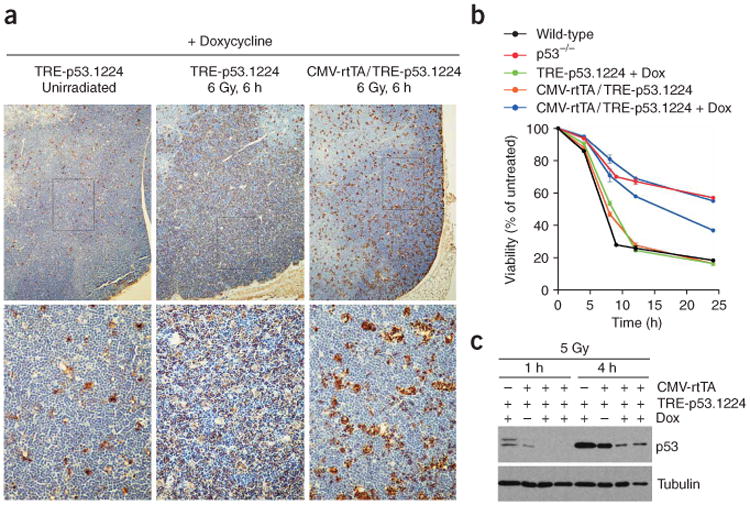
Trp53 knockdown protects thymocytes from radiation-induced apoptosis in vivo. (a) Representative TUNEL staining of thymi isolated from doxycycline (Dox)-treated mice, 6 h after 6 Gy of whole-body ionizing radiation. Note widespread apoptosis in the thymus of a control TRE-p53.1224 mouse (center) compared with a CMV-rtTA/TRE-p53.1224 double-transgenic thymus (right). A control, unirradiated TRE-p53.1224 thymus (left) is also shown. (b) Time course showing viability of cultured thymocytes after 5 Gy of ionizing radiation.Each line represents average viability ± s.e.m.from triplicate samples from a single mouse, normalized to unirradiated samples from the same animal. Black, wild-type; red, Trp53-null; green, doxycycline (Dox)-treated TRE-p53.1224 mice; orange, untreated CMV-rtTA/TRE-p53.1224 mice; blue, doxycycline-treated CMV-rtTA/TRE-p53.1224 mice. (c) Trp53 protein blot of cultured thymocytes after 5 Gy of ionizing radiation. Note substantial Trp53 knockdown in thymocytes derived from two doxycycline-treated CMV-rtTA/TRE-p53.1224 mice.
Figure 5
Figure 5
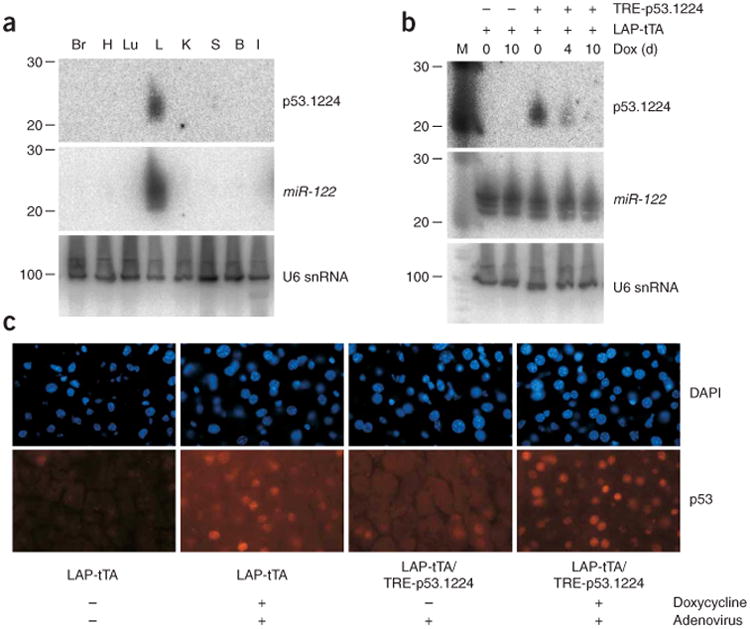
Liver-specific Trp53 knockdown in LAP-tTA/TRE-p53.1224 mice. (a) p53.1224 small RNA blot for various tissues isolated from LAP-tTA/TRE-p53.1224 double-transgenic mice. The blot was stripped and reprobed for the liver-specific microRNA miR-122. U6 snRNA is shown as a loading control. Br, brain; H, heart; Lu, lung; L, liver; K, kidney; S, spleen; B, bone marrow; I, small intestine. (b) p53.1224 small RNA blot of livers isolated from LAP-tTA/TRE-p53.1224 double-transgenic mice and LAP-tTA single transgenic controls. Mice were given doxycycline (Dox) for the indicated amounts of time before livers were harvested. miR-122 and U6 snRNA abundance is also shown. (c) Trp53 immuno-fluorescence (IF) in livers isolated from untreated or doxycycline-treated LAP-tTA/TRE-p53.1224 double-transgenic mice and LAP-tTA single transgenic controls. Trp53 was induced in the liver by injection of adenovirus into the tail vein, as indicated.
Figure 6
Figure 6
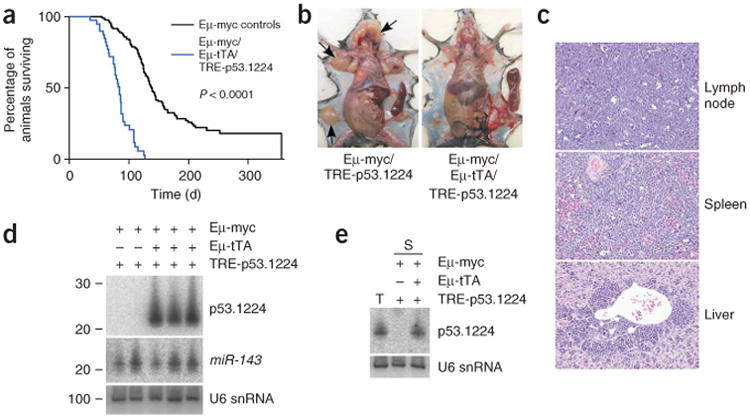
Tissue-specific Trp53 knockdown accelerates Eμ-Myc lymphomagenesis. (a) Kaplan-Meier curves showing decreased survival of Eμ-Myc/Eμ-tTA/TRE-p53.1224 triple-transgenic mice (blue; median survival 82 d) compared with their collective double transgenic (Eμ-Myc/Eμ-tTA and Eμ-Myc/TRE-p53.1224) and single Eμ-Myc transgenic littermates (black; median survival 125 d), referred to as Eμ-Myc controls. (b) Gross anatomy of a representative Eμ-Myc/Eμ-tTA/TRE-p53.1224 triple-transgenic mouse (right) alongside an Eμ-Myc/TRE-p53.1224 control (left). Spleens have been dissected out for visualization. In the control (left), note massive lymph node enlargement (arrows) characteristic of spontaneously arising tumors in Eμ-Myc mice, compared with the grossly enlarged spleen but relatively small peripheral lymph nodes in the Eμ-Myc/Eμ-tTA/TRE-p53.1224 mouse. (c) Histopathology of lymph node, spleen and liver harvested from a representative moribund Eμ-Myc/Eμ-tTA/TRE-p53.1224 mouse. Sections are stained with hematoxylin and eosin (H&E). Note similar appearance of lymph node, spleen and perivascular areas of the liver, all packed with lymphoma cells. (d) p53.1224 small RNA blot of spleens isolated from moribund Eμ-Myc/Eμ-tTA/TRE-1224 triple-transgenic mice, with double-transgenic controls. (e) Small RNA blot showing similar p53.1224 siRNA abundance in lymphoma-laden triple-transgenic spleen (S) compared with a positive control tumor sample (T), derived from transformed MEFs in which Trp53 knockdown is known to drive tumor growth.
Figure 7
Figure 7
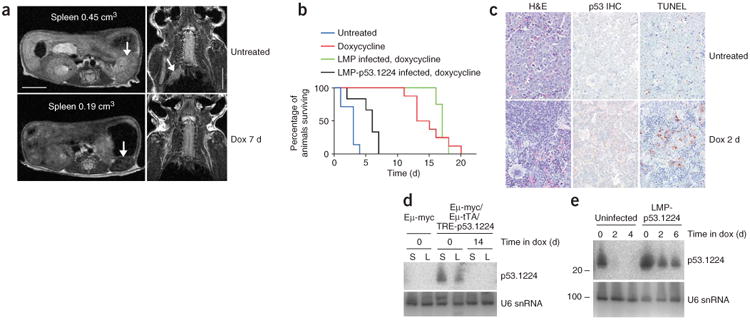
Restoring Trp53 expression in tumors causes apoptosis and regression. (a) MRI of a primary Eμ-Myc/Eμ-tTA/TRE-p53.1224 triple-transgenic mouse, before and after 7 d of doxycycline (Dox) treatment. Left: transverse sections through abdomen (arrows indicate spleen). Right: coronal sections through upper thoracic region (arrow indicates enlarged mediastinal lymph nodes). Scale bars represent 0.5 cm. (b) Kaplan-Meier survival curve for mice transplanted with Eμ-Myc/Eμ-tTA/TRE-p53.1224 lymphoma cells. For all mice, time zero was when disease first became evident (partial hind leg paralysis); mice were killed when moribund. Blue, untreated. Red, doxycycline-treated. Green, mice transplanted with triple-transgenic cells infected with LMP empty vector and treated with doxycycline. Black, mice transplanted with triple-transgenic cells infected with LMP-p53.1224 and treated with doxycycline. (c) H&E staining, Trp53 immunohistochemistry (IHC) and apoptosis in spleens from Eμ-Myc/Eμ-tTA/TRE-p53.1224 lymphoma cell transplant recipients, either without treatment or after 2 d on doxycycline. (d) p53.1224 small RNA blot analysis of spleens (S) and lymph nodes (L) from Eμ-Myc/Eμ-tTA/TRE-p53.1224 lymphoma cell transplant recipients, either without treatment or after 14 d on doxycycline. (e) p53.1224 small RNA blot analysis of spleens from mice receiving transplants of Eμ-Myc/Eμ-tTA/TRE-p53.1224 lymphoma cells, either uninfected or infected with LMP-p53.1224, and treated with doxycycline for various times.

References

    1. Capecchi MR. Gene targeting in mice: functional analysis of the mammalian genome for the twenty-first century. Nat Rev Genet. 2005;6:507–512. - PubMed
    1. Glaser S, Anastassiadis K, Stewart AF. Current issues in mouse genome engineering. Nat Genet. 2005;37:1187–1193. - PubMed
    1. Lewandoski M. Conditional control of gene expression in the mouse. Nat Rev Genet. 2001;2:743–755. - PubMed
    1. Sage J, Miller AL, Perez-Mancera PA, Wysocki JM, Jacks T. Acute mutation of retinoblastoma gene function is sufficient for cell cycle re-entry. Nature. 2003;424:223–228. - PubMed
    1. Loonstra A, et al. Growth inhibition and DNA damage induced by Cre recombinase in mammalian cells. Proc Natl Acad Sci USA. 2001;98:9209–9214. - PMC - PubMed

Publication types