. 2007 Jun 26;104(26):10986-91.
doi: 10.1073/pnas.0703766104. Epub 2007 Jun 15.

Rice-based mucosal vaccine as a global strategy for cold-chain- and needle-free vaccination

Affiliations

Rice-based mucosal vaccine as a global strategy for cold-chain- and needle-free vaccination

Tomonori Nochi et al. Proc Natl Acad Sci U S A. .

Abstract

Capable of inducing antigen-specific immune responses in both systemic and mucosal compartments without the use of syringe and needle, mucosal vaccination is considered ideal for the global control of infectious diseases. In this study, we developed a rice-based oral vaccine expressing cholera toxin B subunit (CTB) under the control of the endosperm-specific expression promoter 2.3-kb glutelin GluB-1 with codon usage optimization for expression in rice seed. An average of 30 mug of CTB per seed was stored in the protein bodies, which are storage organelles in rice. When mucosally fed, rice seeds expressing CTB were taken up by the M cells covering the Peyer's patches and induced CTB-specific serum IgG and mucosal IgA antibodies with neutralizing activity. When expressed in rice, CTB was protected from pepsin digestion in vitro. Rice-expressed CTB also remained stable and thus maintained immunogenicity at room temperature for >1.5 years, meaning that antigen-specific mucosal immune responses were induced at much lower doses than were necessary with purified recombinant CTB. Because they require neither refrigeration (cold-chain management) nor a needle, these rice-based mucosal vaccines offer a highly practical and cost-effective strategy for orally vaccinating large populations against mucosal infections, including those that may result from an act of bioterrorism.


Conflict of interest statement

The authors declare no conflict of interest.

Figures

Fig. 1.
Fig. 1.
Expression of CTB in transgenic rice. (A) T-DNA plasmid-inserted, codon-optimized CTB gene for rice seed, controlled by the rice seed storage protein glutelin 2.3-kb GluB-1 promoter. The signal sequence of GluB-1 and the retention signal to the endoplasmic reticulum coding KDEL are located at the N- and C-terminal regions, respectively. (B) The Kitaake and Hosetsu dwarf type rice strains expressed CTB in a closed chamber. (C) Integration of the CTB gene into the genomic DNA was confirmed by PCR. WT, Wild-type nontransgenic rice; Tg, CTB-expressed transgenic rice. (D) Northern blot analysis was performed for the confirmation of CTB mRNA expression. (E and F) SDS/PAGE and Western blot analysis revealed that high levels of CTB protein were expressed in rice. Arrowheads indicate 12- and 15-kDa forms of CTB (E). The CTB protein, composed of two fragments, forms a 55- to 65-kDa pentamer structure under nonreducing conditions. Arrows indicate monomeric (under reducing condition) and pentamer (under nonreducing condition) forms of CTB (F).
Fig. 2.
Fig. 2.
Localization and digestive enzyme resistivity of rice-expressed CTB in PBs. (A) Data obtained through immunoelectron microscopic analysis with anti-CTB antibody. A positive signal was obtained with 20 nm of gold particles. CTB expressed in rice are stored in PB-I (arrowheads) and PB-II (arrows). (B) Pepsin digestion was carried out under the conditions described in Materials and Methods. Approximately 90% of glutelins but not 13k prolamins were digested in vitro, whereas ≈75% of rice-based CTB but not purified rCTB remained intact.
Fig. 3.
Fig. 3.
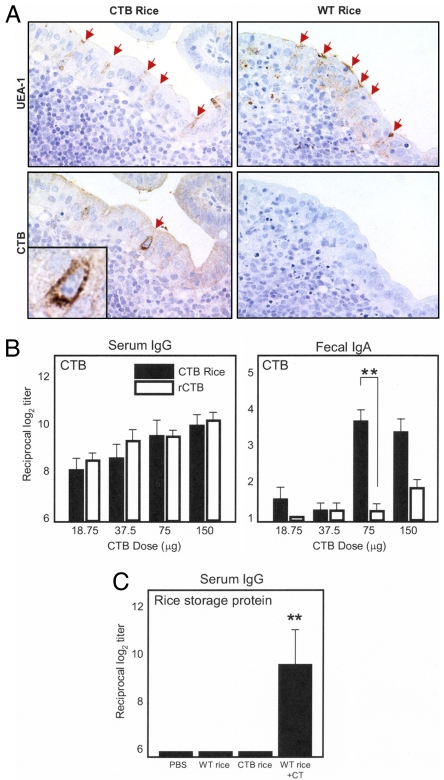
Effective uptake of rice-expressed CTB by M cells for the induction of antigen-specific immune responses. (A) Rice-expressed CTB was administered into an intestinal loop containing PPs. Thirty minutes after the inoculation, the brisk CTBs were taken up by UEA-1-positive M cells (arrow), but not columnar epithelial cells. (B) When mice were orally immunized with rice-expressed CTB, purified rCTB, or nontransgenic rice dissolved in water or water alone as controls, equal levels of CTB-specific serum IgG responses were induced in mice immunized with rice-expressed CTB or purified rCTB, but not in mice receiving WT rice or water alone. In contrast, CTB-specific fecal IgA responses were also induced in mice immunized with a small amount (50 mg of seed powder containing 75 μg of CTB) of rice-expressed CTB, but not with an identical dose of purified rCTB. ∗∗, P < 0.01, CTB rice vs. rCTB. (C) Rice-expressed CTB did not induce rice storage protein-specific serum IgG responses. ∗∗, P < 0.01, WT rice plus CT vs. CTB rice.
Fig. 4.
Fig. 4.
Temperature stability of rice-expressed CTB. (A) One thousand rice seeds expressing CTB were preserved in a 500-ml sealed bottle for >1.5 years at 4°C as well as at RT (25°C). The content of CTB in preserved rice was not changed compared to that in freshly harvested rice (29 ± 4 μg per seed). (B) Mice were orally immunized with preserved rice-expressed CTB (50 mg of seed powder containing 75 μg of CTB) as described in Fig. 3. The preserved rice induced CTB-specific mucosal IgA responses that were comparable to those observed for freshly harvested rice.
Fig. 5.
Fig. 5.
Induction of protective immunity against CT by rice-expressed CTB. (A) The neutralizing index calculated with OD450 obtained by GM1-ELISA. The serum of mice immunized with rice-expressed CTB or purified rCTB, but not with nontransgenic rice or PBS, completely blocked the binding of CT to coated GM1-ganglioside. ∗∗, P < 0.01, CTB rice or rCTB vs. PBS. (B) The elongation assay with CHO cells revealed a morphology similar to normal cells (1) when the cells were stimulated with CT pretreated with serum from mice immunized with rice-expressed CTB (2) or purified rCTB (3), but a marked elongation when stimulated by CT pretreated with the serum from mice immunized with nontransgenic rice, PBS, or nontreated CT (4) as shown by the arrows. (C) In contrast to mice receiving WT rice or PBS, mice orally vaccinated with rice-expressed CTB showed no symptoms of diarrhea and a low level of intestinal water. ∗, P < 0.05, CTB rice or rCTB vs. PBS.

Comment in

  • Vaccines are for dinner.
    Pascual DW. Pascual DW. Proc Natl Acad Sci U S A. 2007 Jun 26;104(26):10757-8. doi: 10.1073/pnas.0704516104. Epub 2007 Jun 20. Proc Natl Acad Sci U S A. 2007. PMID: 17581867 Free PMC article. Review. No abstract available.

References

    1. Watanabe I, Hagiwara Y, Kadowaki SE, Yoshikawa T, Komase K, Aizawa C, Kiyono H, Takeda Y, McGhee JR, Chiba J, et al. Vaccine. 2002;20:3443–3455. - PubMed
    1. Bukreyev A, Lamirande EW, Buchholz UJ, Vogel LN, Elkins WR, St Claire M, Murphy BR, Subbarao K, Collins PL. Lancet. 2004;363:2122–2127. - PMC - PubMed
    1. Belyakov IM, Hel Z, Kelsall B, Kuznetsov VA, Ahlers JD, Nacsa J, Watkins DI, Allen TM, Sette A, Altman J, et al. Nat Med. 2001;7:1320–1326. - PubMed
    1. Czerkinsky C, Anjuere F, McGhee JR, George-Chandy A, Holmgren J, Kieny MP, Fujiyashi K, Mestecky JF, Pierrefite-Carle V, Rask C, Sun JB. Immunol Rev. 1999;170:197–222. - PMC - PubMed
    1. Kiyono H, Fukuyama S. Nat Rev Immunol. 2004;4:699–710. - PMC - PubMed

Publication types