


doi: 10.1128/AAC.01588-06.
Epub 2007 Jun 18.
Molecular characterization of Staphylococcus aureus isolates from a 2005 clinical trial of uncomplicated skin and skin structure infections
Affiliations
- PMID: 17576829
- PMCID: PMC2043172
- DOI: 10.1128/AAC.01588-06
Item in Clipboard
Molecular characterization of Staphylococcus aureus isolates from a 2005 clinical trial of uncomplicated skin and skin structure infections
Antimicrob Agents Chemother.
2007 Sep.
Abstract
A clinical trial of uncomplicated skin and skin structure infections (39 locations in 19 states) observed that community-associated or community-onset methicillin-resistant Staphylococcus aureus (CO-MRSA) represented 23% of all pathogens at baseline culture and 53% of 190 S. aureus isolates. CO-MRSA strains typically were Panton-Valentine leukocidin (PVL) positive (95%), contained staphylococcal cassette chromosome mec type IVa (99%), were USA300 or USA400 clones (92%), and exhibited minimal coresistances (macrolides and/or fluoroquinolones). Clinical results remained identical (89% cures) regardless of the antimicrobial used or CO-MRSA molecular patterns, PVL production, or antimicrobial susceptibility profiles.
Figures
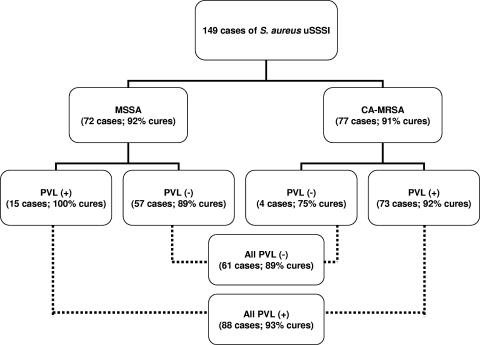
Clinical response results for 149 evaluable cases of S. aureus uSSSI treated with either cefdinir or cephalexin that were characterized by susceptibility to oxacillin (methicillin) and PVL production. CA-MRSA, community-acquired MRSA (6).
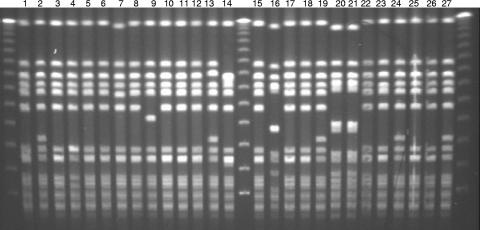
Typical PFGE patterns of CO-MRSA uSSSI clinical trial strains showing dominant USA300 (lanes 1 to 13, 15, 17 to 19, and 22 to 27) and USA400 (lanes 16, 20, and 21) clonal patterns (18).
References
-
- Centers for Disease Control and Prevention. 1999. Four pediatric deaths from community-acquired methicillin-resistant Staphylococcus aureus—Minnesota and North Dakota, 1997-1999. Morb. Mortal. Wkly. Rep. 48:707-710. - PubMed
-
- Chambers, H. F. 2005. Community-associated MRSA—resistance and virulence converge. N. Engl. J. Med. 352:1485-1487. - PubMed
-
- Clinical and Laboratory Standards Institute. 2006. Methods for dilution antimicrobial susceptibility tests for bacteria that grow aerobically, 7th ed. Approved standard M7-A7. CLSI, Wayne, PA.
-
- Clinical and Laboratory Standards Institute. 2006. Performance standards for antimicrobial susceptibility testing. 16th informational supplement, M100-S16. CLSI, Wayne, PA.
-
- Fridkin, S. K., J. C. Hageman, M. Morrison, L. T. Sanza, K. Como-Sabetti, J. A. Jernigan, K. Harriman, L. H. Harrison, R. Lynfield, and M. M. Farley. 2005. Methicillin-resistant Staphylococcus aureus disease in three communities. N. Engl. J. Med. 352:1436-1444. - PubMed
Publication types
MeSH terms
Substances
LinkOut - more resources
Full Text Sources
Medical
