


doi: 10.1128/AAC.00137-07.
Epub 2007 Jun 18.
Pneumococcal LytA autolysin, a potent therapeutic agent in experimental peritonitis-sepsis caused by highly beta-lactam-resistant Streptococcus pneumoniae
Affiliations
- PMID: 17576844
- PMCID: PMC2043201
- DOI: 10.1128/AAC.00137-07
Item in Clipboard
Pneumococcal LytA autolysin, a potent therapeutic agent in experimental peritonitis-sepsis caused by highly beta-lactam-resistant Streptococcus pneumoniae
Antimicrob Agents Chemother.
2007 Sep.
Abstract
The in vitro and in vivo antipneumococcal activities of the main pneumococcal autolysin (LytA) and Cpl-1, a lysozyme encoded by phage Cp-1, were studied. Intraperitoneal therapy with LytA or high-dose Cpl-1 remarkably reduced peritoneal bacterial counts (>5 log(10) CFU/ml) compared with those for the controls. After intravenous injection, LytA was the most effective treatment.
Figures
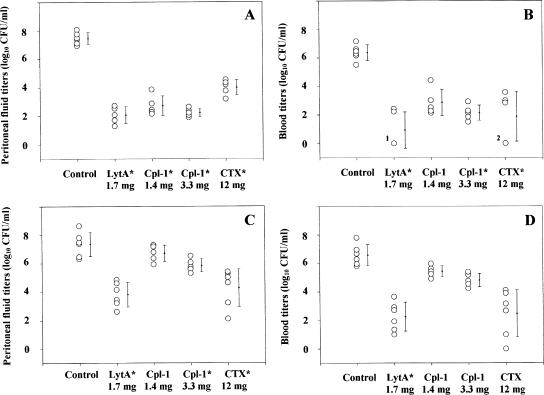
Antipneumococcal activities in the peritoneal fluid (A and C) and in the blood (B and D) of lytic enzymes or CTX 4 h after administration by the i.p. (A and B) or i.v. (C and D) route in mice with β-lactam-resistant S. pneumoniae peritonitis-sepsis. Each point represents one mouse; five to six animals were included in each group; the mean ± standard deviation for each group is also shown. In panel B, the label 1 indicates that three animals treated with LytA i.p. showed bacterial clearance from the blood and the label 2 indicates that two animals treated with CTX i.p. also showed bacterial clearance from the blood. *, statistically significant difference compared to the results for the control.
References
-
- Fischetti, V. A. 2005. Bacteriophage lytic enzymes: novel anti-infectives. Trends Microbiol. 13:491-496. - PubMed
-
- López, R., C. Ronda, and E. García. 1990. Autolysins are direct involved in the bactericidal effect caused by penicillin in wild type and in tolerant pneumococci. FEMS Microbiol. Lett. 66:317-322. - PubMed
Publication types
MeSH terms
Substances
LinkOut - more resources
Full Text Sources
Other Literature Sources
Medical
Miscellaneous
