


Smoking during teenage pregnancies: effects on behavioral problems in offspring
- PMID: 17577803
- PMCID: PMC2593871
- DOI: 10.1080/14622200701416971
Smoking during teenage pregnancies: effects on behavioral problems in offspring
Abstract
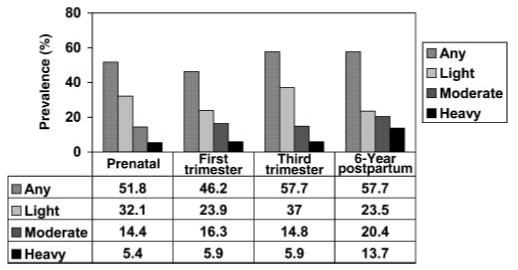
We prospectively examined the relationship between prenatal tobacco exposure (PTE) and child behavior in a birth cohort of 357 offspring of teenage mothers. PTE was defined as any exposure across pregnancy and, in separate analyses, exposure within each trimester. Outcomes included measures of behavior problems, activity, and attention. On average, the children were 6.4 years of age, 48% were females, and 69% were Black. Data on maternal tobacco and other substance use were collected prenatally and postnatally: 46% of the mothers smoked in the first trimester and 58% smoked 6 years later. Child urinary cotinine measured exposure to environmental tobacco smoke (ETS). Stepwise multiple regressions were run. PTE predicted significantly increased offspring activity; impulsivity; and aggression, externalizing, and total behavior problems in step 1. PTE remained a significant predictor of increased activity when maternal psychological characteristics, home environment, and ETS were added. The results were similar when PTE was examined by trimesters, although later pregnancy tobacco exposure predicted the most behavioral outcomes. In the final model, PTE (all three trimesters) and PTE (second trimester) were significant predictors of increased activity and attention problems, respectively. Other predictors of child behavior included maternal anxiety, depression, hostility, and home environment. ETS was not a significant predictor of child behavior when PTE was considered. Smoking during pregnancy among adolescents is a significant predictor of increased activity and attention problems in their offspring after controlling for covariates in the prenatal and current environments. Smoking cessation interventions are recommended for this population to avoid the effects of PTE on the offspring of pregnant adolescents. This is particularly important because these mothers will likely become pregnant again and many will increase their level of tobacco use as they mature.
Figures
References
-
- Achenbach TM. Manual for the Child Behavior Checklist/4-18 and 1991 profile. University of Vermont Department of Psychiatry; Burlington, VT: 1991.
-
- Ackerman B, Kogos J, Youngstrom E, Schoff K, Izard C. Family instability and the problem behaviors of children from economically disadvantaged families. Developmental Psychology. 1999;35:258–268. - PubMed
-
- Ajarem JS, Ahmad M. Prenatal nicotine exposure modifies behavior of mice through early development. Pharmacology, Biochemistry, and Behavior. 1998;59:313–318. - PubMed
-
- Arnold E, Elliot M, Lindsay R, Molina B, Cornelius M, Vitiello B, Hechtman L, Elliot G, Newcorn J, Epstein J, Wigal T, Swanson J, Wells K. Gestational and postnatal tobacco smoke exposure as predictor of ADHD, comorbid ODD/CD, and treatment response in the MTA. Journal of Clinical Neuroscience Research. 2005;5:295–306.
-
- Atluri P, Fleck M, Shen Q, Mah S, Stadfelt D, Barnes W, Goderie S, Temple S, Schneider A. Functional nicotinic acetylcholine receptors expression in stem and progenitor cells of the early embryonic mouse cerebral cortex. Developmental Biology. 2001;240:143–156. - PubMed
Publication types
MeSH terms
Substances
Grants and funding
LinkOut - more resources
Full Text Sources
Medical
