


Control of graft-versus-host disease with maintenance of the graft-versus-leukemia effect in a murine allogeneic transplant model using retrovirally transduced murine suicidal lymphocytes
- PMID: 17577932
- PMCID: PMC4075062
- DOI: 10.1016/j.exphem.2007.02.008
Control of graft-versus-host disease with maintenance of the graft-versus-leukemia effect in a murine allogeneic transplant model using retrovirally transduced murine suicidal lymphocytes
Abstract
Objective: Limited clinical trials have validated the hypothesis of controlling graft-versus-host disease (GVHD) arising from stem cell transplant utilizing suicidal T-lymphocytes that have been transduced to express the HSV-TK gene. However, clinical utility has been limited by diminished T-cell function arising from the production process. To evaluate strategies for harnessing the graft-versus-leukemia (GVL) effect while improving the safety and function of suicidal lymphocytes, we have developed techniques to produce fully functional, retrovirally transduced, HSV-TK-positive murine T cells (TK+TC).
Methods: Utilizing a murine major histocompatibility complex-matched transplant model, we evaluated the ability of TK+TC to generate a GVL effect and the ability to control GVHD in experiments where we varied the dose of TK+TC, ganciclovir (GCV) dose, the start of GCV administration (day 4, 7, 10, 13, 15, or 19) posttransplantation, and the GCV administration route (osmotic pump versus intraperitoneal).
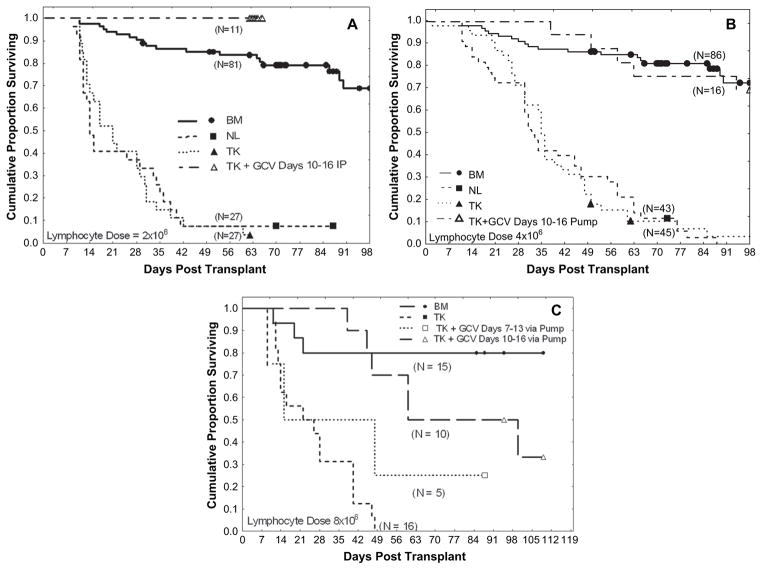
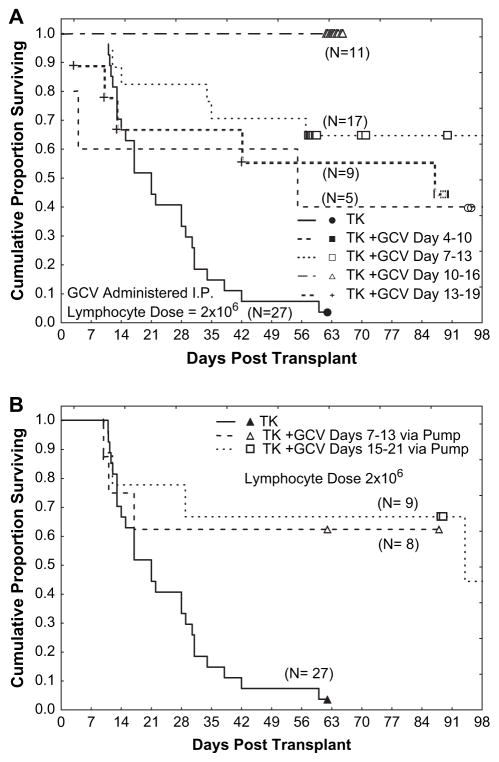
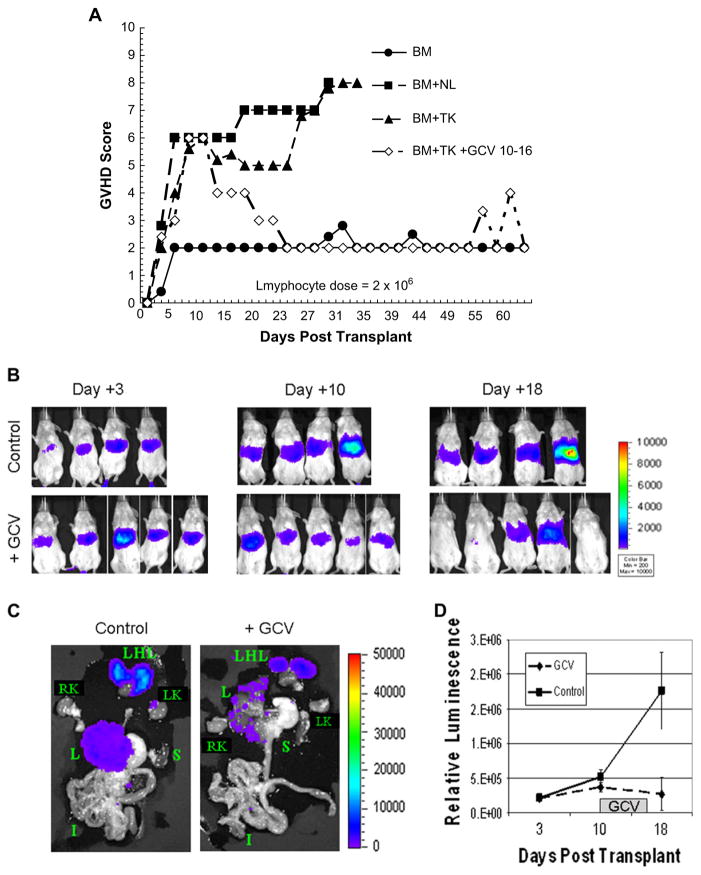
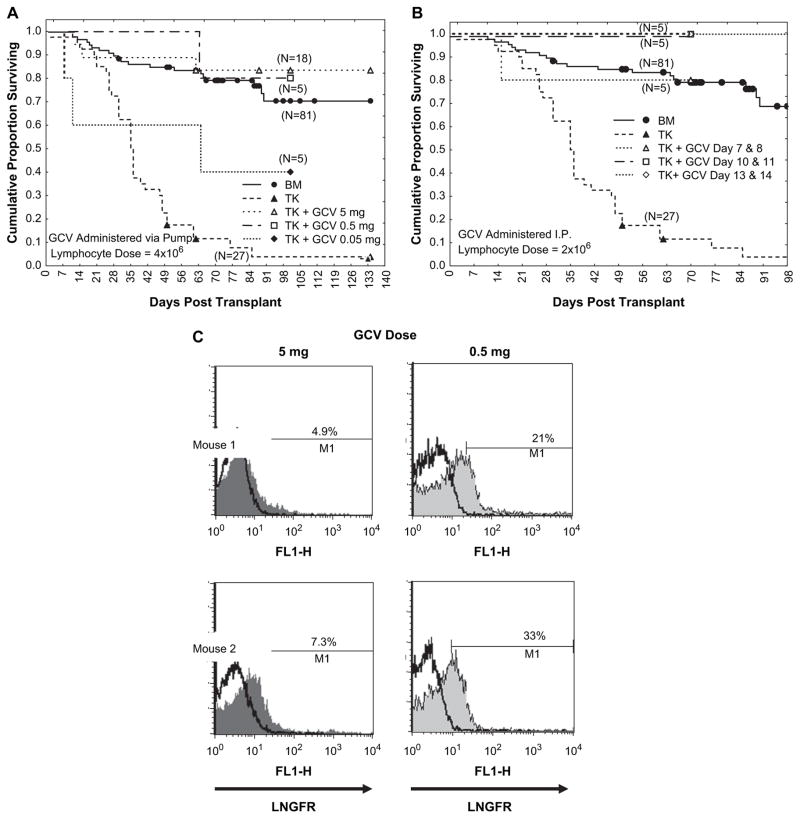
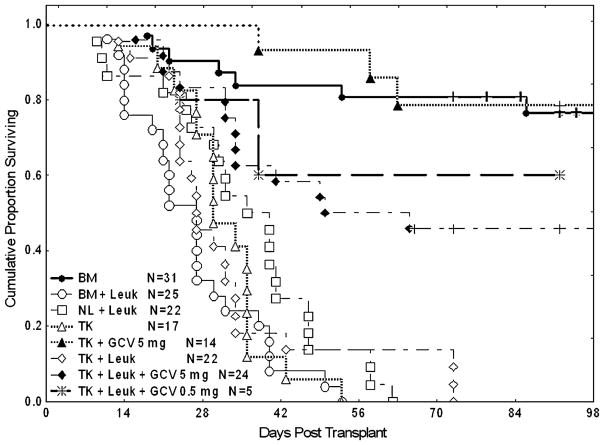
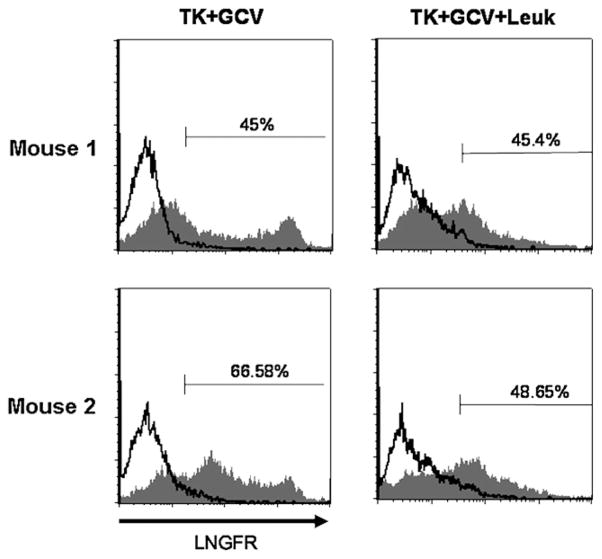
Results: At TK+TC doses in excess of the standard lethal dose (SLD) of unmanipulated T-cells, GCV administration completely (2 x SLD) and partially (4 x SLD) controlled GVHD. Additionally, GVHD remained reversible despite delaying administration of GCV for a week after GVHD developed. Importantly, GVHD was controlled with a 1-log but not 2-log reduction in GCV dose, and this "partial suicide" preserved more circulating TK+TC compared with standard-dose GCV. Survival of leukemia-positive mice receiving TK+TC and GCV was significantly increased compared with control cohorts not receiving GCV or transplanted with unmanipulated T cells, thereby demonstrating a GVL effect.
Conclusion: Retrovirally transduced suicidal lymphocytes generate a potent GVL effect while simultaneously enabling control of GVHD, which results in improved leukemia and GVHD-free survival.
Figures
References
-
- Biggs JC, Horowitz MM, Gale RP, et al. Bone marrow transplants may cure patients with acute leukemia never achieving remission with chemotherapy. Blood. 1992;80:1090–1093. - PubMed
-
- Sullivan KM. Graft-versus-host-disease. In: Thomas ED, Blume KG, Forman SJ, editors. Hematopoietic Cell Transplantation. 2. Oxford: Blackwell Science; 1999. pp. 515–536.
-
- Papadopoulos EB, Carabasi MH, Castro-Malaspina H, et al. T-cell-depleted allogeneic bone marrow transplantation as postremission therapy for acute myelogenous leukemia: freedom from relapse in the absence of graft-versus-host disease. Blood. 1998;91:1083–1090. - PubMed
-
- Sadelain M, Riviere I. Sturm und drang over suicidal lymphocytes. Mol Ther. 2002;5:655–657. - PubMed
-
- Bonini C, Ferrari G, Verzeletti S, et al. HSV-TK gene transfer into donor lymphocytes for control of allogeneic graft-versus-leukemia. Science. 1997;276:1719–1724. - PubMed
Publication types
MeSH terms
Substances
Grants and funding
LinkOut - more resources
Full Text Sources
Medical
