Review
. 2007:76:387-417.
doi: 10.1146/annurev.biochem.75.103004.142819.

TRP channels

Affiliations
Review

TRP channels

Kartik Venkatachalam et al. Annu Rev Biochem. 2007.

Abstract

The TRP (Transient Receptor Potential) superfamily of cation channels is remarkable in that it displays greater diversity in activation mechanisms and selectivities than any other group of ion channels. The domain organizations of some TRP proteins are also unusual, as they consist of linked channel and enzyme domains. A unifying theme in this group is that TRP proteins play critical roles in sensory physiology, which include contributions to vision, taste, olfaction, hearing, touch, and thermo- and osmosensation. In addition, TRP channels enable individual cells to sense changes in their local environment. Many TRP channels are activated by a variety of different stimuli and function as signal integrators. The TRP superfamily is divided into seven subfamilies: the five group 1 TRPs (TRPC, TRPV, TRPM, TRPN, and TRPA) and two group 2 subfamilies (TRPP and TRPML). TRP channels are important for human health as mutations in at least four TRP channels underlie disease.


Figures
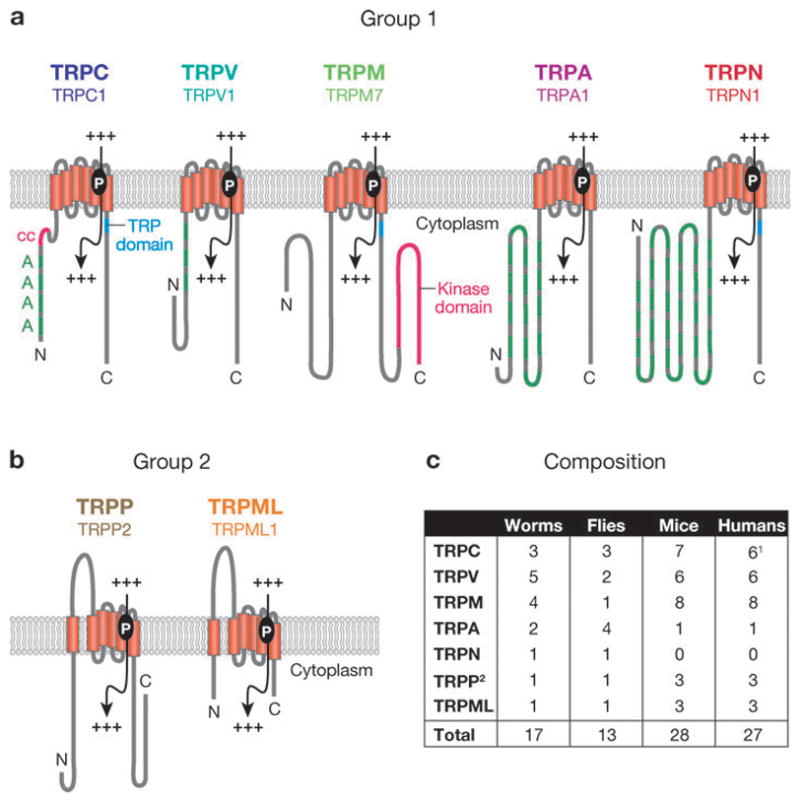
Figure 1
Figure 1
The TRP superfamily. (a) Single members from each of the five group 1 subfamilies. (b) Single members from each of the two group 2 subfamilies. The following domains are indicated: A, ankyrin repeats; cc, coiled-coil domain; protein kinase domain; TRP domain. Also shown are transmembrane segments (vertical rectangles) and pore loop (P), allowing the passage of cations (+++). (c) Composition of the TRP superfamily in worms, flies, mice, and humans. 1Human TRPC2 is a pseudogene and is not counted. 2TRPP1-like proteins are not counted. Modified and reprinted with permission from Reference .
Figure 2
Figure 2
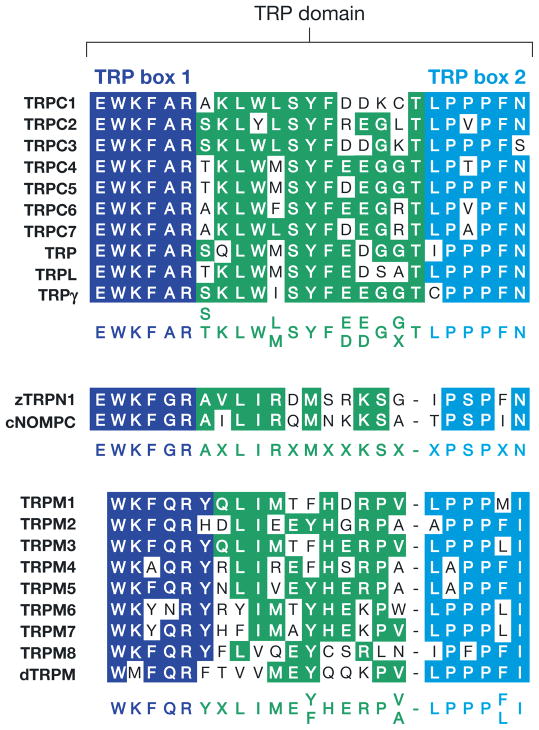
The TRP domain. Highly conserved region of 23–25 amino acids C-terminal to the transmembrane domains in TRPCs, TRPNs, and TRPMs. TRP box 1 is invariant in TRPCs, and variations of TRP box 1 are also present in TRPNs and TRPMs. The TRP box 2 is a proline-rich region. Sequences are from mammals, except zTRPN1 is from zebrafish; cNOMPC is from Caenorhabditis elegans; and TRP, TRPL, TRPγ, and dTRPM are from Drosophila.
Figure 3
Figure 3
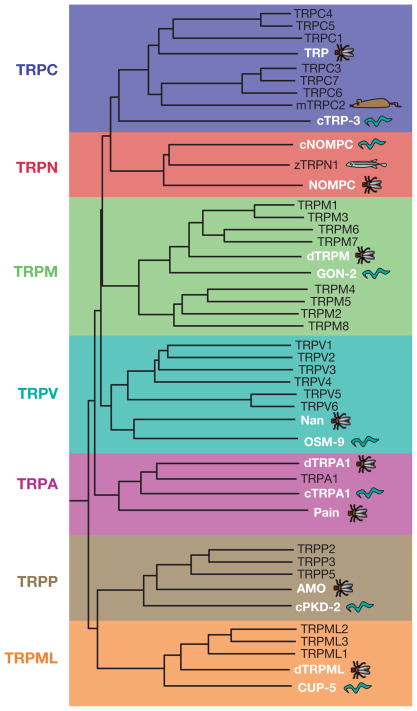
Phylogenetic tree showing the relatedness of the TRP proteins. The dendrogram of vertebrate TRPs includes mostly human TRPs, except for mouse TRPC2 (cartoon of a mouse) and zebrafish TRPN1 (cartoon of a zebrafish). White text and cartoons highlight the TRP proteins from worms and flies. One C. elegans and one Drosophila member of each subfamily are included.

References

    1. Montell C. Sci STKE. 2005;2005:re3. - PubMed
    1. Palmer CP, Zhou XL, Lin J, Loukin SH, Kung C, Saimi Y. Proc Natl Acad Sci USA. 2001;98:7801–5. - PMC - PubMed
    1. Denis V, Cyert MS. J Cell Biol. 2002;156:29–34. - PMC - PubMed
    1. Montell C, Rubin GM. Neuron. 1989;2:1313–23. - PubMed
    1. Montell C, Birnbaumer L, Flockerzi V. Cell. 2002;108:595–98. - PubMed

Publication types

MeSH terms

LinkOut - more resources