


Shedding and reversion of oral polio vaccine type 3 in Mexican vaccinees: comparison of mutant analysis by PCR and enzyme cleavage to a real-time PCR assay
- PMID: 17581940
- PMCID: PMC1951214
- DOI: 10.1128/JCM.02268-06
Shedding and reversion of oral polio vaccine type 3 in Mexican vaccinees: comparison of mutant analysis by PCR and enzyme cleavage to a real-time PCR assay
Abstract
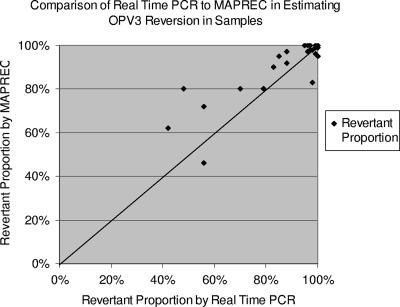
A uracil-to-cytosine mutation at nucleotide position 472 of oral poliovirus vaccine type 3 (OPV3) contributes to the development of vaccine-associated paralytic poliomyelitis (VAPP). To analyze OPV3 shedding patterns, we previously used the multistep method of mutant analysis by PCR and enzyme cleavage (MAPREC). This involves conventional reverse transcription-PCR to detect OPV3, followed by a restriction digest to quantify position 472 reversion. Real-time PCR detects and quantifies nucleic acid as PCR occurs and avoids postreaction processing. The goal of this study was to compare a real-time PCR method to MAPREC. Seventy-three stool samples from Mexican OPV recipients underwent the reverse transcription-PCR step of MAPREC and real-time PCR. Real-time PCR identified 23% more OPV3-positive samples than conventional reverse transcription-PCR. When reversion was compared, the revertant proportion (RP), defined as the percentage of revertants in a sample, differed by < or =10% in 21/25 (84%) samples. The four samples differing by >10% were obtained within 5 days of OPV administration. The real-time PCR assay identified samples with an RP of > or =85% with 94% sensitivity and 86% specificity compared to MAPREC. The mean difference in RP between the two methods was 3.6% (95% confidence interval, -0.3 to 7.5%). Real-time PCR methods reliably detect OPV3, and reversion estimates correlate more consistently with MAPREC when OPV3 reversion rates are high. Detecting VAPP-related mutations by real-time PCR is rapid and efficient and can be useful in monitoring ongoing global polio eradication efforts.
Figures
References
-
- Blume, S., and I. Geesink. 2000. A brief history of polio vaccines. Science 288:1593-1594. - PubMed
-
- Bustin, S. A. 2002. Quantification of mRNA using real-time reverse transcription PCR (RT-PCR): trends and problems. J. Mol. Endocrinol. 29:23-39. - PubMed
-
- Centers for Disease Control and Prevention. 2001. Acute flaccid paralysis associated with circulating vaccine-derived poliovirus—Philippines, 2001. Morb. Mortal. Wkly. Rep. 50:874-875. - PubMed
Publication types
MeSH terms
Substances
LinkOut - more resources
Full Text Sources
