


Myofibre damage in human skeletal muscle: effects of electrical stimulation versus voluntary contraction
- PMID: 17584833
- PMCID: PMC2277245
- DOI: 10.1113/jphysiol.2007.128827
Myofibre damage in human skeletal muscle: effects of electrical stimulation versus voluntary contraction
Abstract
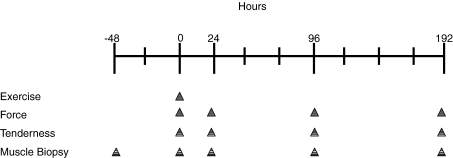
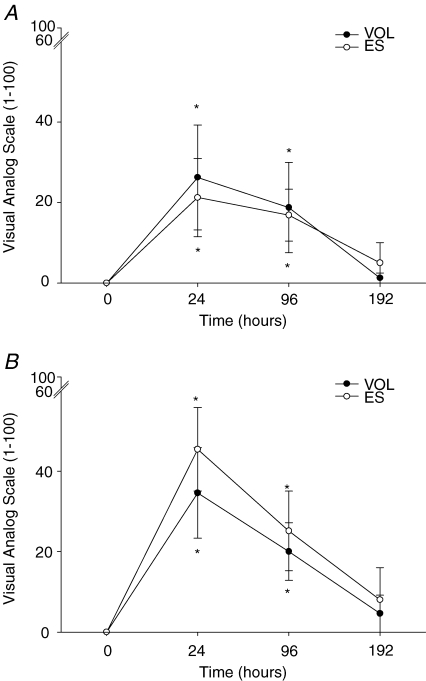
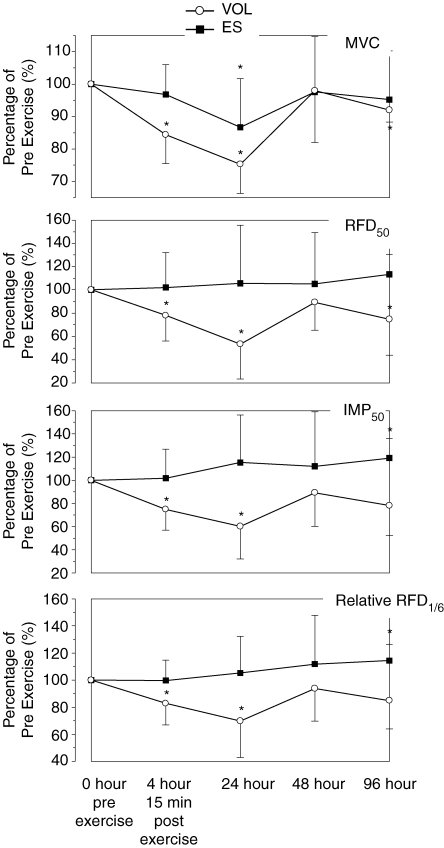
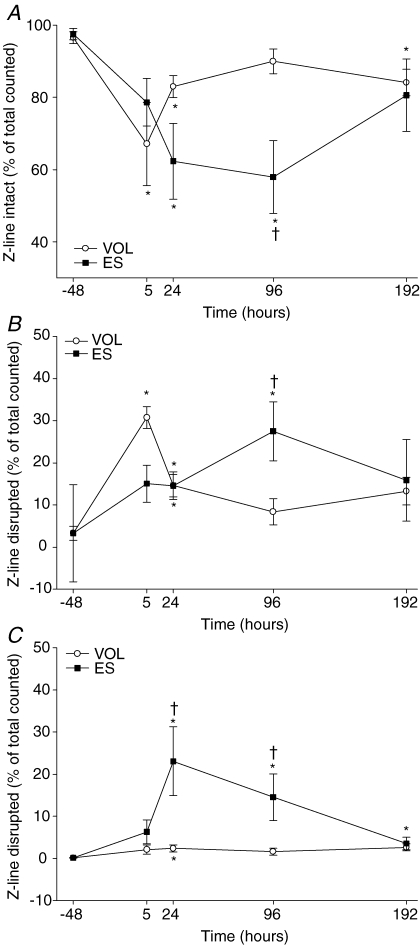
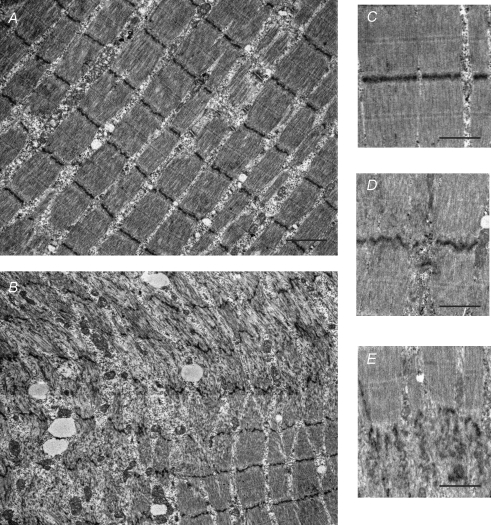
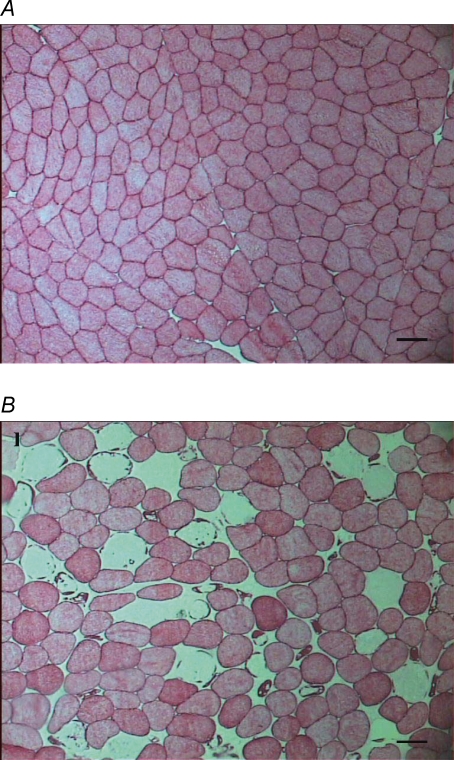
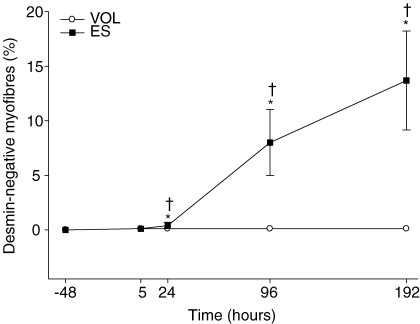
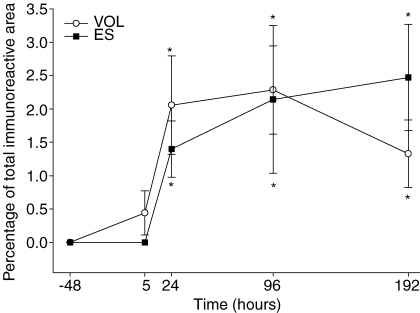
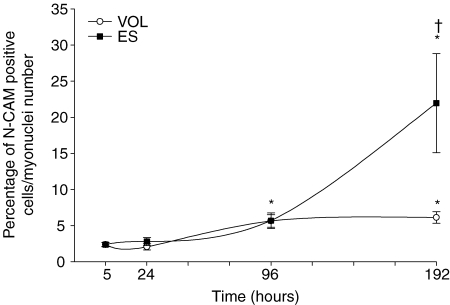
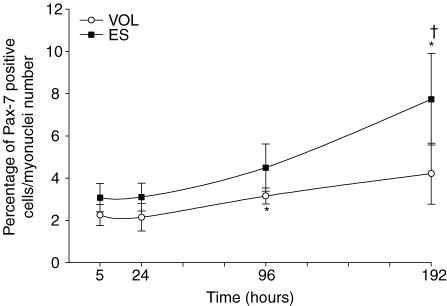
Disruption to proteins within the myofibre after a single bout of unaccustomed eccentric exercise is hypothesized to induce delayed onset of muscle soreness and to be associated with an activation of satellite cells. This has been shown in animal models using electrical stimulation but not in humans using voluntary exercise. Untrained males (n=8, range 22-27 years) performed 210 maximal eccentric contractions with each leg on an isokinetic dynamometer, voluntarily (VOL) with one leg and electrically induced (ES) with the other leg. Assessments from the skeletal muscle were obtained prior to exercise and at 5, 24, 96 and 192 h postexercise. Muscle tenderness rose in VOL and ES after 24 h, and did not differ between groups. Maximal isometric contraction strength, rate of force development and impulse declined in the VOL leg from 4 h after exercise, but not in ES (except at 24 h). In contrast, a significant disruption of cytoskeletal proteins (desmin) and a rise of myogenic growth factors (myogenin) occurred only in ES. Intracellular disruption and destroyed Z-lines were markedly more pronounced in ES (40%) compared with VOL (10%). Likewise, the increase in satellite cell markers [neural cell adhesion molecule (N-CAM) and paired-box transcription factor (Pax-7)] was more pronounced in ES versus VOL. Finally, staining of the intramuscular connective tissue (tenascin C) was increased equally in ES and VOL after exercise. The present study demonstrates that in human muscle, the delayed onset of muscle soreness was not significantly different between the two treatments despite marked differences in intramuscular histological markers, in particular myofibre proteins and satellite cell markers. An increase in tenascin C expression in the midbelly of the skeletal muscle in both legs provides further evidence of a potential role for the extracellular matrix in the phenomenon of delayed onset of muscle soreness.
Figures

References
-
- Aagaard P, Simonsen E, Andersen J, Magnusson P, Dyhre-Poulsen P. Increased rate of force development and neural drive of human skeletal muscle following resistance training. J Appl Physiol. 2002;93:1318–1326. - PubMed
-
- Aagaard P, Simonsen E, Andersen J, Magnusson P, Halkjær-Kristensen J, Dyhre-Poulsen P. Neural inhibition during maximal eccentric and concentric quadriceps contraction: effects of resistance training. J Appl Physiol. 2000;89:2249–2257. - PubMed
-
- Aagaard P, Simonsen EB, Trolle M, Bangsbo J, Klausen K. Moment and power generation during maximal knee extensions performed at low and high speeds. Eur J Appl Physiol. 1994;69:376–381. - PubMed
-
- Barash IA, Mathew L, Ryan AF, Chen J, Lieber RL. Rapid muscle-specific gene expression changes after a single bout of eccentric contractions in the mouse. Am J Physiol Cell Physiol. 2004;286:C355–C364. - PubMed
-
- Barash IA, Peters D, Friden J, Lutz GJ, Lieber RL. Desmin cytoskeletal modifications after a bout of eccentric exercise in the rat. Am J Physiol Regul Integr Comp Physiol. 2002;283:R958–R963. - PubMed
Publication types
MeSH terms
Substances
LinkOut - more resources
Full Text Sources
Research Materials
Miscellaneous
