


Parents' perspectives regarding a physician-parent conference after their child's death in the pediatric intensive care unit
- PMID: 17586190
- PMCID: PMC1993355
- DOI: 10.1016/j.jpeds.2007.01.050
Parents' perspectives regarding a physician-parent conference after their child's death in the pediatric intensive care unit
Abstract
Objective: To investigate parents' perspectives on the desirability, content, and conditions of a physician-parent conference after their child's death in the pediatric intensive care unit (PICU).
Study design: Audio-recorded telephone interviews were conducted with 56 parents of 48 children. All children died in the PICU of one of six children's hospitals in the National Institute of Child Health and Human Development Collaborative Pediatric Critical Care Research Network (CPCCRN) 3 to 12 months before the study.
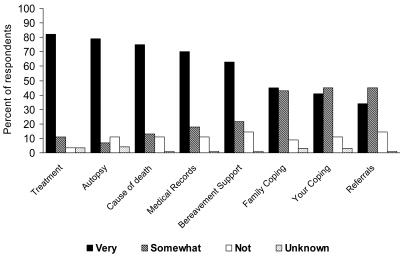
Results: Only seven (13%) parents had a scheduled meeting with any physician to discuss their child's death; 33 (59%) wanted to meet with their child's intensive care physician. Of these, 27 (82%) were willing to return to the hospital to meet. Topics that parents wanted to discuss included the chronology of events leading to PICU admission and death, cause of death, treatment, autopsy, genetic risk, medical documents, withdrawal of life support, ways to help others, bereavement support, and what to tell family. Parents sought reassurance and the opportunity to voice complaints and express gratitude.
Conclusions: Many bereaved parents want to meet with the intensive care physician after their child's death. Parents seek to gain information and emotional support, and to give feedback about their PICU experience.
Figures
Comment in
-
For whom the bell tolls...J Pediatr. 2007 Jul;151(1):4-5. doi: 10.1016/j.jpeds.2007.04.038. J Pediatr. 2007. PMID: 17586180 No abstract available.
References
-
- National Vital Statistics Reports. Vol. 54. Apr 19, 2006. - PubMed
-
- Field MJ, Behrman RE, editors. When children die: improving palliative and end-of-life care for children and their families. Washington, DC: National Academy Press; 2003. - PubMed
-
- Angus DC, Barnato AE, Linde-Zwirble WT, Weissfeld LA, Watson RS, Rickert T, et al. on behalf of the Robert Wood Foundation ICU End-of-Life Peer Group. Use of intensive care at the end of life in the United States: an epidemiologic study. Crit Care Med. 2004;320:638–43. - PubMed
-
- Robinson WM. Special concerns for infants and children. In: Curtis JR, Rubenfeld GD, editors. Managing death in the intensive care unit The transition from cure to comfort. New York: Oxford University Press; 2001. pp. 337–47.
-
- Meyer EC, Ritholz MD, Burns JP, Truog RD. Improving the quality of end-of-life care in the pediatric intensive care unit: parents' priorities and recommendations. Pediatrics. 2006;117:649–57. - PubMed
Publication types
MeSH terms
Grants and funding
- U10HD049945/HD/NICHD NIH HHS/United States
- U01HD049934/HD/NICHD NIH HHS/United States
- U10 HD050012/HD/NICHD NIH HHS/United States
- U10 HD049945/HD/NICHD NIH HHS/United States
- U10HD049981/HD/NICHD NIH HHS/United States
- UG1 HD050096/HD/NICHD NIH HHS/United States
- U10 HD049981/HD/NICHD NIH HHS/United States
- U10 HD050096/HD/NICHD NIH HHS/United States
- U10 HD049983/HD/NICHD NIH HHS/United States
- RL1 HD107773/HD/NICHD NIH HHS/United States
- U10HD050096/HD/NICHD NIH HHS/United States
- U10HD049983/HD/NICHD NIH HHS/United States
- U10HD050012/HD/NICHD NIH HHS/United States
- U01 HD049934/HD/NICHD NIH HHS/United States
- U10HD500009/HD/NICHD NIH HHS/United States
LinkOut - more resources
Full Text Sources
Medical
Molecular Biology Databases
