


Adherence to warfarin assessed by electronic pill caps, clinician assessment, and patient reports: results from the IN-RANGE study
- PMID: 17587092
- PMCID: PMC2219760
- DOI: 10.1007/s11606-007-0233-1
Adherence to warfarin assessed by electronic pill caps, clinician assessment, and patient reports: results from the IN-RANGE study
Abstract
Background: Patient adherence to warfarin may influence anticoagulation control; yet, adherence among warfarin users has not been rigorously studied.
Objective: Our goal was to quantify warfarin adherence over time and to compare electronic medication event monitoring systems (MEMS) cap measurements with both self-report and clinician assessment of patient adherence.
Design: We performed a prospective cohort study of warfarin users at 3 Pennsylvania-based anticoagulation clinics and assessed pill-taking behaviors using MEMS caps, patient reports, and clinician assessments.
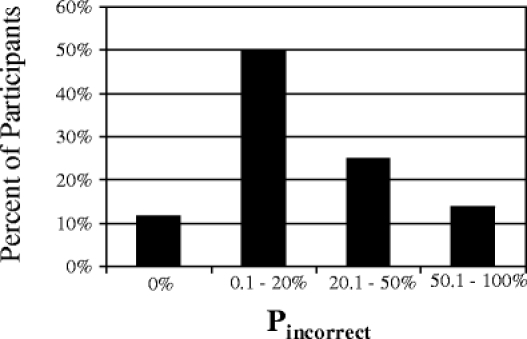
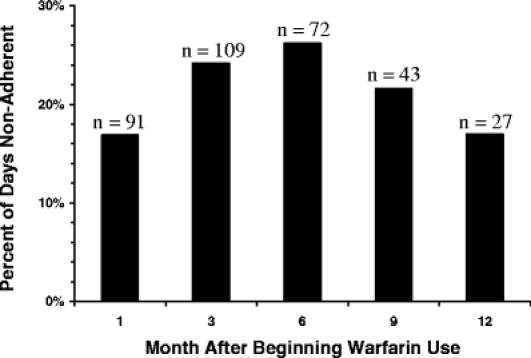
Results: Among 145 participants, the mean percent of days of nonadherence by MEMS was 21.8% (standard deviation+/-21.1%). Participants were about 6 times more likely to take too few pills than to take extra pills (18.8 vs. 3.3%). Adherence changed over time, initially worsening over the first 6 months of monitoring, which was followed by improvement beyond 6 months. Although clinicians were statistically better than chance at correctly labeling a participant's adherence (odds ratio = 2.05, p = 0.015), their estimates often did not correlate with MEMS-cap data; clinicians judged participants to be "adherent" at 82.8% of visits that were categorized as moderately nonadherent using MEMS-cap data (>or=20% nonadherence days). Similarly, at visits when participants were moderately nonadherent by MEMS, they self-reported perfect adherence 77.9% of the time.
Conclusions: These results suggest that patients may benefit from adherence counseling even when they claim to be taking their warfarin or the clinician feels they are doing so, particularly several months into their course of therapy.
Figures
References
-
- {'text': '', 'ref_index': 1, 'ids': [{'type': 'DOI', 'value': '10.1001/archinte.158.15.1641', 'is_inner': False, 'url': 'https://doi.org/10.1001/archinte.158.15.1641'}, {'type': 'PubMed', 'value': '9701098', 'is_inner': True, 'url': 'https://pubmed.ncbi.nlm.nih.gov/9701098/'}]}
- Chiquette E, Amato MG, Bussey HI. Comparison of an anticoagulation clinic with usual medical care: anticoagulation control, patient outcomes, and health care costs. Arch Intern Med. 1998;158:1641–7. - PubMed
-
- {'text': '', 'ref_index': 1, 'ids': [{'type': 'DOI', 'value': '10.1016/S0140-6736(96)01109-9', 'is_inner': False, 'url': 'https://doi.org/10.1016/s0140-6736(96)01109-9'}, {'type': 'PubMed', 'value': '8709780', 'is_inner': True, 'url': 'https://pubmed.ncbi.nlm.nih.gov/8709780/'}]}
- Palareti G, Leali N, Coccheri S, et al. Bleeding complications of oral anticoagulant treatment: an inception-cohort, prospective collaborative study (ISCOAT). Italian Study on Complications of Oral Anticoagulant Therapy. Lancet. 1996;348:423–8. - PubMed
-
- {'text': '', 'ref_index': 1, 'ids': [{'type': 'DOI', 'value': '10.1001/archinte.151.10.1950', 'is_inner': False, 'url': 'https://doi.org/10.1001/archinte.151.10.1950'}, {'type': 'PubMed', 'value': '1929682', 'is_inner': True, 'url': 'https://pubmed.ncbi.nlm.nih.gov/1929682/'}]}
- Kutner M, Nixon G, Silverstone F. Physicians’ attitudes toward oral anticoagulants and antiplatelet agents for stroke prevention in elderly patients with atrial fibrillation. Arch Intern Med. 1991;151:1950–3. - PubMed
-
- {'text': '', 'ref_index': 1, 'ids': [{'type': 'DOI', 'value': '10.1016/S0002-9343(97)00352-5', 'is_inner': False, 'url': 'https://doi.org/10.1016/s0002-9343(97)00352-5'}, {'type': 'PubMed', 'value': '9528733', 'is_inner': True, 'url': 'https://pubmed.ncbi.nlm.nih.gov/9528733/'}]}
- Bush D, Tayback M. Anticoagulation for nonvalvular atrial fibrillation: effects of type of practice on physicians’ self-reported behavior. Am J Med. 1998;104:148–51. - PubMed
-
- {'text': '', 'ref_index': 1, 'ids': [{'type': 'DOI', 'value': '10.1056/NEJMra050100', 'is_inner': False, 'url': 'https://doi.org/10.1056/nejmra050100'}, {'type': 'PubMed', 'value': '16079372', 'is_inner': True, 'url': 'https://pubmed.ncbi.nlm.nih.gov/16079372/'}]}
- Osterberg L, Blaschke T. Adherence to medication. N Engl J Med. 2005;353:487–97. - PubMed
Publication types
MeSH terms
Substances
Grants and funding
LinkOut - more resources
Full Text Sources
Medical
Miscellaneous
