. 2007 Jun 22;316(5832):1738-43.
doi: 10.1126/science.1139862.

Evolutionary dynamics of immune-related genes and pathways in disease-vector mosquitoes

Affiliations

Evolutionary dynamics of immune-related genes and pathways in disease-vector mosquitoes

Robert M Waterhouse et al. Science. .

Abstract

Mosquitoes are vectors of parasitic and viral diseases of immense importance for public health. The acquisition of the genome sequence of the yellow fever and Dengue vector, Aedes aegypti (Aa), has enabled a comparative phylogenomic analysis of the insect immune repertoire: in Aa, the malaria vector Anopheles gambiae (Ag), and the fruit fly Drosophila melanogaster (Dm). Analysis of immune signaling pathways and response modules reveals both conservative and rapidly evolving features associated with different functional gene categories and particular aspects of immune reactions. These dynamics reflect in part continuous readjustment between accommodation and rejection of pathogens and suggest how innate immunity may have evolved.


Figures
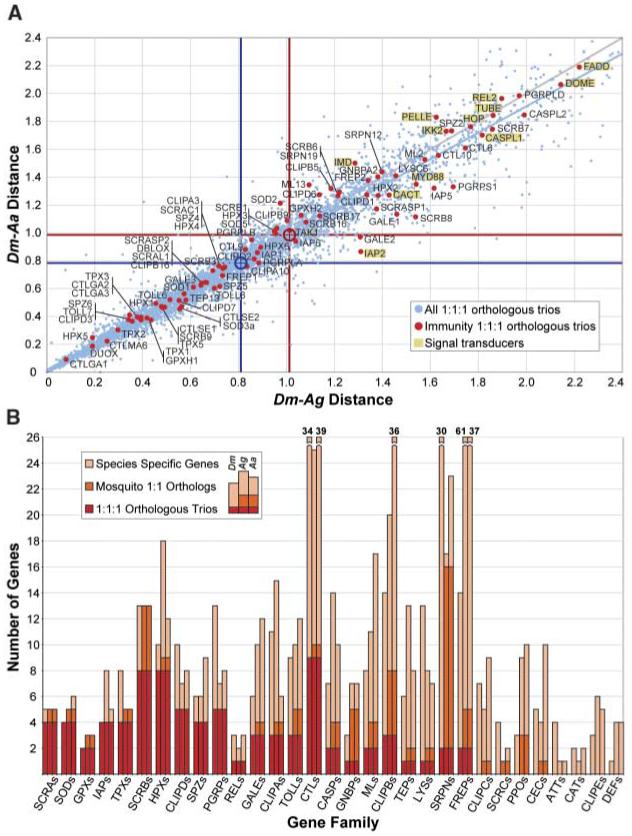
Fig. 1
Fig. 1
(A) Divergence of orthologous trios. Immunity single-copy trios are compared with all single-copy trios in terms of genetic distances of each mosquito species (Ag or Aa) protein to the corresponding Dm ortholog (3) (fig. S1B). Signal transducers are highlighted. Red and blue lines indicate distance means for immunity (red dots) and all trios (blue dots), respectively. (B) The repertoire of putative immune-related gene families. The numbers of 1:1:1 orthologous trios (red), mosquito-specific 1:1 orthologs (orange), and species-specific genes (light brown) are summed to give the total number of genes identified in Dm (first bar), Ag (second bar), and Aa (third bar) for each gene (sub)family. Families are arranged from left to right, according to the decreasing proportion of 1:1:1 orthologous trios within the family. Family acronyms that are not defined in the text include: CASPs, caspases; CATs, catalases; FREPs, fibrinogen-related proteins; GALEs, galectins; MLs, MD2-like receptors.
Fig. 2
Fig. 2
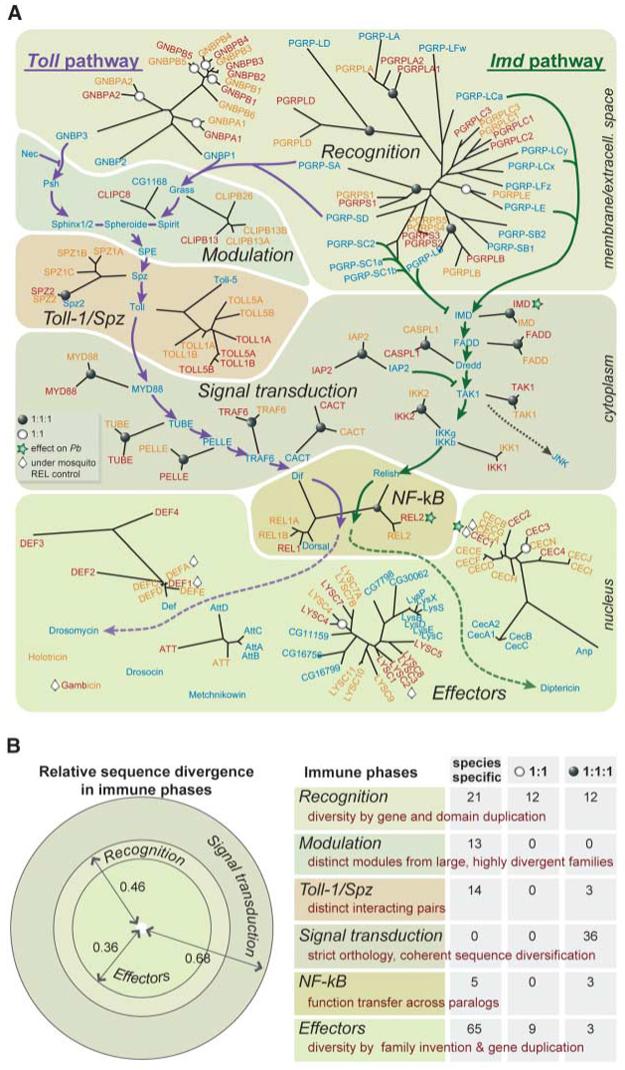
Evolution of immune signaling phases in insects. (A) Genes and gene families implicated in two immune signaling pathways, Toll and Imd (green and purple, respectively). The well-recognized phases of signaling, from recognition to effector production, are outlined. Genes known to be part of these pathways in Dm are indicated in blue, with their closest phylogenetic relatives in Ag in red and Aa in yellow (based on the analysis presented in the SOM). Single-copy orthologs (1:1:1) in all three genomes are indicated with solid circles at the branching node and mosquito 1:1 orthologs are indicated with open circles, respectively. Ag genes affecting survival of the malaria parasite P. berghei are marked with stars, and mosquito genes transcriptionally regulated by NF-κB-like mosquito REL factors are marked with diamonds; Aa CECA and Aa DEFA effectors are controlled by both REL1A and REL2 (33, 39); similarly, Ag REL2 controls expression of immune effectors, including CEC1/3 and GAM (40). Dm LYSs show little response to bacterial infection, but several are up-regulated after infection by microsporidia (41). The mosquito Ag LYSC1/2 and Aa LYSC11 (LysA) genes are up-regulated after bacterial challenge (42, 43), and Ag LYSC2 is controlled by REL1. We constructed radial trees using similarity distances of the conserved sequence cores computed by maximum likelihood. Branch-length scaling is preserved within, but not between, trees. (B) Gene families implicated in the three major immune phases (recognition, signal transduction, and effector production) are clearly different in relative sequence divergence (left panel; sum of branch lengths divided by number of members). Quantitative analysis of evolutionary divergence modes in all six phases defined in (A) is based on gene numbers: trios, mosquito pairs, and genes found in only one species (right panel). All signal transduction genes form trios but are maximally divergent in sequence. In contrast, effector families diversify not by sequence divergence but by gene duplication and creation of new families (e.g., Gambicin in mosquitoes and Diptericin, Drosocin, and others in Dm). This mode results in numerous species-specific effectors but very few trios, contrasting with the pattern seen in signal transduction. The species-specific modulators are selected separately in each species, from very large, divergent families such as SRPNs and CLIPs. Although the Toll and SPZ families are rich in trios, the mosquito genes most closely related to the Dm Toll-1/Spz interaction module are largely species-specific. Finally, the recognition phase shows an intermediate level of diversification, with species-specific genes approximately equal in number to the gene sum of trios and mosquito pairs; in this case, diversification arises by duplication of both genes and domains within genes [see (A)].
Fig. 3
Fig. 3
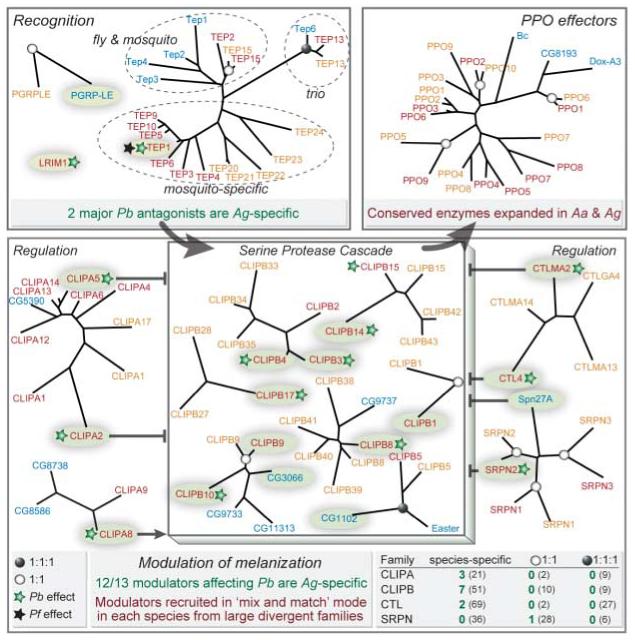
The melanization immune response evolves by convergence and is based on pathogen-related, species-specific regulatory modules. Components are highlighted and shown in relation to their closest phylogenetic relatives in Dm (blue), Ag (red), and Aa (yellow). They are grouped in three phases: recognition, signal modulation, and effectors. TEPs exhibit only one orthologous trio and otherwise form two groups: one with both Dm and mosquito genes and another with species-specific mosquito clades. Recognition genes affecting P. berghei (Pb) melanization (green stars) are Ag-specific. Similarly, among modulators, those affecting Pb melanization (numbers in green in the bottom right box) are almost exclusively specific for Ag and are recruited from large divergent families (numbers in parentheses). In the modulation phase, CLIPB cascades are regulated positively and/or negatively by serine protease homologs (CLIPAs), CTLs, and SRPNs. Among those, CLIPB1, 4, 8, 9, and 10 are involved in melanization of Sephadex beads. The PPO effectors remain conserved in sequence to preserve their enzymatic function, but the family is expanded in mosquitoes. Ag genes marked with black stars affect survival of P. falciparum (Pf). Single-copy orthologs (1:1:1) in all three genomes are indicated with solid circles, and mosquito 1:1 orthologs are indicated with open circles on respective nodes. We constructed radial trees using similarity distances of the conserved sequence cores computed by maximum likelihood, with branch-length scaling preserved within but not between trees.

References

    1. Christophides GK, et al. Science. 2002;298:159. - PubMed
    1. Nene V, et al. Science. 2007;316:1718. published online 17 May 2007 (10.1126/science.1138878) - PMC - PubMed
    1. Materials and methods are available as supporting material on Science Online

    1. Wang L, Ligoxygakis P. Immunobiology. 2006;211:251. - PubMed
    1. Zaidman-Remy A, et al. Immunity. 2006;24:463. - PubMed

Publication types

MeSH terms