


Significance of endothelial dysfunction in the pathogenesis of early and delayed radiation enteropathy
- PMID: 17589919
- PMCID: PMC4172610
- DOI: 10.3748/wjg.v13.i22.3047
Significance of endothelial dysfunction in the pathogenesis of early and delayed radiation enteropathy
Abstract
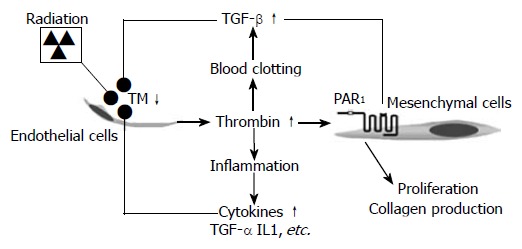
This review summarizes the current state of knowledge regarding the role of endothelial dysfunction in the pathogenesis of early and delayed intestinal radiation toxicity and discusses various endothelial-oriented interventions aimed at reducing the risk of radiation enteropathy. Studies published in the biomedical literature during the past four decades and cited in PubMed, as well as clinical and laboratory data from our own research program are reviewed. The risk of injury to normal tissues limits the cancer cure rates that can be achieved with radiation therapy. During treatment of abdominal and pelvic tumors, the intestine is frequently a major dose-limiting factor. Microvascular injury is a prominent feature of both early (inflammatory), as well as delayed (fibroproliferative) radiation injuries in the intestine and in many other normal tissues. Evidence from our and other laboratories suggests that endothelial dysfunction, notably a deficiency of endothelial thrombomodulin, plays a key role in the pathogenesis of these radiation responses. Deficient levels of thrombomodulin cause loss of vascular thromboresistance, excessive activation of cellular thrombin receptors by thrombin, and insufficient activation of protein C, a plasma protein with anticoagulant, anti-inflammatory, and cytoprotective properties. These changes are presumed to be critically involved in many aspects of early intestinal radiation toxicity and may sustain the fibroproliferative processes that lead to delayed intestinal dysfunction, fibrosis, and clinical complications. In conclusion, injury of vascular endothelium is important in the pathogenesis of the intestinal radiation response. Endothelial-oriented interventions are appealing strategies to prevent or treat normal tissue toxicity associated with radiation treatment of cancer.
Figures
Comment in
-
Tissue toxicity induced by ionizing radiation to the normal intestine: understanding the pathophysiological mechanisms to improve the medical management.World J Gastroenterol. 2007 Jun 14;13(22):3031-2. doi: 10.3748/wjg.v13.i22.3031. World J Gastroenterol. 2007. PMID: 17589916 Free PMC article. No abstract available.
References
-
- National Cancer Policy Board CoCS, Hewitt M, Greenfield S, Stovall E. From Cancer Patient to Cancer Survivor: Lost in Transition. Hewitt M, Greenfield S, Stovall E, editors. Washington DC: The National Academies Press; 2006.
-
- DeVita VT, Hellman S, Rosenberg SA. Cancer: Principles and Practice of Oncology. Philadelphia: Lippincott Williams & Wilkins; 2005.
-
- Denham JW, Hauer-Jensen M. The radiotherapeutic injury--a complex 'wound'. Radiother Oncol. 2002;63:129–145. - PubMed
-
- Wolinsky H. A proposal linking clearance of circulating lipoproteins to tissue metabolic activity as a basis for understanding atherogenesis. Circ Res. 1980;47:301–311. - PubMed
-
- Cines DB, Pollak ES, Buck CA, Loscalzo J, Zimmerman GA, McEver RP, Pober JS, Wick TM, Konkle BA, Schwartz BS, et al. Endothelial cells in physiology and in the pathophysiology of vascular disorders. Blood. 1998;91:3527–3561. - PubMed
Publication types
MeSH terms
Substances
Grants and funding
LinkOut - more resources
Full Text Sources
Other Literature Sources
Medical
Miscellaneous
