


Aggressive mimics profit from a model-signal receiver mutualism
- PMID: 17591589
- PMCID: PMC2706197
- DOI: 10.1098/rspb.2007.0543
Aggressive mimics profit from a model-signal receiver mutualism
Abstract
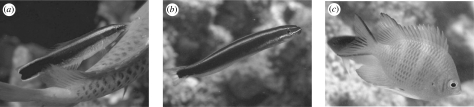
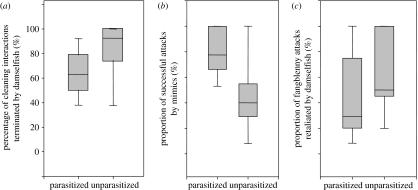
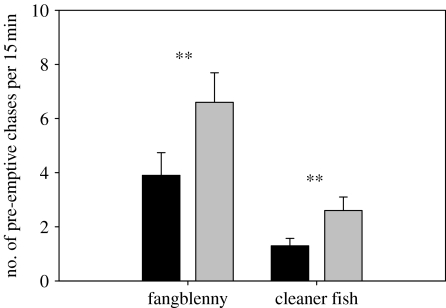
Mimetic species have evolved to resemble other species to avoid predation (protective mimicry) or gain access to food (aggressive mimicry). Mimicry systems are frequently tripartite interactions involving a mimic, model and 'signal receiver'. Changes in the strength of the relationship between model and signal receiver, owing to shifting environmental conditions, for example, can affect the success of mimics in protective mimicry systems. Here, we show that an experimentally induced shift in the strength of the relationship between a model (bluestreak cleaner fish, Labroides dimidiatus) and a signal receiver (staghorn damselfish, Amblyglyphidodon curacao) resulted in increased foraging success for an aggressive mimic (bluestriped fangblenny, Plagiotremus rhinorhynchos). When the parasite loads of staghorn damselfish clients were experimentally increased, the attack success of bluestriped fangblenny on damselfish also increased. Enhanced mimic success appeared to be due to relaxation of vigilance by parasitized clients, which sought cleaners more eagerly and had lower overall aggression levels. Signal receivers may therefore be more tolerant of and/or more vulnerable to attacks from aggressive mimics when the net benefit of interacting with their models is high. Changes in environmental conditions that cause shifts in the net benefits accrued by models and signal receivers may have important implications for the persistence of aggressive mimicry systems.
Figures
References
-
- Bansemer C, Grutter A.S, Poulin R. Geographic variation in the behaviour of the cleaner fish Labroides dimidiatus (Labridae) Ethology. 2002;108:353–366. doi:10.1046/j.1439-0310.2002.00777.x - DOI
-
- Bates H.W. Contributions to an insect fauna of the Amazon Valley. Lepidoptera: Heliconidae. Trans. Linn. Soc. 1862;23:495–566.
-
- Cheney K.L, Côté I.M. Are Caribbean cleaning symbioses mutualistic? Costs and benefits of visiting cleaning stations to longfin damselfish. Anim. Behav. 2001;62:927–933. doi:10.1006/anbe.2001.1832 - DOI
-
- Cheney K.L, Côté I.M. Frequency-dependent success of aggressive mimics in a cleaning symbiosis. Proc. R. Soc. B. 2005a;272:2635–2639. doi:10.1098/rspb.2005.3256 - DOI - PMC - PubMed
-
- Cheney K.L, Côté I.M. Mutualism or parasitism? The variable outcome of cleaning symbioses. Biol. Lett. 2005b;1:162–165. doi:10.1098/rsbl.2004.0288 - DOI - PMC - PubMed
Publication types
MeSH terms
LinkOut - more resources
Full Text Sources