Physiological properties of rod photoreceptor cells in green-sensitive cone pigment knock-in mice
- PMID: 17591985
- PMCID: PMC2154367
- DOI: 10.1085/jgp.200609729
Physiological properties of rod photoreceptor cells in green-sensitive cone pigment knock-in mice
Abstract
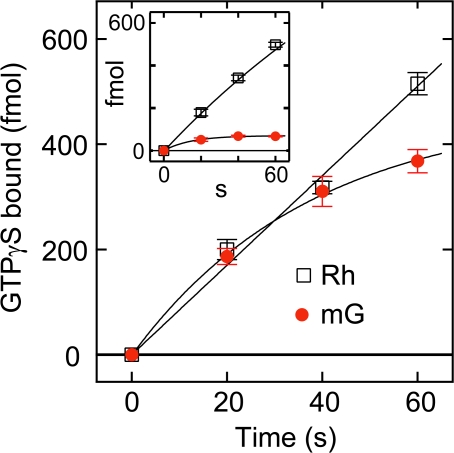
Rod and cone photoreceptor cells that are responsible for scotopic and photopic vision, respectively, exhibit photoresponses different from each other and contain similar phototransduction proteins with distinctive molecular properties. To investigate the contribution of the different molecular properties of visual pigments to the responses of the photoreceptor cells, we have generated knock-in mice in which rod visual pigment (rhodopsin) was replaced with mouse green-sensitive cone visual pigment (mouse green). The mouse green was successfully transported to the rod outer segments, though the expression of mouse green in homozygous retina was approximately 11% of rhodopsin in wild-type retina. Single-cell recordings of wild-type and homozygous rods suggested that the flash sensitivity and the single-photon responses from mouse green were three to fourfold lower than those from rhodopsin after correction for the differences in cell volume and levels of several signal transduction proteins. Subsequent measurements using heterozygous rods expressing both mouse green and rhodopsin E122Q mutant, where these pigments in the same rod cells can be selectively irradiated due to their distinctive absorption maxima, clearly showed that the photoresponse of mouse green was threefold lower than that of rhodopsin. Noise analysis indicated that the rate of thermal activations of mouse green was 1.7 x 10(-7) s(-1), about 860-fold higher than that of rhodopsin. The increase in thermal activation of mouse green relative to that of rhodopsin results in only 4% reduction of rod photosensitivity for bright lights, but would instead be expected to severely affect the visual threshold under dim-light conditions. Therefore, the abilities of rhodopsin to generate a large single photon response and to retain high thermal stability in darkness are factors that have been necessary for the evolution of scotopic vision.
Figures




References
-
- Aho, A.C., K. Donner, C. Hyden, L.O. Larsen, and T. Reuter. 1988. Low retinal noise in animals with low body temperature allows high visual sensitivity. Nature. 334:348–350. - PubMed
-
- Applebury, M.L., M.P. Antoch, L.C. Baxter, L.L. Chun, J.D. Falk, F. Farhangfar, K. Kage, M.G. Krzystolik, L.A. Lyass, and J.T. Robbins. 2000. The murine cone photoreceptor: a single cone type expresses both S and M opsins with retinal spatial patterning. Neuron. 27:513–523. - PubMed
-
- Arshavsky, V.Y., T.D. Lamb, and E.N. Pugh Jr. 2002. G proteins and phototransduction. Annu. Rev. Physiol. 64:153–187. - PubMed
-
- Barlow, H.B. 1956. Retinal noise and absolute threshold. J. Opt. Soc. Am. 46:634–639. - PubMed
Publication types
MeSH terms
Substances
LinkOut - more resources
Full Text Sources
Other Literature Sources