


Review
doi: 10.1038/sj.bjc.6603844.
Epub 2007 Jun 26.
Histone modifications as markers of cancer prognosis: a cellular view
Affiliations
- PMID: 17592497
- PMCID: PMC2359665
- DOI: 10.1038/sj.bjc.6603844
Item in Clipboard
Review
Histone modifications as markers of cancer prognosis: a cellular view
Br J Cancer.
.
Abstract
Alterations in modifications of histones have been linked to deregulated expression of many genes with important roles in cancer development and progression. The effects of these alterations have so far been interpreted from a promoter-specific viewpoint, focussing on gene-gene differences in patterns of histone modifications. However, recent findings suggest that cancer tissues also display cell-cell differences in total amount of specific histone modifications. This novel cellular epigenetic heterogeneity is related to clinical outcome of cancer patients and may serve as a valuable marker of prognosis.
Figures
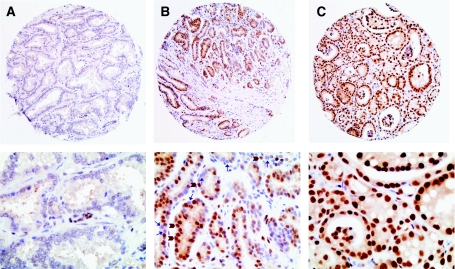
Cellular epigenetic heterogeneity in cancer. Immunohistochemical examination of prostate cancer tissues by an antibody against histone H3 lysine 18 acetylation reveals cell–cell differences in total levels of H3K18ac. The cells with brown nuclei are positively stained (indicated by brown block arrows) and their increased percentage is related to better clinical outcome. The unstained nuclei are blue (indicated by blue arrows). The tissues shown are of equivalent grade but represent (A) low, (B) medium and (C) high levels of cellular H3K18ac. Magnification: 10 × , top panel; 40 × , bottom panel.
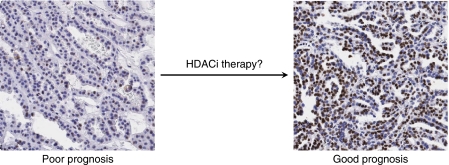
A hypothetical effect of HDAC inhibitors on cellular epigenetic patterns in cancer. In addition to their promoter-specific effects, inhibitors of histone deacetylases (HDACis) may also increase the prevalence of cells with high acetylation levels of specific histone residues. This would shift the cellular epigenetic patterns from a poor (left) to better (right) prognosis. Histone demethylase inhibitors may have a similar effect on cellular methylation patterns.
References
-
- Alaminos M, Davalos V, Cheung NK, Gerald WL, Esteller M (2004) Clustering of gene hypermethylation associated with clinical risk groups in neuroblastoma. J Natl Cancer Inst 96: 1208–1219 - PubMed
-
- Baylin SB, Ohm JE (2006) Epigenetic gene silencing in cancer – a mechanism for early oncogenic pathway addiction? Nat Rev Cancer 6: 107–116 - PubMed
-
- Brehm A, Miska EA, McCance DJ, Reid JL, Bannister AJ, Kouzarides T (1998) Retinoblastoma protein recruits histone deacetylase to repress transcription. Nature 391: 597–601 - PubMed
-
- Cha TL, Zhou BP, Xia W, Wu Y, Yang CC, Chen CT, Ping B, Otte AP, Hung MC (2005) Akt-mediated phosphorylation of EZH2 suppresses methylation of lysine 27 in histone H3. Science 310: 306–310 - PubMed
Publication types
MeSH terms
Substances
LinkOut - more resources
Full Text Sources
Other Literature Sources
Medical
