. 2007 Jun 26:7:96.
doi: 10.1186/1471-2148-7-96.

Chitinase family GH18: evolutionary insights from the genomic history of a diverse protein family

Affiliations

Chitinase family GH18: evolutionary insights from the genomic history of a diverse protein family

Jane D Funkhouser et al. BMC Evol Biol. .

Abstract

Background: Chitinases (EC.3.2.1.14) hydrolyze the beta-1,4-linkages in chitin, an abundant N-acetyl-beta-D-glucosamine polysaccharide that is a structural component of protective biological matrices such as insect exoskeletons and fungal cell walls. The glycoside hydrolase 18 (GH18) family of chitinases is an ancient gene family widely expressed in archea, prokaryotes and eukaryotes. Mammals are not known to synthesize chitin or metabolize it as a nutrient, yet the human genome encodes eight GH18 family members. Some GH18 proteins lack an essential catalytic glutamic acid and are likely to act as lectins rather than as enzymes. This study used comparative genomic analysis to address the evolutionary history of the GH18 multiprotein family, from early eukaryotes to mammals, in an effort to understand the forces that shaped the human genome content of chitinase related proteins.

Results: Gene duplication and loss according to a birth-and-death model of evolution is a feature of the evolutionary history of the GH18 family. The current human family likely originated from ancient genes present at the time of the bilaterian expansion (approx. 550 mya). The family expanded in the chitinous protostomes C. elegans and D. melanogaster, declined in early deuterostomes as chitin synthesis disappeared, and expanded again in late deuterostomes with a significant increase in gene number after the avian/mammalian split.

Conclusion: This comprehensive genomic study of animal GH18 proteins reveals three major phylogenetic groups in the family: chitobiases, chitinases/chitolectins, and stabilin-1 interacting chitolectins. Only the chitinase/chitolectin group is associated with expansion in late deuterostomes. Finding that the human GH18 gene family is closely linked to the human major histocompatibility complex paralogon on chromosome 1, together with the recent association of GH18 chitinase activity with Th2 cell inflammation, suggests that its late expansion could be related to an emerging interface of innate and adaptive immunity during early vertebrate history.


Figures
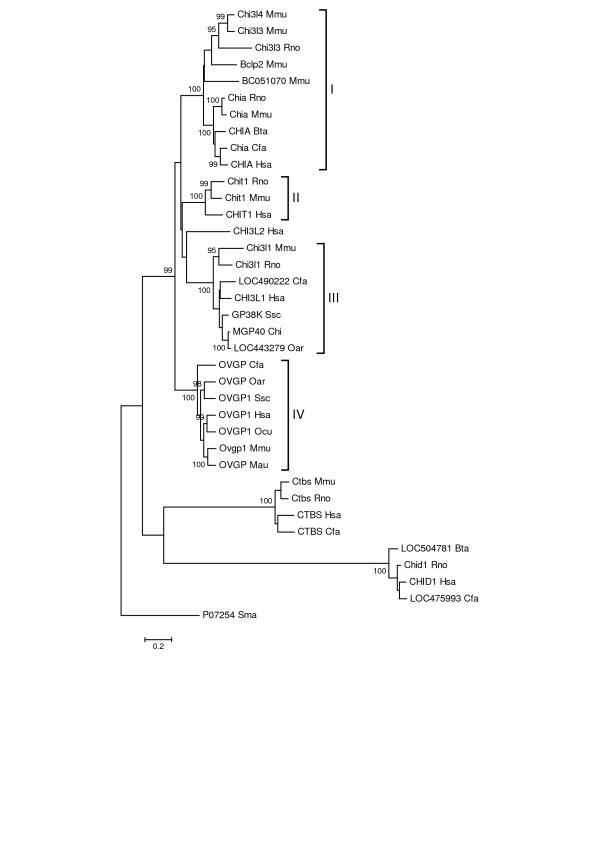
Figure 1
Figure 1
Phylogenetic tree of GH18 domains from 36 mammalian proteins. The phylogenetic trees presented in this paper were constructed with Mega version 3.1 software [86]. Minimum evolution, neighbor-joining, and maximum parsimony methods were used with Poisson correction for multiple amino acid substitution and with 1000 random bootstrap replicates. The figure shows the minimum evolution tree (the three methods produced very similar topologies). Alignment of the GH18 domain amino acid sequences used ClustalX (1.83) [84]. Gene symbols (or protein symbols where genes symbols are not available) and binomen species abbreviations of the form "Gsp" (Genus, species) are used. The GH18 proteins comprise three major phylogenetic groups, with the chitinase/chitolectin group forming four subgroups denoted I, II, III and IV (discussed in the text). The scale at the bottom left is in units of amino acid substitutions per site. Bootstrap values ≥ 95% are shown. The tree is rooted with the Serratia marcescens family GH18 chitinase A [GenBank:P07254].
Figure 2
Figure 2
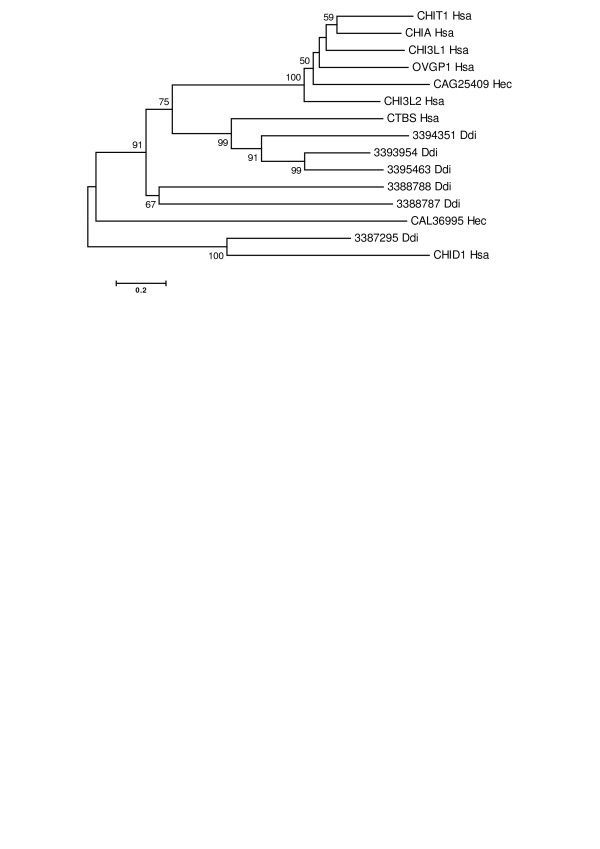
Phylogenetic relationship of D. discoideum, H. echinata, and human GH18 proteins. The figure shows a minimum evolution tree from a phylogenetic analysis conducted as described for Figure 1. Gene (or protein symbols when gene symbols are not available) and binomen species abbreviations are used. The tree is rooted at midpoint. Bootstrap values ≥ 50% are shown.
Figure 3
Figure 3
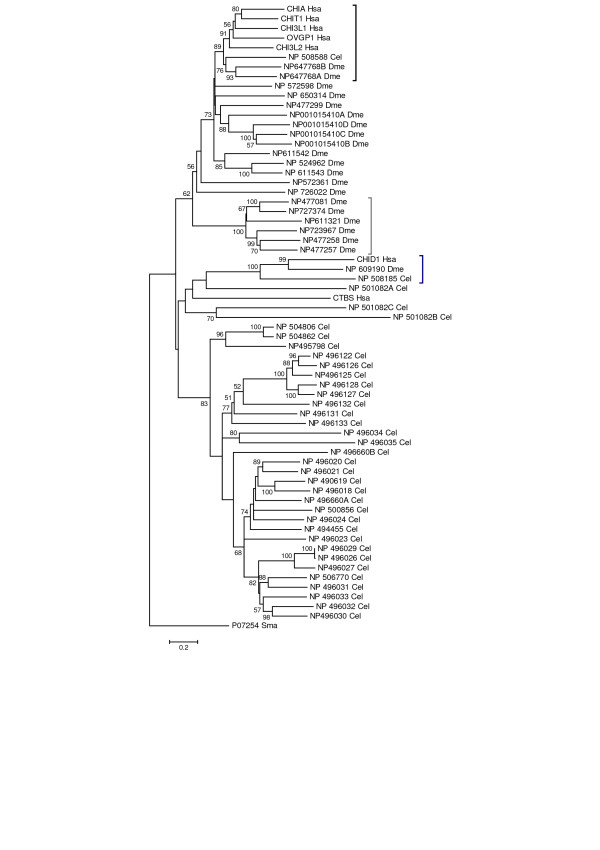
Phylogenetic analysis of GH18 domains of chitinase/chitolectins from human, D. melanogaster and C. elegans. The figure shows a minimum evolution tree from a phylogenetic analysis conducted as described in the legend for Figure 1. Binomen abbreviations are used for species, gene symbols for human proteins, and accession numbers for D. melanogaster and C. elegans proteins. A black bracket at the right indicates the clade encompassing all the human chitinases/chitolectins, two domains from a single protein of D. melanogaster, and a single protein of C. elegans; a dark gray bracket indicates the clade encompassing the D. melanogaster imaginal disc growth factors (chitolectins); and a dark blue bracket the stabilin-1 interacting chitolectin group. Scale, bootstrapping and rooting are as described for Figure 1. Bootstrap values ≥ 50% are shown.
Figure 4
Figure 4
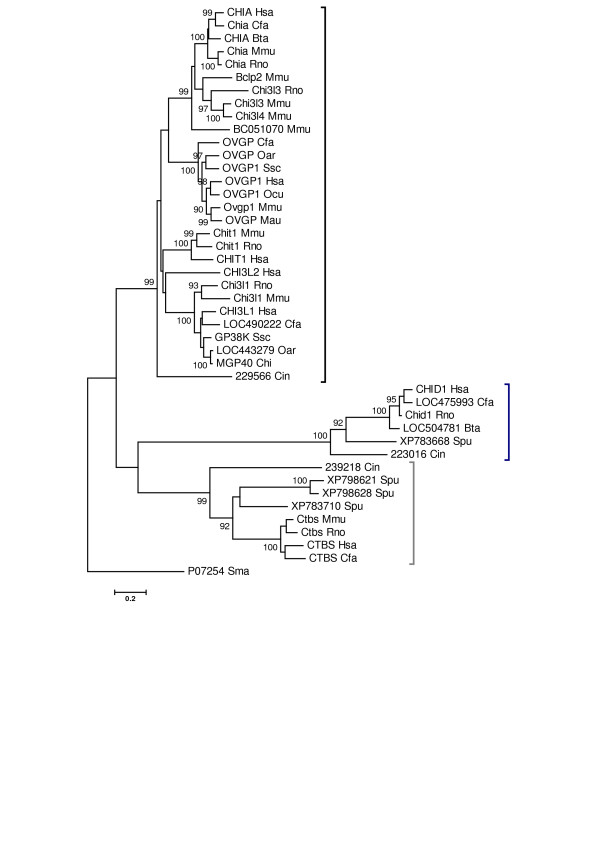
Phylogenetic analysis of GH18 family members from mammals, C. intestinalis and S. purpuratus. The figure shows the minimum evolution tree from a phylogenetic analysis conducted as described in the legend for Figure 1. JGI model protein ID numbers are used for C. intestinalis proteins, accession numbers for the S. purpuratus proteins, and gene symbols (or protein symbols when gene symbols are not available) for mammalian proteins. A black bracket indicates the chitinases/chitolectins, a dark blue bracket the stabilin-1 interacting chitolectins, and a dark gray bracket the chitobiases.
Figure 5
Figure 5
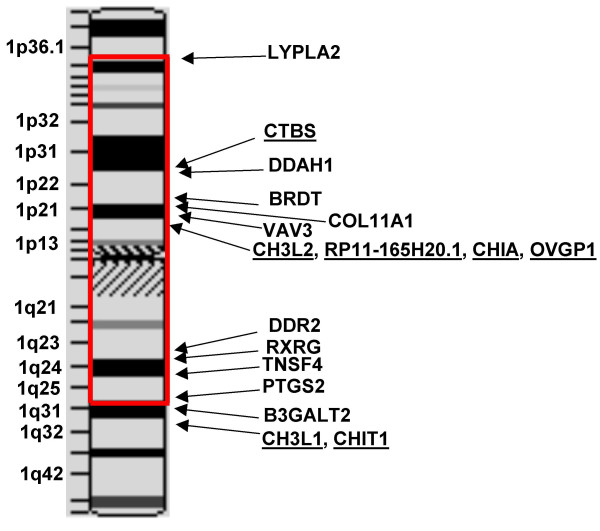
Proximity of the human family GH18 genes to the human MHC paralogon on chromosome 1. An ideogram from NCBI Map Viewer shows human chromosome 1 with region encoding MHC paralogon genes boxed in red. Arrows point to the locations of the human family GH18 genes (symbols underlined to distinguish them from MHC related genes) and representative genes from the MHC paralogous region. The choice of genes is based on a recent comparative analysis of the MHC [48]. The MHC paralog symbols are: LYPLA2, lysophospholipase II (1p36.12-p35.1); DDAH1, dimethylarginine dimethylaminohydrolase 1 (1p22); BRDT, bromodomain, testis-specific (1p22.1); COL11A1, collagen, type XI alpha 1 (1p21); VAV3, vav 3 oncogene (1p13.3), DDR2, discoidin domain receptor family, member 2 (1q12-q23); RXRG, retinoid X receptor, gamma, 1q22-q23); TNFS4, tumor necrosis factor (ligand) superfamily, member 4 (1q25); PTGS2, prostaglandin-endoperoxide synthase 2 (1q25.2-q25.3); and B3GALT2, UDP-Gal:beta GlcNAc beta 1,3-galactosyltransferase, polypeptide 2 (1q31).
Figure 6
Figure 6
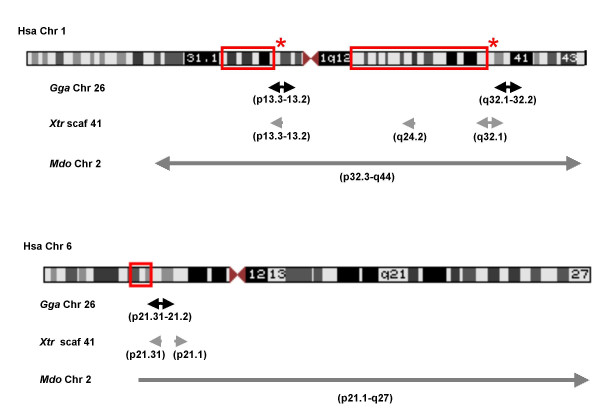
Syntenic relationships of X. tropicalis, G. gallus, M. domestica and human genomic regions involving MHC. The red rectangles on ideograms of human chromosomes show the locations of the MHC (chr 6) and the two MHC paralogous regions (chr 1). Red asterisks indicate the loci for the human chitinase/chitolectin genes on chr1 (p13.3-p13.2) and chr1 (q32.1). The labeled horizontal arrows below the two ideograms designate the regions and orientations of human chromosomes 1 and 6 that correspondingly align with G. gallus chromosome 26 (black); X. tropicalis scaffold 41 (gray), and M. domestica chromosome 2 (diagonal-pattern).
Figure 7
Figure 7
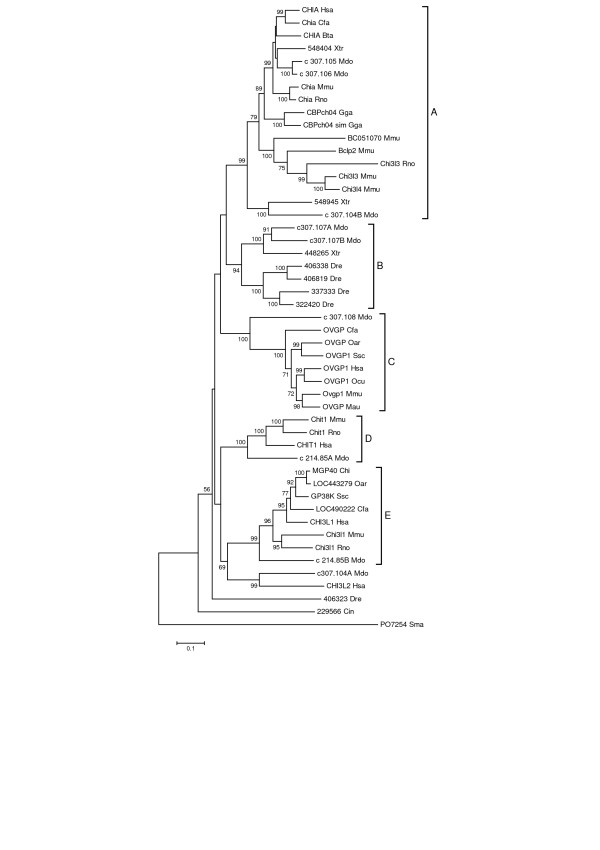
Phylogenetic tree of chordate chitinases/chitolectins. The figure shows the minimum evolution tree from a phylogenetic analysis conducted as described in the legend for Figure 1. Besides mammals, the species are X. tropicalis (Xtr), D. rerio (Dre), G. gallus (Gga), M. domestica (Mdo) and C. intestinalis (Cin). Gene or protein symbols are used for mammals; Gene ID numbers for X. tropicalis, D. rerio and G. gallus; Genscan Gene Prediction symbols for M. domestica; and the JGI Model protein ID number for C. intestinalis. Groups A-E and their correspondence to subgroups I-IV in Fig. 1 are described in the text. Scale, rooting and bootstrapping are as described for Figure 1. Bootstrap values ≥ 50% are shown.
Figure 8
Figure 8
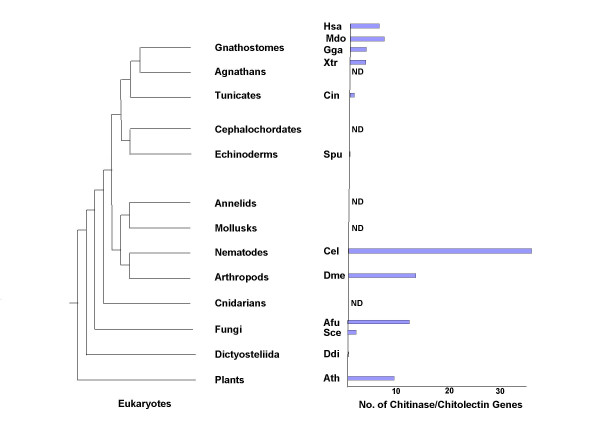
Summary diagram indicating contraction and expansion of the chitinase/chitolectin protein family during eukaryotic evolution. A schematic of eukaryote phylogeny is shown alongside a bar graph indicating the number of chitinase/chitolectin genes identified in the genomes of selected species corresponding to the tree classifications. The schematic is according to the recent animal phylogeny suggested by multigene analyses of bilaterian animals [71]. The species for which the number of genes is shown are the gnathostomes (jawed-vertebrates) human (Hsa), opossum (Mdo), chicken (Gga) and Xenopus (Xtr); the chordate C. intestinalis (Cin); the echinoderm S. purpuratus (Spu); the nematode C. elegans (Cel); the arthropod D. melanogaster (Dme); and the Dictyosteliida D. discoideum (Ddi), all discussed in the text. Also included in the graph are data for the fungi Aspergillis fumigatus and Saccharomyces cerevisiae and the plant Arabidopis thaliana (Additional file 7: Other chitinase sequences). The A. fumigatus and S. cerevisiae genes were obtained by querying Fungal Genomes Central at NCBI.

References

    1. Henrissat B. Classification of chitinases modules. Exs. 1999;87:137–156. - PubMed
    1. Stam M, Blanc E, Coutinho P, Henrissat B. Evolutionary and mechanistic relationships between glycosidases acting on alpha- and beta-bonds. Carbohydr Res. 2005;340:2728–2734. doi: 10.1016/j.carres.2005.09.018. - DOI - PubMed
    1. CAZy http://www.cazy.org/
    1. Merzendorfer H, Zimoch L. Chitin metabolism in insects: structure, function and regulation of chitin synthases and chitinases. J Exp Biol. 2003;206:4393–4412. doi: 10.1242/jeb.00709. - DOI - PubMed
    1. Zhu Z, Zheng T, Homer RJ, Kim YK, Chen NY, Cohn L, Hamid Q, Elias JA. Acidic mammalian chitinase in asthmatic Th2 inflammation and IL-13 pathway activation. Science. 2004;304:1678–1682. doi: 10.1126/science.1095336. - DOI - PubMed

Publication types

LinkOut - more resources