


Three unusual but cytogenetically similar cases with up to five different cell lines involving structural and numerical abnormalities of chromosome 18
- PMID: 17595336
- PMCID: PMC3957532
- DOI: 10.1369/jhc.7A7244.2007
Three unusual but cytogenetically similar cases with up to five different cell lines involving structural and numerical abnormalities of chromosome 18
Abstract
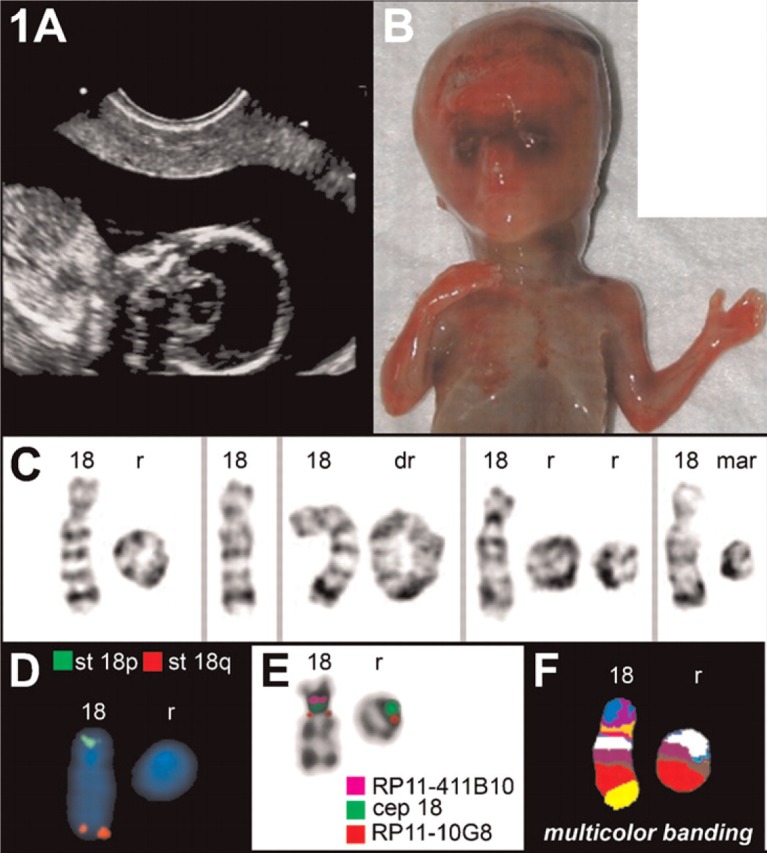
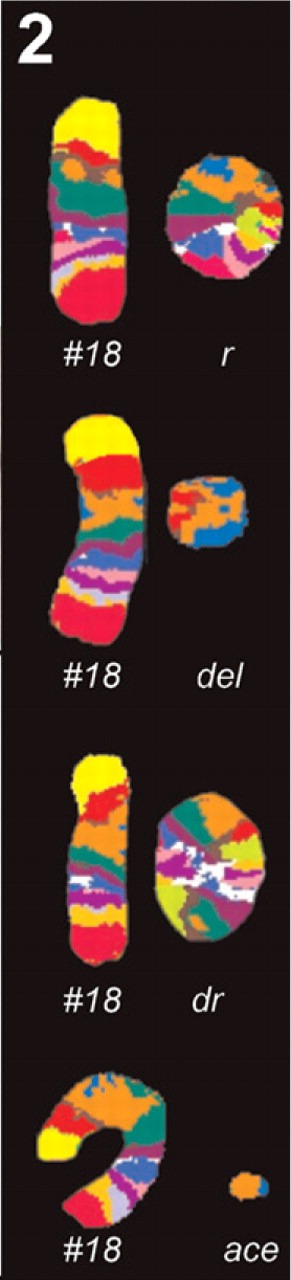
We report two prenatal and two postnatal diagnosed cases (the latter monozygotic twins) with ring chromosomes after GTG banding. All four, de novo r(18), cases turned out to be more complex after application of high-resolution molecular cytogenetics techniques such as use of fluorescence in situ hybridization, centromeric probes, multicolor banding, and locus-specific probes for chromosome 18. All four cases are mosaics involving chromosome 18 in up to five different cell lines, including 46,r(18); 46,dr(18); 47,r(18)x2; 46,mar(18); and 45,-18. Mosaicism sharing both numerical and structural anomalies is rare, but rings often appear as mosaics due to their mitotic instability. Overall, patients with ring chromosome 18 usually share clinical features of 18q- syndrome and, less frequently, those of 18p- syndrome. High-resolution molecular cytogenetics techniques were useful in the characterization of cases with dynamic mosaicism and in establishing the relationship between loss or gain of chromosomal material and the phenotype.
Figures
References
-
- Baumer A, Uzielli MLG, Guarducci S, Lapi E, Rothlisberger B, Shinzel A. (2002) Meiotic origin of two ring chromosomes 18 in a girl with developmental delay. Am J Med Genet 113: 101–104 - PubMed
-
- Bird LM, Pretorius DH, Mendonza AE, Jones MC. (1997) Anencephaly with holoprosencephalic facies due to ring chromosome 18. Clin Dysmorphol 6: 351–358 - PubMed
-
- Cody JD, Ghidoni PD, DuPont BR, Hale DE, Hilsenbeck SG, Stratton RF, Hoffman DS, et al. (1999) Congenital anomalies and anthromometry of 42 individuals with deletions of chromosome 18q. Am J Med Genet 85: 455–462 - PubMed
-
- Cohen MM. (1989) Perspectives on holoprosencephaly: Part I. Epidemiology, genetics, and syndromology. Teratology 40: 211–235 - PubMed
Publication types
MeSH terms
LinkOut - more resources
Full Text Sources
Medical
