


Neural correlates of attentional expertise in long-term meditation practitioners
- PMID: 17596341
- PMCID: PMC1903340
- DOI: 10.1073/pnas.0606552104
Neural correlates of attentional expertise in long-term meditation practitioners
Abstract
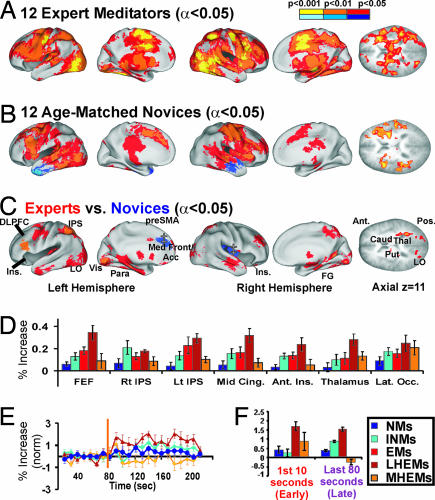
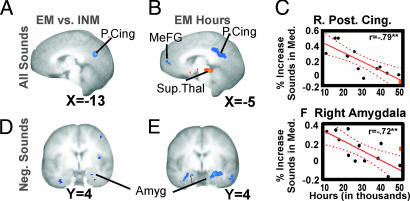
Meditation refers to a family of mental training practices that are designed to familiarize the practitioner with specific types of mental processes. One of the most basic forms of meditation is concentration meditation, in which sustained attention is focused on an object such as a small visual stimulus or the breath. In age-matched participants, using functional MRI, we found that activation in a network of brain regions typically involved in sustained attention showed an inverted u-shaped curve in which expert meditators (EMs) with an average of 19,000 h of practice had more activation than novices, but EMs with an average of 44,000 h had less activation. In response to distracter sounds used to probe the meditation, EMs vs. novices had less brain activation in regions related to discursive thoughts and emotions and more activation in regions related to response inhibition and attention. Correlation with hours of practice suggests possible plasticity in these mechanisms.
Conflict of interest statement
The authors declare no conflict of interest.
Figures
References
-
- Lutz A, Dunne JD, Davidson RJ. In: The Cambridge Handbook of Consciousness. Zelazo PD, Moscovitch M, Thompson E, editors. Cambridge, UK: Cambridge Univ Press; 2007.
-
- Kyabgon T. The Benevolent Mind, A Manual in Mind Training. Auckland, New Zealand: Zhyisil Chokyi Gyatsal Trust; 2003.
-
- Mipham SJ. 1999 Seminary Transcripts, Teaching from the Sutra Tradition. Nova Scotia, Canada: Vajradhatu; 2000.
-
- Jha A, Klein R, Krompinger J, Baime M. Cogn Affect Behav Neurosci. 2007;7:109–119. - PubMed
Publication types
MeSH terms
Grants and funding
LinkOut - more resources
Full Text Sources
Other Literature Sources
