


Inhibition of progesterone metabolism mimics the effect of progesterone withdrawal on forced swim test immobility
- PMID: 17597197
- PMCID: PMC2020505
- DOI: 10.1016/j.pbb.2007.05.017
Inhibition of progesterone metabolism mimics the effect of progesterone withdrawal on forced swim test immobility
Abstract
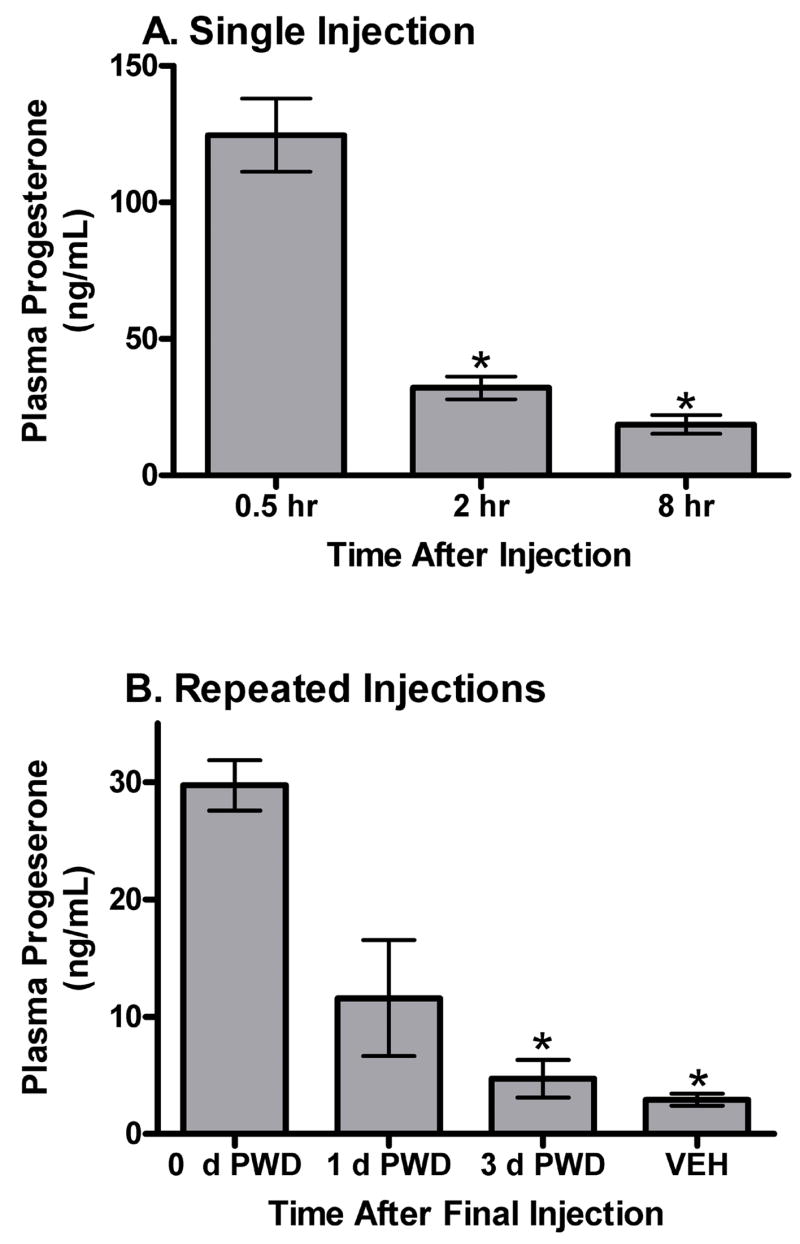
Withdrawal from high levels of progesterone in rodents has been proposed as a model for premenstrual syndrome or postpartum depression. Forced swim test (FST) immobility, used to model depression, was assessed in intact female DBA/2J mice following progesterone withdrawal (PWD) or treatment with the 5alpha-reductase inhibitor finasteride. Following 5 daily progesterone injections (5 mg/kg IP) FST immobility increased only in mice withdrawn for 3 days (p<.05). In another experiment, 3 days of PWD significantly decreased levels of progesterone compared to 0 days of withdrawal, but progesterone levels at 3 days of PWD did not differ from vehicle-treated controls. In a final study, mice received daily injections of progesterone (5 mg/kg IP) for 8 days, with 0 mg/kg, 50 mg/kg, or 100 mg/kg finasteride co-administered for the last three days. Mice that received 100 mg/kg finasteride, but not 50 mg/kg finasteride, displayed increased FST immobility. PWD and finasteride treatment, both of which reduce allopregnanolone levels, were associated with increased FST immobility in female DBA/2J mice. These findings suggest that decreased levels of the GABAergic neurosteroid allopregnanolone contribute to symptoms of PWD. Future studies of PWD may provide information about human conditions that are associated with hormone changes such as premenstrual syndrome or postpartum depression.
Figures


References
-
- Bekku N, Yoshimura H, Araki H. Factors producing a menopausal depressive-like state in mice following ovariectomy. Psychopharmacology (Berl) 2007;187:170–80. - PubMed
-
- Belelli D, Bolger MB, Gee KW. Anticonvulsant profile of the progesterone metabolite 5α-pregnan-3α-ol-20-one. Eur J Pharmacol. 1989;166:325–9. - PubMed
-
- Belelli D, Lan NC, Gee KW. Anticonvulsant steroids and the GABA/benzodiazepine receptor-chloride ionophore complex. Neurosci Biobehav Rev. 1990;14:315–22. - PubMed
-
- Bernardi F, Pluchino N, Begliuomini S, Lenzi E, Palumbo M, Luisi M, et al. Disadaptive disorders in women: Allopregnanolone, a sensitive steroid. Gynecol Endocrinol. 2004;19:344–53. - PubMed
-
- Bitran D, Smith SS. Termination of pseudopregnancy in the rat produces an anxiogenic-like response that is associated with an increase in benzodiazepine receptor binding density and a decrease in GABA-stimulated chloride influx in the hippocampus. Brain Res Bull. 2005;64:511–8. - PubMed
Publication types
MeSH terms
Substances
Grants and funding
LinkOut - more resources
Full Text Sources
Other Literature Sources
Miscellaneous
