. 2007 Jun 27:8:195.
doi: 10.1186/1471-2164-8-195.

Definition of the zebrafish genome using flow cytometry and cytogenetic mapping

Affiliations

Definition of the zebrafish genome using flow cytometry and cytogenetic mapping

Jennifer L Freeman et al. BMC Genomics. .

Abstract

Background: The zebrafish (Danio rerio) is an important vertebrate model organism system for biomedical research. The syntenic conservation between the zebrafish and human genome allows one to investigate the function of human genes using the zebrafish model. To facilitate analysis of the zebrafish genome, genetic maps have been constructed and sequence annotation of a reference zebrafish genome is ongoing. However, the duplicative nature of teleost genomes, including the zebrafish, complicates accurate assembly and annotation of a representative genome sequence. Cytogenetic approaches provide "anchors" that can be integrated with accumulating genomic data.

Results: Here, we cytogenetically define the zebrafish genome by first estimating the size of each linkage group (LG) chromosome using flow cytometry, followed by the cytogenetic mapping of 575 bacterial artificial chromosome (BAC) clones onto metaphase chromosomes. Of the 575 BAC clones, 544 clones localized to apparently unique chromosomal locations. 93.8% of these clones were assigned to a specific LG chromosome location using fluorescence in situ hybridization (FISH) and compared to the LG chromosome assignment reported in the zebrafish genome databases. Thirty-one BAC clones localized to multiple chromosomal locations in several different hybridization patterns. From these data, a refined second generation probe panel for each LG chromosome was also constructed.

Conclusion: The chromosomal mapping of the 575 large-insert DNA clones allows for these clones to be integrated into existing zebrafish mapping data. An accurately annotated zebrafish reference genome serves as a valuable resource for investigating the molecular basis of human diseases using zebrafish mutant models.


Figures
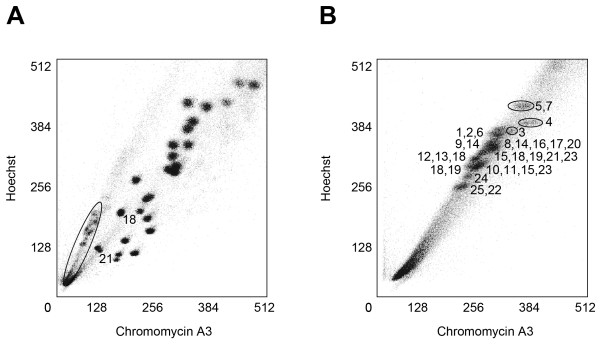
Figure 1
Figure 1
Estimation of the size of the 25 zebrafish LG chromosome pairs using flow cytometry. (A) A flow karyogram depicting the mixed chromosome preparation of human and zebrafish chromosomes. Flow-peaks contained in the oval represent the zebrafish chromosomes (see B for the chromosomal composition of each peak). The largest zebrafish LG chromosomes (5 and 7) were slightly larger than human chromosome 18 (76.12 Mb) and the smallest zebrafish LG chromosomes (22 and 25) were similar to the size of human chromosome 21 (46.94 Mb). Thus, human chromosomes 18 and 21 were chosen as references (labeled in the karyogram). (B) A flow karyogram of the zebrafish chromosome preparation. LG chromosomes ranged in size from 42.2 to 77.9 Mb and the LG chromosomes composing each peak are denoted. The similarity of size resulted in only LG chromosomes 3, 4, and 24 separating into distinct peaks. The remaining nine peaks contained 2 to 5 chromosomes.
Figure 2
Figure 2
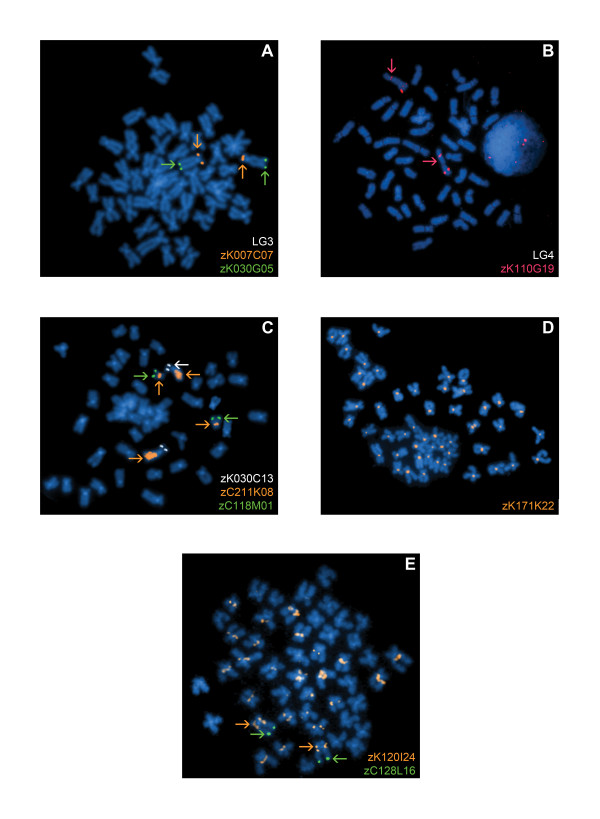
The processing of 670 BAC clones for cytogenetic mapping in the zebrafish genome by FISH. (A) BAC clone zK030G05 (labeled in green, denoted by green arrows) is observed to be syntenic with a previously mapped BAC clone probe, zK007C07, which localizes to the short arm (p arm) of LG chromosome 3, (labeled in orange, denoted by orange arrows). (B) One BAC clone, zK110G19 (labeled in red), was observed to have two signals on the same chromosome, LG chromosome 4. The primary signal is on 4p with a secondary signal in the heterochromatic region of 4q. LG chromosome 4 is denoted by red arrows. (C) Seventeen clones had signals on two non-homologous chromosomes. For example, zC211K08 (labeled in orange) localized to the p arm of LG chromosome 22 and to the q arm heterochromatic region of LG chromosome 4 (denoted by orange arrows). The near-telomeric marker for the q arm of LG chromosome 22, zC118M01, is labeled in green (denoted by green arrows) and the near-telomeric marker for the p arm of LG chromosome 4, zK030C13, is labeled in white (denoted by white arrows). (D) Five BAC clones were pan-centromeric, such as zK171K22 (labeled in orange). (E) Five BAC clones were peri-centromeric. For example, zK120I24 (labeled in orange) localized to the p arm and near the centromere of LG chromosome 7 (denoted by orange arrows), the p arm and near the centromere of an unknown chromosome, and near the centromere of multiple chromosomes. The near-telomeric marker for the q arm of LG chromosome 7, zC128L16, is labeled in green (denoted by green arrows).
Figure 3
Figure 3
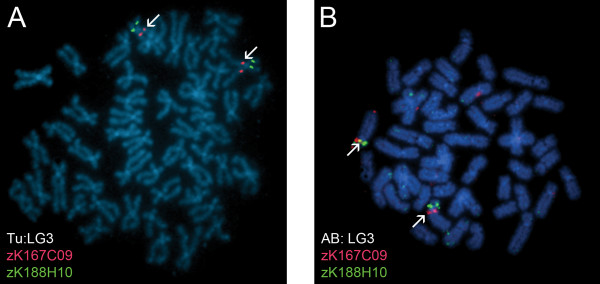
A chromosome inversion variant observed between the Tu strain and the AB strain. (A) In metaphase preparations from Tu embryos, BAC clone zK167C09 (labeled in red) was observed to have only homozygous signals near the centromere of LG chromosome 3q. zK188H10, which consistently localized near the middle of LG chromosome 3p, is labeled in green. (B) Three hybridization patterns were observed for zK167C09 in metaphase preparations from AB embryos including homozygous signals near the centromere of LG chromosome 3q, homozygous signals located medially on LG chromosome 3p, and a heterozygous state. The heterozygous pattern is depicted in this image with zK167C09 labeled in red and zK188H10, which consistently hybridized medially on LG chromosome 3p, labeled in green. White arrows denote LG chromosome 3 in (A) and (B).
Figure 4
Figure 4
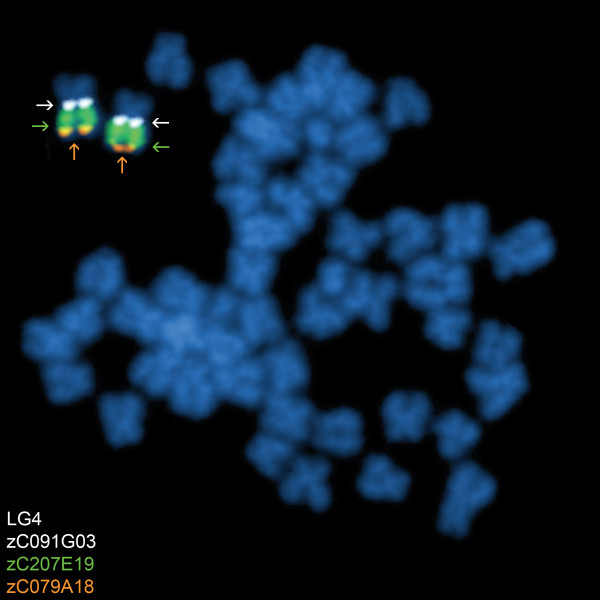
Identification of a near-telomeric marker for the long arm of LG chromosome 4. A large portion of the q arm of LG chromosome 4 consists of a heterochromatic region, which made finding a near-telomeric marker probe difficult for this chromosome arm. zC079A18 (labeled in orange) was established as a near-telomeric marker probe for the q arm of LG chromosome 4 (denoted by orange arrows). Also shown is the near-centromeric marker for LG chromosome 4, zC091G03, (labeled in white, denoted by white arrows) and BAC clone zC207E19, which localizes to the heterochromatic region of the long arm of LG chromosome 4 (labeled in green, denoted by green arrows).

References

    1. Driever W, Stemple D, Schier A, Solnica-Krezel L. Zebrafish: genetic tools for studying vertebrate development. Trends Genet. 1994;10:152–159. doi: 10.1016/0168-9525(94)90091-4. - DOI - PubMed
    1. Lamatsch DK, Steinlein C, Schmid M, Schartl M. Noninvasive determination of genome size and ploidy level in fishes by flow cytometry: detection of triploid Poecilia formosa. Cytometry. 2000;39:91–95. doi: 10.1002/(SICI)1097-0320(20000201)39:2<91::AID-CYTO1>3.0.CO;2-4. - DOI - PubMed
    1. Endo A, Ingalls TH. Chromosomes of the zebrafish. A model for cytogenetic, embryologic, and ecologic study. J Hered. 1968;59:382–384. - PubMed
    1. Postlethwait JH, Talbot WS. Zebrafish genomics: from mutants to genes. Trends Genet. 1997;13:183–190. doi: 10.1016/S0168-9525(97)01129-3. - DOI - PubMed
    1. Postlethwait JH, Yan Y, Gates MA, Horne S, Amores A, Brownlie A, Donovan A, Egan ES, Force A, Gong Z, Goutel C, Fritz A, Kelsh R, Knapik E, Liao E, Paw B, Ranson D, Singer A, Thomson M, Abduljabbar TS, Yelik P, Beier D, Joly JS, Larhammar D, Rosa F, Westerfield M, Zon LI, Johnson SL, Talbot WS. Vertebrate genome evolution and the zebrafish gene map. Nat Genet. 1998;18:345–349. doi: 10.1038/ng0498-345. - DOI - PubMed

Publication types

LinkOut - more resources