


Test-retest reliability of sudden ankle inversion measurements in subjects with healthy ankle joints
- PMID: 17597945
- PMCID: PMC1896082
Test-retest reliability of sudden ankle inversion measurements in subjects with healthy ankle joints
Abstract
Context: Sudden ankle inversion tests have been used to investigate whether the onset of peroneal muscle activity is delayed in patients with chronically unstable ankle joints. Before interpreting test results of latency times in patients with chronic ankle instability and healthy subjects, the reliability of these measures must be first demonstrated.
Objective: To investigate the test-retest reliability of variables measured during a sudden ankle inversion movement in standing subjects with healthy ankle joints.
Design: Validation study.
Setting: Research laboratory.
Patients or other participants: 15 subjects with healthy ankle joints (30 ankles).
Intervention(s): Subjects stood on an ankle inversion platform with both feet tightly fixed to independently moveable trapdoors. An unexpected sudden ankle inversion of 50 degrees was imposed.
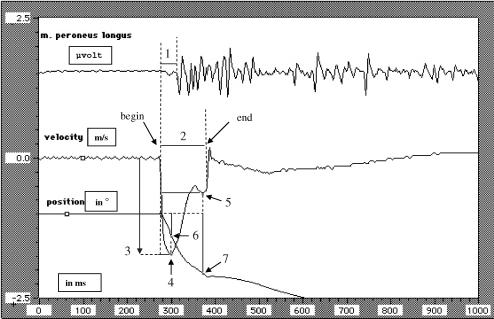
Main outcome measure(s): We measured latency and motor response times and electromechanical delay of the peroneus longus muscle, along with the time and angular position of the first and second decelerating moments, the mean and maximum inversion speed, and the total inversion time. Correlation coefficients and standard error of measurements were calculated.
Results: Intraclass correlation coefficients ranged from 0.17 for the electromechanical delay of the peroneus longus muscle (standard error of measurement = 2.7 milliseconds) to 0.89 for the maximum inversion speed (standard error of measurement = 34.8 milliseconds).
Conclusions: The reliability of the latency and motor response times of the peroneus longus muscle, the time of the first and second decelerating moments, and the mean and maximum inversion speed was acceptable in subjects with healthy ankle joints and supports the investigation of the reliability of these measures in subjects with chronic ankle instability. The lower reliability of the electromechanical delay of the peroneus longus muscle and the angular positions of both decelerating moments calls the use of these variables into question.
Figures
References
-
- Beckman SM, Buchanan TS. Ankle inversion injury and hypermobility: effect on hip and ankle muscle electromyography onset latency. Arch Phys Med Rehabil. 1995;76:1138–1143. - PubMed
-
- Ebig M, Lephart SM, Burdett RG, Miller MC, Pincivero DM. The effect of sudden inversion stress on EMG activity of the peroneal and tibialis anterior muscles in the chronically unstable ankle. J Orthop Sports Phys Ther. 1997;26:73–77. - PubMed
-
- Fernandes N, Allison GT, Hopper D. Peroneal latency in normal and injured ankles at varying angles of perturbations. Clin Orthop Rel Res. 2000;375:193–201. - PubMed
-
- Isakov E, Mizrahi J, Solzi P, Susak Z. Response of the peroneal muscles to sudden inversion of the ankle during standing. Int J Sports Biomech. 1986;2:100–109.
-
- Johnson MB, Johnson CL. Electromyographic response of peroneal muscles in surgical and nonsurgical injured ankles during sudden inversion. J Orthop Sports Phys Ther. 1993;18:497–501. - PubMed
Publication types
MeSH terms
LinkOut - more resources
Full Text Sources
Medical