


Neonatal newborn hearing screening: four years' experience at Ferrara University Hospital (CHEAP project): part 1
- PMID: 17601205
- PMCID: PMC2640016
Neonatal newborn hearing screening: four years' experience at Ferrara University Hospital (CHEAP project): part 1
Abstract
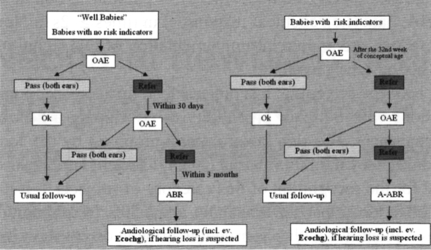
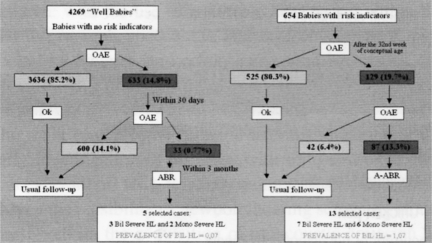
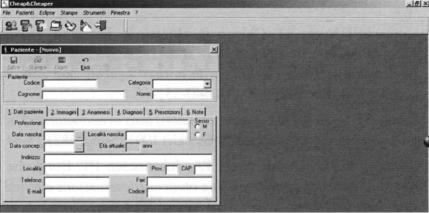
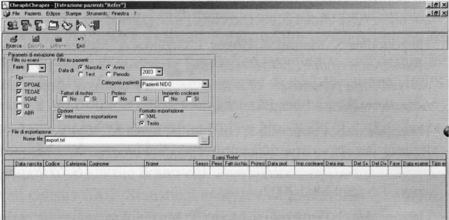
The Child Hearing Early Assessment Programme (CHEAP) regional project, was a combined departmental approach (Audiology, Neonatology) of the University Hospital of Ferrara, aimed at identifying neonatal hearing impairment and defining early intervention strategies. Aims of this project have been: (i) construction of a neonatal screening programme using evoked otoacoustic emission and auditory brainstem responses; (ii) the calculation of a precise estimate of cost-benefits for every child tested; (iii) the development of an information flow instrument (database) for the storage of data and the statistical analysis of the results. The present report refers only to the results of the project related to the otoacoustic emission data from well-babies and intensive care unit residents. In the period January 2000-December 2004, 4269 full-term newborns and 654 Neonatal Intensive Care Unit babies were tested at the Neonatology Department. The cost of the Universal Neonatal Hearing Screening was estimated at Euro 9.20 per child, considering the use of the ILO-292 apparatus, and Euro 8.28 per child in the case of an automatic screener. In this screening model, the initial hardware costs can be re-iterated into budget in a period of two years, if 1000 children per year are tested.
Il CHEAP (Child Hearing Early Assessment Programme) è stato un progetto regionale e multi-dipartimentale (Audiologia, Neonatologia) dell’Università di Ferrara mirato all’identificazione della ipoacusia infantile e ad un intervento precoce. Gli obiettivi del progetto sono stati la costruzione di un programma di screening neonatale con emissioni otoacustiche (OAE) e potenziali del tronco, il calcolo di una stima precisa dei costi-benefici per ogni bambino testato e lo sviluppo del software per l’archiviazione e l’analisi statistica delle risposte ottenute. Nel presente articolo, gli Autori riportano solo i risultati relativi a quattro anni (2000-2004) di screening uditivo neonatale con le OAE; al Nido sono stati testati 4269 neonati in totale, 654 in terapia intensiva. Una stima dei costi associati allo screening neonatale è di 9,20 € per bambino se si considera come apparecchio l’ILO-292 e 8,28 € per bambino nel caso si utilizzi un apparecchio automatico; tali costi/investimenti iniziali possono essere azzerati in un periodo di due anni se vengono testati almeno 1000 bambini all’anno.
Figures
References
-
- Parving A. Prevalence of congenital hearing impairment and risk factors. Neonatal hearing screening. In: Grandori F, Lutman M, editors. The European Consensus Development Conference on Neonatal Hearing Screening. Milan: 1998. p. 6-10.
-
- Moeller MP. Early intervention and language development in children who are deaf and hard of hearing. Pediatrics 2000;106:43-51. - PubMed
-
- Hayes D. Newborn hearing screening: selected experience in the United States. Scand Audiol 2001;30(Suppl 53):29-32. - PubMed
-
- Yoshinaga-Itano C, Sedey AL, Coulter BA, Mehl AL. Language of early and later-identified children with hearing loss. Pediatrics 1998;102:1168-71. - PubMed
-
- Apuzzo ML, Yoshinaga-Itano C. Early identification of infants with significant hearing loss and the Minnesota Child Development Inventory. Semin Hear 1995;16:124-39.
Publication types
MeSH terms
LinkOut - more resources
Full Text Sources
Other Literature Sources
Medical